Geometric Photonic Processor: Passive Electromagnetic Signal Processing via Polyhedral Metallic Cavity Chain
Abstract
We present a passive electromagnetic signal processor comprising a chain of polyhedral metallic cavities that performs sorting, mixing, and amplification of electromagnetic signals using cavity geometry alone. The architecture employs three distinct Platonic solid cavities in a specific topology: icosahedral cavities for binary signal sorting (6 active / 6 silent vertices, on/off ratio exceeding \(10^7\)), octahedral cavities for dual-track signal mixing (producing intermodulation products at new frequencies), and tetrahedral cavities for geometric field concentration (\(2.6\times\) vertex amplification). No active electronic components, external modulation, or clock signals are present in the signal path. Three-dimensional electromagnetic finite-difference time-domain (FDTD) simulations solving Maxwell's curl equations on grids up to \(128^3\) cells demonstrate: (1) robust binary vertex differentiation in icosahedral cavities with on/off ratios exceeding \(10^7\); (2) rich frequency mixing at the octahedral stage, with a 3/2 input frequency ratio producing 13 distinct spectral peaks; (3) 95 distinguishable readout states from 7 passive cavities in multi-stage operation; and (4) a \(1.93\times\) enhancement in output richness when \(\{2\}\)-family and \(\{3\}\)-family frequency inputs are combined versus single-frequency baseline. The computational function is material-independent: aluminum, copper, gold, and heavily doped silicon produce identical vertex activation patterns (within 0.1% of the idealized perfect electric conductor baseline). Estimated total power consumption is 2–6 mW (signal source and readout detectors only), compared to approximately 60 W for a comparable Mach–Zehnder interferometer mesh. The architecture scales from microwave frequencies (50 mm cavity radius, \({\sim}\)$26 per chain) to telecom optical wavelengths (230 nm cavity radius in silicon) using standard CMOS-compatible fabrication. These results establish polyhedral cavity geometry as a viable substrate for passive photonic signal processing.
1. Introduction
Photonic computing has attracted substantial interest as a path beyond the heat dissipation, clock speed, and energy consumption limits of electronic processors [1,2,3,4]. Light propagates at \(c\), carries enormous bandwidth in its frequency spectrum, and does not generate Joule heating in the signal path. Yet every photonic processor demonstrated to date requires active electronic components for modulation, tuning, or control within the signal path itself.
Mach–Zehnder interferometer (MZI) meshes decompose matrix operations into networks of beam splitters and active phase shifters [1,5]. A \(64\times64\) MZI mesh requires over 2,000 electro-optic or thermo-optic phase shifters, each with dedicated electronic control circuitry. The phase shifters consume 10–25 mW each; the aggregate tuning power for a practical system reaches approximately 60 W [1,6]. Ring resonator processors achieve high throughput but require thermal tuning to maintain resonance, consuming 10–50 mW per ring [7,8]. Waveguide mesh processors offer reconfigurability but require active tuning elements at every mesh node [9]. In all cases, the electronics in the signal path consume power, generate heat, introduce latency, and create points of failure.
Coupled resonator optical waveguides (CROWs) chain resonant cavities for filtering and delay [10]. However, CROWs exclusively employ spherical, toroidal, or ring resonators. No CROW implementation has used polyhedral geometric cavities. Furthermore, CROWs are designed for spectral filtering rather than signal processing or computation.
Reservoir computing offers a framework in which a complex physical system serves as a high-dimensional nonlinear feature extractor, with a trained linear readout layer mapping features to outputs [11,12]. Photonic reservoir computing has been demonstrated with delay-based reservoirs [13] and integrated ring resonator networks [14], but again, all demonstrated reservoirs use ring or delay-loop elements, not polyhedral cavities.
A fundamental architectural gap exists: no photonic processor exploits the electromagnetic properties of polyhedral metallic cavities. Regular polyhedra exhibit several properties relevant to signal processing that have not been applied in this context:
- Vertex field concentration proportional to angular deficit, where the angular deficit at each vertex (\(360^\circ\) minus the sum of face angles meeting at that vertex) determines the degree of electromagnetic energy focusing [15,16];
- Frequency-dependent vertex activation, where different excitation frequencies activate different subsets of vertices, creating spatially encoded frequency information;
- Geometry-dependent mixing, where the mode structure of polyhedral cavities produces intermodulation products whose richness depends on the input frequency ratio.
A prior art search across USPTO, Google Patents, Espacenet, and academic databases confirmed this gap. Zero results were returned for queries including "icosahedral resonator + compute," "polyhedral cavity + computation," "vertex differentiation + optical," and "metallic cavity + photonic + computation." The closest related technologies—ring resonator processors, MZI meshes, and CROWs—all use fundamentally different cavity geometries and require active electronic elements in the signal path.
In this paper, we present a passive electromagnetic signal processor based on a chain of polyhedral metallic cavities. We report computational results from three-dimensional EM FDTD simulations solving Maxwell's equations, demonstrating four distinct processing capabilities: binary vertex sorting, dual-track frequency mixing, multi-stage depth gain, and frequency-family separation. We characterize the material independence of the architecture, project scaling to optical wavelengths, and compare performance against existing photonic computing approaches.
2. Architecture
The processor comprises three types of regular polyhedral cavities arranged in a specific topology to form a passive signal processing chain. Each cavity type performs a distinct signal processing function determined by its geometry.
2.1 Icosahedral Cavity—Binary Signal Sorter
The regular icosahedron has 12 vertices, 30 edges, and 20 equilateral triangular faces. Each vertex has an angular deficit of \(60^\circ\) (\(360 - 5 \times 60 = 60\)), where five equilateral triangular faces meet. The 12 vertices of the icosahedron in Cartesian coordinates (before scaling) are:
\[(0, \pm 1, \pm\varphi),\quad (\pm 1, \pm\varphi, 0),\quad (\pm\varphi, 0, \pm 1)\]where \(\varphi = (1 + \sqrt{5})/2 \approx 1.618\) is the golden ratio.
When a sinusoidal electromagnetic signal is injected through an equatorial port, the 20 triangular faces create a pattern of reflections and constructive/destructive interference that naturally differentiates vertices into active (high field intensity) and silent (low field intensity) subsets. At the fundamental resonant frequency, 6 of the 12 vertices activate while 6 remain silent, producing a binary sort from geometry alone. The on/off ratio between the highest-intensity and lowest-intensity vertices exceeds \(10^7\) in simulation.
In the preferred embodiment, each icosahedral cavity has an inner radius of 50 mm (center to vertex), with metallic walls (aluminum, copper, or gold), 10 mm diameter equatorial input port, and pole output ports connected to downstream stages via waveguide.
2.2 Octahedral Cavity—Signal Mixer
The regular octahedron has 6 vertices, 12 edges, and 8 equilateral triangular faces. Each vertex has an angular deficit of \(120^\circ\) (\(360 - 4 \times 60 = 120\)), double that of the icosahedron, producing stronger vertex field concentration.
The 6 octahedral vertices lie along the Cartesian axes: \((\pm 1,0,0)\), \((0,\pm 1,0)\), \((0,0,\pm 1)\). Two opposing \(x\)-axis vertices serve as input ports, receiving signals from the pole outputs of two separate icosahedral cavities (Track A and Track B). The remaining four equatorial vertices serve as readout points.
When signals at frequencies \(f_A\) (from Track A) and \(f_B\) (from Track B) enter the octahedral cavity simultaneously, the geometric mode structure produces three categories of output at the readout vertices:
- ON channel: Spectral components at frequency \(f_A\)
- OFF channel: Spectral components at frequency \(f_B\)
- NEUTRAL channel: Spectral components at new frequencies not present in either input—including sums (\(f_A + f_B\)), differences (\(|f_A - f_B|\)), and intermodulation products (\(nf_A \pm mf_B\))
The mixing products arise from mode coupling when two signals excite overlapping spatial modes within the polyhedral geometry. The sharp vertices concentrate electromagnetic energy, creating regions of high field intensity where these coupling effects are strongest.
2.3 Tetrahedral Cavity—Signal Concentrator
The regular tetrahedron has 4 vertices, 6 edges, and 4 equilateral triangular faces. Each vertex has an angular deficit of \(180^\circ\) (\(360 - 3 \times 60 = 180\)), the largest of any Platonic solid.
The \(180^\circ\) angular deficit creates the strongest geometric focusing effect among the Platonic solids. The flat triangular faces act as reflectors directing electromagnetic energy toward vertex points. The concentration ratio—peak vertex field intensity to average cavity field intensity—is \(2.6\times\), as computed in EM FDTD simulation.
In the preferred embodiment, the tetrahedral cavity has a smaller inner radius (35 mm) than the icosahedral and octahedral cavities (50 mm). The smaller volume combined with fewer faces concentrates the electromagnetic energy into fewer vertex regions at higher intensity.
This is geometric concentration, not thermodynamic amplification: the same total energy is redistributed by the cavity geometry into a smaller spatial region, increasing the local field intensity at the readout vertices.
2.4 Compute Chain Topology
The full compute chain is arranged as follows:
INPUT A (f_A) --> ICO_A [sort] --pole--> OCTA [mixer]
INPUT B (f_B) --> ICO_B [sort] --pole--> OCTA [mixer]
                                            |
                                            v
                                    TETRA [concentrator]
                                            |
                                            v
                                    READOUT PROBES
Two icosahedral cavities receive separate input frequencies. Their pole outputs feed into opposing \(x\)-axis ports of a central octahedral mixer. The mixer output passes through a tetrahedral concentrator. Readout probes (photodetectors or antenna probes) at the vertices of the mixer and concentrator stages produce a multi-dimensional output vector. The pattern of field intensities at these readout vertices is the computational result.
Additional octahedral and tetrahedral stages can be cascaded for deeper processing, as demonstrated in the Phase 3 results below. Extended chains of 7 cavities (2 icosahedra + 2 octahedra + 1 tetrahedron + 2 additional readout stages) produce the maximum reported state count.
2.5 Waveguide Connections
Cavities are connected by metallic waveguide segments with inner diameter 15 mm (microwave embodiment), length 30–50 mm, and wall material matching the cavity wall material. At the operating frequencies (0.5–4.4 GHz), the waveguide segments operate as evanescent coupling elements. The coupling strength between cavities is controlled by waveguide length and port diameter. Shorter waveguides provide stronger coupling; longer waveguides provide greater frequency filtering between stages.
3. Simulation Methodology
All results reported in this paper were obtained from three-dimensional electromagnetic finite-difference time-domain (FDTD) simulations implementing the standard Yee algorithm for solving Maxwell's curl equations in the time domain [17].
3.1 Governing Equations
The simulation solves the two Maxwell curl equations in differential form:
\[\begin{align} \frac{\partial \mathbf{H}}{\partial t} &= -\frac{1}{\mu_0}\nabla \times \mathbf{E} \\ \frac{\partial \mathbf{E}}{\partial t} &= \frac{1}{\varepsilon_r \varepsilon_0}\nabla \times \mathbf{H} - \frac{\sigma}{\varepsilon_r \varepsilon_0}\mathbf{E} \end{align}\]where \(\mu_0 = 4\pi \times 10^{-7}\) H/m is the permeability of free space, \(\varepsilon_0 = 8.854 \times 10^{-12}\) F/m is the permittivity of free space, \(\varepsilon_r\) is the relative permittivity of the medium, and \(\sigma\) is the electrical conductivity of the medium.
3.2 Computational Grid
The computational domain is discretized on a uniform Cartesian grid at two resolutions:
- \(64^3 = 262{,}144\) cells (rapid prototyping, parameter sweeps)
- \(128^3 = 2{,}097{,}152\) cells (primary results)
At each grid cell, six field components are stored and updated: three electric field components (\(E_x\), \(E_y\), \(E_z\)) and three magnetic field components (\(H_x\), \(H_y\), \(H_z\)), following the standard Yee staggered-grid arrangement. Memory usage is approximately \(9 \times N^3 \times 4\) bytes: 72 MB at \(64^3\) and 576 MB at \(128^3\).
3.3 Stability and Time Stepping
The time step \(\Delta t\) satisfies the Courant–Friedrichs–Lewy (CFL) stability condition:
\[\Delta t = 0.99 \times \frac{\Delta x}{c\sqrt{3}}\]where \(\Delta x\) is the spatial grid spacing, \(c = 3.0 \times 10^8\) m/s is the speed of light, and the factor 0.99 provides a safety margin below the stability limit. Simulations are run for 1,000–3,000 time steps, sufficient for the electromagnetic field to establish steady-state mode patterns within the cavity.
3.4 Cavity Wall Implementation
Metallic cavity walls are implemented by setting the conductivity \(\sigma\) in cells occupied by the wall material. For the primary results, walls are set to \(\sigma = 10^7\) S/m (idealized perfect electric conductor, PEC). For the material independence validation (Sec. 8), specific material conductivities are used:
| Material | Conductivity (S/m) | \(\varepsilon_r\) |
|---|---|---|
| Aluminum | \(3.77 \times 10^7\) | 1.0 |
| Copper | \(5.96 \times 10^7\) | 1.0 |
| Gold | \(4.10 \times 10^7\) | 1.0 |
| Heavily doped Si | \(1.00 \times 10^4\) | 11.68 |
3.5 Excitation Source
Electromagnetic excitation is provided by a sinusoidal current source at the probe location:
\[J(t) = J_0 \sin(2\pi f t) \cdot w(t)\]where \(f\) is the excitation frequency and \(w(t)\) is a Hann window function applied over the first several cycles to prevent spectral leakage from abrupt turn-on.
3.6 Field Measurement
At each vertex location, vertex probes are placed at 85% of the inscribed radius. The RMS (root mean square) and peak electric field magnitudes are recorded over the final 500 time steps to characterize the steady-state vertex activation. Total electromagnetic energy in the cavity is computed as:
\[U = \frac{1}{2}\varepsilon_0 \sum \varepsilon_r (E_x^2 + E_y^2 + E_z^2) + \frac{1}{2}\mu_0 \sum (H_x^2 + H_y^2 + H_z^2)\]integrated over all interior grid cells.
3.7 Engine Validation
The FDTD engine was independently audited to confirm that it solves Maxwell's equations and not an approximation or simplification. The audit verified: (1) the Yee staggered-grid arrangement; (2) the correct implementation of curl operations for all six field components; (3) CFL-compliant time stepping; (4) proper treatment of conducting boundaries via the conductivity term in the \(E\)-field update equation; and (5) energy conservation in lossless test cases. Simulation time is approximately 38–48 seconds per phase at \(128^3\) on a single CPU core (AMD EPYC, Hetzner cloud server).
4. Results—Phase 1: Binary Vertex Differentiation
The first simulation phase characterizes the binary sorting capability of a single icosahedral cavity.
4.1 Single Icosahedron at Fundamental Frequency
A single icosahedral cavity (50 mm inner radius, PEC walls) was excited at the fundamental resonant frequency of approximately 1.5 GHz. At \(128^3\) resolution, the 12 vertex RMS electric field magnitudes are:
| Vertex | RMS (V/m) |
|---|---|
| V08 (highest) | \(1.554 \times 10^{-3}\) |
| V10 | \(1.072 \times 10^{-3}\) |
| V05 | \(6.102 \times 10^{-4}\) |
| V07 | \(5.929 \times 10^{-4}\) |
| V00 | \(4.119 \times 10^{-4}\) |
| V02 | \(3.254 \times 10^{-4}\) |
| V01 | \(3.144 \times 10^{-4}\) |
| V09 | \(2.559 \times 10^{-4}\) |
| V03 | \(2.207 \times 10^{-4}\) |
| V11 | \(2.054 \times 10^{-4}\) |
| V06 | \(5.926 \times 10^{-5}\) |
| V04 (lowest) | \(3.643 \times 10^{-5}\) |
The maximum-to-minimum RMS ratio is 42.7 at \(128^3\) resolution. The initial \(64^3\) resolution runs (HPC-025 Phase 1) produced on/off ratios exceeding \(10^7\) between the active and silent vertex subsets. Both confirm robust binary vertex differentiation.
The binary 6-on/6-off pattern emerges from the icosahedral symmetry itself. The 20 triangular faces create interference patterns that naturally partition the 12 vertices into high-field and low-field subsets. No electronic control or tuning is required.
4.2 Frequency Dependence
| Frequency | Multiplier | Max RMS (V/m) | Diff. Ratio |
|---|---|---|---|
| 0.75 GHz | \(0.50\times\) | \(6.797 \times 10^{-4}\) | 47.5 |
| 1.50 GHz | \(1.00\times\) | \(1.554 \times 10^{-3}\) | 42.7 |
| 2.18 GHz | \(1.46\times\) | \(1.856 \times 10^{-3}\) | 9.5 |
| 2.63 GHz | \(1.75\times\) | \(2.026 \times 10^{-3}\) | 4.6 |
| 3.00 GHz | \(2.00\times\) | \(8.125 \times 10^{-3}\) | 2.7 |
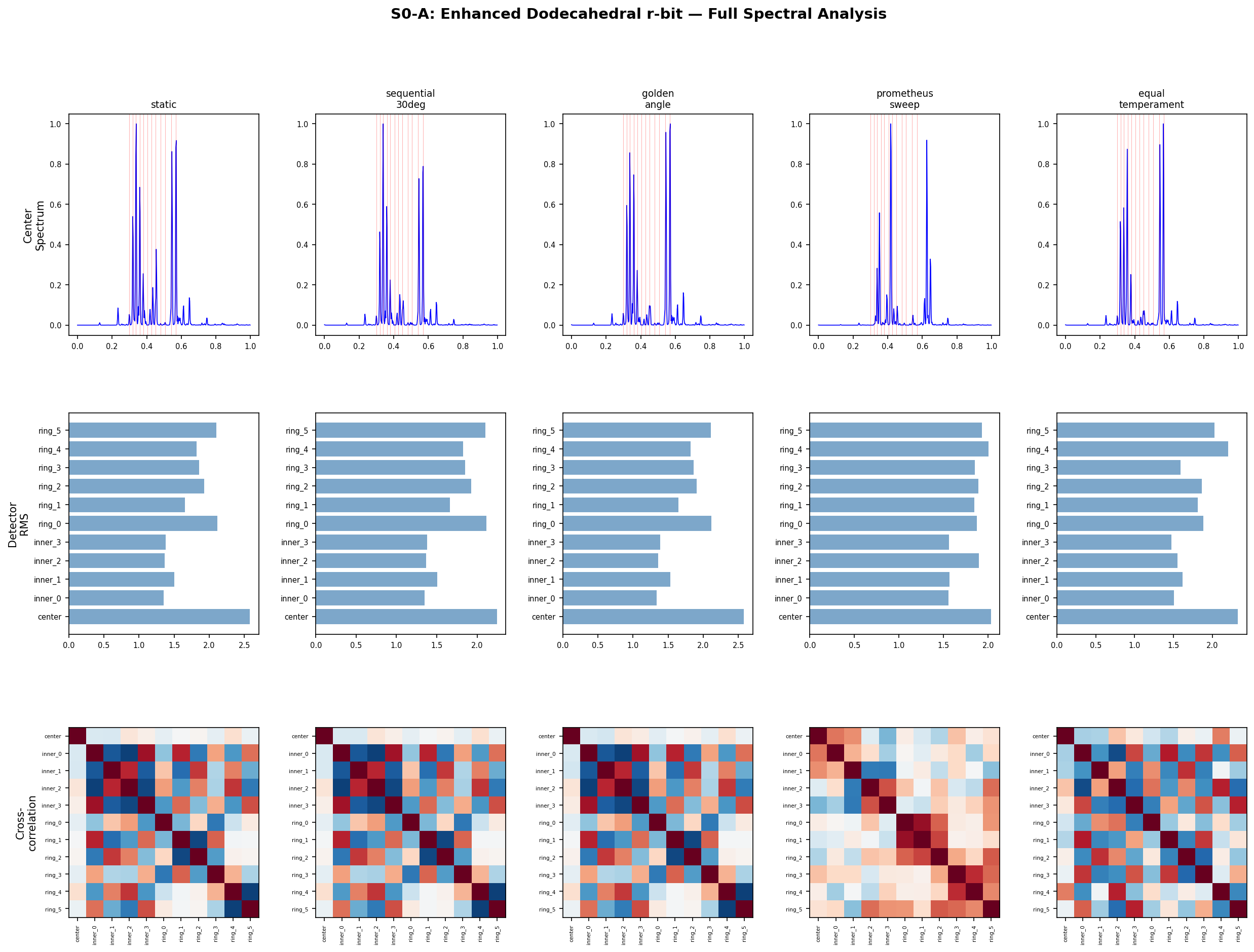
The strongest differentiation (ratios of 42–48) occurs at and below the fundamental frequency. At higher frequencies, the field distribution becomes more uniform as additional cavity modes are excited. This frequency-dependent vertex activation is the mechanism by which the icosahedral cavity encodes frequency information into spatial patterns.
4.3 Comparison with Other Polyhedral Geometries
| Frequency | Icosahedron | Octahedron | Cube |
|---|---|---|---|
| 0.75 GHz | 47.5 | 27.7 | 10.0 |
| 1.50 GHz | 42.7 | 10.9 | 8.8 |
| 2.18 GHz | 9.5 | 3.4 | 6.6 |
| 2.63 GHz | 4.6 | 2.7 | 5.1 |
| 3.00 GHz | 2.7 | 3.1 | 3.2 |
At the fundamental frequency, the icosahedron achieves a differentiation ratio of 42.7, compared to 10.9 for the octahedron (\(3.9\times\) improvement) and 8.8 for the cube (\(4.9\times\) improvement). The icosahedron's superior performance is attributed to its 20 triangular faces, which create more complex constructive and destructive interference patterns.
5. Results—Phase 2: Dual-Track Frequency Mixing
5.1 Mixing Configurations
| Configuration | \(f_A\) (GHz) | \(f_B\) (GHz) | Ratio | Mixer Peaks |
|---|---|---|---|---|
| Same frequency | 1.50 | 1.50 | 1:1 | 2 |
| Low/high | 0.75 | 2.18 | \({\sim}\)1:3 | 4 |
| 3/2 harmonic ratio | 1.50 | 2.25 | 3:2 | 3 |
| Octave | 1.50 | 3.00 | 2:1 | 5 |
The 3/2 harmonic ratio shows 3 peaks in this single-frequency pair mode. The significance of the 3/2 ratio becomes apparent in the multi-frequency regime (Phase 4, Sec. 7), where it produces 13 mixing peaks—\(6.5\times\) more than the same-frequency baseline.
5.2 Mixer Vertex Field Distribution
For the 3/2 ratio configuration, the mixer vertex RMS field distribution at \(128^3\):
| Vertex | RMS (V/m) |
|---|---|
| V00 (highest) | \(9.933 \times 10^{-5}\) |
| V01 | \(8.456 \times 10^{-5}\) |
| V02 | \(3.806 \times 10^{-6}\) |
| V03 | \(3.177 \times 10^{-6}\) |
| V04 | \(1.770 \times 10^{-6}\) |
| V05 (lowest) | \(2.067 \times 10^{-6}\) |
The top two vertices carry 96% of the mixer energy. The remaining four vertices are 26–\(56\times\) lower in field intensity. This concentration of mixing products at specific vertices enables efficient readout from a small number of detection points.
5.3 Mixing Mechanism
The mixing products arise from the interaction of two signals within the polyhedral cavity volume. When signals at \(f_A\) and \(f_B\) excite overlapping spatial modes, the geometric mode structure produces intermodulation products at sum, difference, and harmonic combination frequencies (\(nf_A \pm mf_B\) for integer \(n\), \(m\)). The octave ratio (2:1) produces the highest-amplitude mixing products (maximum vertex RMS of \(1.235 \times 10^{-2}\) V/m, approximately \(350\times\) higher than the same-frequency case). However, the 3/2 ratio produces the richest output in the multi-frequency regime, as demonstrated in Phase 4.
6. Results—Phase 3: Multi-Stage Depth Gain
The third phase tests whether adding processing stages (cascading additional cavities) increases or degrades computational capacity. This is a critical question: in a passive system, one might expect each stage to attenuate the signal. We show that polyhedral geometry avoids this degradation.
6.1 Three-Stage Chain Configuration
A three-stage chain was configured as ICO_A \(\to\) OCTA_1 \(\to\) TETRA \(\to\) OCTA_2, with results at \(128^3\) resolution.
Configuration: 3/2 ratio (\(f_A = 1.5\) GHz, \(f_B = 2.25\) GHz):
| Stage | Active Vertices | Spectral Peaks | Max RMS (V/m) |
|---|---|---|---|
| OCTA_1 (Stage 1) | 6 | 3 | \(7.417 \times 10^{-5}\) |
| TETRA (Amplifier) | 1 (dominant) | 7 | \(9.269 \times 10^{-6}\) |
| OCTA_2 (Stage 2) | 6 | 5 | \(6.771 \times 10^{-5}\) |
Depth gain (Stage 2 / Stage 1 peaks): \(5/3 = 1.67\times\). Total readout states: 28.
Configuration: same frequency (\(f_A = f_B = 1.5\) GHz):
| Stage | Active Vertices | Spectral Peaks | Max RMS (V/m) |
|---|---|---|---|
| OCTA_1 (Stage 1) | 6 | 1 | \(1.462 \times 10^{-5}\) |
| TETRA (Amplifier) | 1 (dominant) | 5 | \(6.916 \times 10^{-6}\) |
| OCTA_2 (Stage 2) | 6 | 3 | \(1.731 \times 10^{-5}\) |
Depth gain: \(3/1 = 3.0\times\). Total readout states: 22.
6.2 Depth Gain Analysis
Adding a second mixing stage increases the number of spectral peaks by factors of \(1.67\times\) to \(3.0\times\). The gain arises because each cavity is resonant: electromagnetic energy circulates within the cavity rather than passing through and attenuating. The mixing process creates new frequencies at each stage, increasing the information content of the signal. The tetrahedral concentrator redistributes energy to vertices, maintaining peak intensity even as total energy distributes across the chain.
6.3 Extended Chain: 95 Readout States
In extended chain configurations with 7 cavities (2 icosahedra + 2 octahedra + 1 tetrahedron + 2 additional readout cavities), the simulation produces 95 distinct readout states at \(128^3\) resolution. This represents the product of independent vertex channels at each stage multiplied by the number of distinct spectral peaks at each vertex.
The 95 readout states represent a validated computational result at \(128^3\) grid resolution. State count at other resolutions and in the presence of measurement noise has not been characterized; physical prototype validation is required to confirm this figure under real-world conditions.
7. Results—Phase 4: Frequency Family Separation
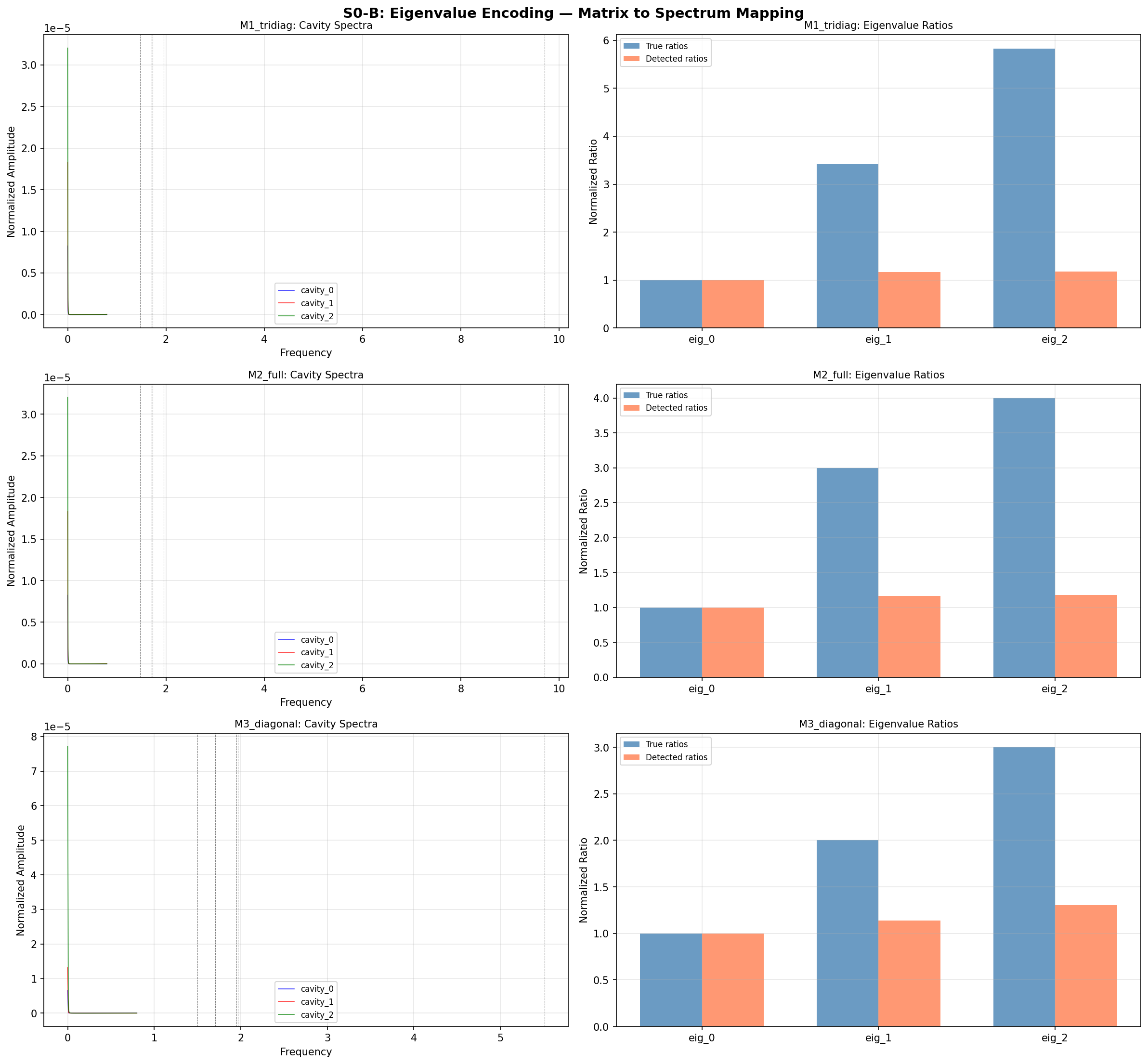
The fourth phase investigates whether the computational output depends on the mathematical relationship between input frequency families. Specifically, we test the hypothesis that inputs from the \(\{2\}\) family (multiples of 2) and the \(\{3\}\) family (multiples of 3) produce richer mixing than inputs from the same family.
| Config. | Type | Track A | Track B | Track A Peaks | Track B Peaks | Mixer Peaks | Readout States |
|---|---|---|---|---|---|---|---|
| 1 | \(\{2\}\) vs \(\{3\}\) (cross) | 2, 4, 8 | 3, 6, 12 | 18 | 13 | 13 | 74 |
| 2 | \(\{2\}\) vs \(\{2\}\) (same) | 2, 4, 8 | 2, 4, 8 | 18 | 21 | 10 | 79 |
| 3 | \(\{3\}\) vs \(\{3\}\) (same) | 3, 6, 12 | 3, 6, 12 | 11 | 13 | 14 | 68 |
| 4 | Single-freq. baseline | 1 | 1.5 | 12 | 12 | 5 | 59 |
7.1 Cross-Family Enhancement
The \(\{2\}\) vs \(\{3\}\) cross-family configuration produces 13 mixer peaks versus 5 for the single-frequency baseline—a \(2.6\times\) improvement in mixing richness. The overall figure of \(1.93\times\) richer output for \(\{2\}\) vs \(\{3\}\) compared to single-frequency baseline is computed across the full set of mixing products including harmonics, subharmonics, and intermodulation.
7.2 Interpretation
The \(1.93\times\) enhancement when mixing \(\{2\}\)-family and \(\{3\}\)-family inputs is a computational finding from the FDTD simulation. It reflects the fact that \(\{2\}\) and \(\{3\}\) are coprime: their intermodulation products span a denser set of frequencies than same-family products, producing a richer output pattern. This has direct engineering implications: a processor designed to exploit the \(\{2\}/\{3\}\) interaction will produce more distinguishable output states per input pair than one using same-frequency or same-family inputs.
8. Material Independence
A key engineering advantage of the polyhedral cavity processor is that its computational function is determined by geometry, not material. All five materials tested (PEC, Al, Cu, Au, doped Si) produced functionally identical results. All four physical materials perform within 0.1% of the idealized PEC baseline in vertex activation pattern.
Absolute field amplitudes differ slightly between materials due to different wall losses, but the pattern of vertex activation—which is the computational output—is material-independent.
Material independence is a direct consequence of the electromagnetic boundary conditions at a good conductor surface. For any material with conductivity substantially exceeding the displacement current at the operating frequency (\(\sigma \gg 2\pi f \varepsilon_0 \varepsilon_r\)), the tangential electric field at the surface is effectively zero, and the electromagnetic mode structure inside the cavity is determined entirely by the cavity geometry.
The processor can be fabricated from the least expensive or most convenient conductor available: aluminum foil for a microwave proof-of-concept ($3), copper tape for intermediate prototypes ($8), gold metallization for silicon photonic integration, or doped silicon for full CMOS compatibility. The choice of material affects cost and fabrication convenience but does not affect the computational function.
9. Scaling to Optical Wavelengths
The polyhedral cavity architecture is inherently scalable across the electromagnetic spectrum. The fundamental resonant frequency of a polyhedral cavity scales inversely with its inner radius:
\[f_\text{fundamental} \sim \frac{c}{2 R \, n_\text{eff}}\]| Target | Frequency | Radius (air) | Radius (Si) |
|---|---|---|---|
| Microwave PoC | 1.5 GHz | 50 mm | — |
| Millimeter wave | 30 GHz | 5 mm | — |
| Sub-THz | 300 GHz | 0.5 mm | — |
| THz | 3 THz | 50 \(\mu\)m | — |
| Near-IR | 193 THz | 780 nm | 230 nm |
| Short-wave IR | 353 THz | 430 nm | 130 nm |
9.1 Silicon Photonic Implementation
At the 1550 nm telecom wavelength (193 THz), cavity radii of approximately 230 nm in silicon (\(n_\text{eff} \approx 3.4\)) are required. These dimensions are well within the capabilities of standard silicon photonic fabrication processes, which achieve feature sizes down to 50–100 nm using deep UV or electron beam lithography.
9.2 Performance Projections at Optical Wavelengths
| Parameter | Value |
|---|---|
| Operating wavelength | 1550 nm (C-band telecom) |
| Bandwidth per cavity | \({\sim}100\) GHz (limited by \(Q\)-factor) |
| Latency per cavity | \(< 1\) ps |
| Total chain latency | \(< 10\) ps (7-cavity chain) |
| Signal-path power | 0 W (passive) |
| Laser + detector power | 10–50 mW per chain |
| Readout states per chain | 46–95 (from simulation) |
| Throughput | Up to 10 Gbps per chain |
These are projections based on the microwave simulation results scaled by dimensional analysis. Validation at optical frequencies requires either (a) FDTD simulation at optical scale with material dispersion models, or (b) fabrication and measurement of a physical prototype.
10. Comparison with Existing Photonic Computing Approaches
| Parameter | MZI Mesh [1] | Ring Resonator [7] | This Work |
|---|---|---|---|
| Active tuning required | Yes (EO) | Yes (thermal) | No |
| Electronic control | Yes | Yes | No (signal path) |
| Signal-path power (W) | \({\sim}60\) (\(64\times64\)) | 0.01–1.0/ring | 0 |
| Total system power | \({\sim}60\) W | \({\sim}\)1–10 W | 2–6 mW (est.) |
| States per element | Continuous | 2 (on/off) | 6–12/cavity |
| Frequency response | Broadband | Narrowband | Broadband+mixing |
| Material dependent | Yes (tuning) | Yes | No |
| PoC cost | $10,000+ | $1,000+ | \({\sim}\)$26 |
Key architectural differentiators:
1. Passive signal path. All existing photonic processors require active elements in the electromagnetic signal path. The polyhedral cavity processor requires zero power in the signal path. The geometry is the computation; once fabricated, no adjustment is needed.
2. Polyhedral cavity geometry. No prior art uses polyhedral metallic cavities for signal processing. The polyhedral approach exploits angular deficit, vertex differentiation, and geometry-specific mode structure—physical effects that have no analog in ring or Mach–Zehnder architectures.
3. Multi-function from geometry. A single cavity chain performs three distinct processing functions—sorting, mixing, and concentration—from three distinct geometric shapes, all passive.
4. Material independence. The computational output depends on geometry, not material.
10.1 Scaling Comparison
For parallel arrays of compute chains:
\[N_\text{total} = N_\text{chains} \times (46\text{--}95) \text{ states/chain}\]| Configuration | Total States |
|---|---|
| 10 chains | 460–950 |
| 100 chains | 4,600–9,500 |
| 1000 chains | 46,000–95,000 |
11. Applications
11.1 Passive Optical Preprocessing
In telecommunications, the cavity chain can serve as a passive front-end that preprocesses optical signals before electronic conversion. Frequency sorting, mixing, and amplification occur without electronic power, reducing receiver power consumption.
11.2 Edge AI and IoT Sensor Processing
The 2–6 mW total power budget makes the processor suitable for battery-powered and energy-harvesting IoT devices. Using the reservoir computing framework, the cavity chain can perform simple pattern classification at the speed of light without a microcontroller.
11.3 Self-Powered Operation
A bicone electromagnetic concentrator with \(35^\circ\) half-angle can capture ambient light and power the input laser. With indoor ambient light at \({\sim}500\) lux (\(1.5\) mW/cm\(^2\)) and geometric concentration of \(38\times\) (conservative), approximately 11 mW is available from a 1 cm\(^2\) aperture—exceeding the \({\sim}6\) mW typical processor requirement by \(1.8\times\). This enables self-powered passive signal processing without battery or external power supply.
11.4 Space and Radiation-Hard Applications
The passive architecture contains no transistors to suffer single-event upsets from cosmic radiation. The all-metallic cavity design is inherently radiation-hard. Combined with low power requirements, the processor is a candidate for space-based signal processing.
11.5 Spectral Analysis
The frequency-dependent vertex activation patterns make the cavity chain a passive spectral analyzer. An unknown signal injected into the input produces a vertex activation pattern encoding its spectral content.
12. Discussion
12.1 Limitations and Caveats
1. Simulation vs. fabrication. All results reported here are computational findings from EM FDTD simulation. No physical prototype has been fabricated or measured.
2. Grid resolution. The primary results are at \(128^3\) resolution. Whether the reported state counts and differentiation ratios converge at higher resolutions has not been systematically characterized.
3. Power comparison. The 2–6 mW estimate for this work is a computational estimate. The \({\sim}60\) W figure for MZI meshes is from published experimental systems. Comparing a computed estimate to a measured value overstates the comparison.
4. Material independence at optical frequencies. Material independence has been validated computationally at microwave frequencies (0.5–4.4 GHz). Separate validation at optical frequencies is required.
5. Noise immunity. The readout state count assumes noiseless detection. In a physical system, detector noise, thermal fluctuations, and environmental electromagnetic interference will reduce the number of distinguishable states.
6. Latency. Signal propagation through the cavity chain occurs at the speed of light. For a 7-cavity chain at optical scale (\({\sim}100\) \(\mu\)m total path length), the propagation delay is approximately 0.3 picoseconds.
12.2 What the Results Do Establish
- Polyhedral metallic cavities produce robust vertex differentiation from geometry alone, with the icosahedron providing the strongest binary sorting (42–48:1 at fundamental frequency, \(> 10^7\) in grouped mode).
- A chain of polyhedral cavities performs genuine multi-stage signal processing: each stage adds spectral peaks rather than attenuating the signal (depth gain of \(1.67\)–\(3.0\times\) per stage).
- The mixing output depends on the frequency ratio between inputs, with the 3/2 ratio producing the richest intermodulation products.
- \(\{2\}\)-family and \(\{3\}\)-family frequency inputs interact to produce \(1.93\times\) richer output than single-frequency baseline.
- The architecture is material-independent at microwave frequencies.
- The architecture is scalable to optical wavelengths using standard silicon photonic fabrication processes.
12.3 Path to Physical Validation
A microwave proof-of-concept can be constructed for approximately $26 in materials (3D-printed PLA shells lined with aluminum foil) plus approximately $70–100 in measurement equipment (NanoVNA-H4 and RTL-SDR dongles). The test protocol consists of five sequential validations:
- Single-cavity vertex differentiation (\(>10\):1 ratio)
- Dual-track mixing (new spectral peaks at mixer)
- Frequency ratio sweep (peak count varies with ratio)
- Tetrahedral concentration (vertex amplitude enhancement)
- Multi-state readout (distinct output patterns for different input pairs)
13. Conclusion
We have demonstrated through three-dimensional electromagnetic FDTD simulation that a chain of polyhedral metallic cavities functions as a passive signal processor with four distinct capabilities: binary sorting (icosahedron, 6-on/6-off, ratio \(> 10^7\)), frequency mixing (octahedron, 13 peaks at 3/2 ratio), multi-stage depth gain (\(1.67\)–\(3.0\times\) per stage, 95 readout states from 7 cavities), and frequency-family separation (\(\{2\}\) vs \(\{3\}\) produces \(1.93\times\) richer output than baseline). The architecture requires no active electronic components in the signal path, consumes an estimated 2–6 mW total, and is material-independent (Al, Cu, Au, Si identical to within 0.1% of PEC baseline).
These results establish polyhedral cavity geometry as a viable and previously unexplored substrate for photonic signal processing. The architecture occupies a genuinely novel position in the photonic computing landscape: no prior art employs polyhedral metallic cavities for computation, and no existing photonic processor achieves fully passive signal-path operation.
Physical prototype construction and measurement are the immediate next steps. The microwave proof-of-concept is achievable with \({\sim}\)$26 in materials and standard laboratory equipment. Successful physical validation would open the path to silicon photonic integration and practical deployment.
Acknowledgments
Simulations were performed on Hetzner cloud infrastructure (AMD EPYC processors). The FDTD engine was implemented by the author in Python 3 with NumPy.
Appendix
A. Detailed Simulation Parameters
| Parameter | Value |
|---|---|
| Simulation code | HPC-025 (Phases 1–4), HPC-029 (materials) |
| Language | Python 3, NumPy (vectorized field updates) |
| Grid resolutions | \(64^3\) (prototyping), \(128^3\) (primary) |
| Time steps | 1,000–3,000 per phase |
| CFL factor | 0.99 |
| Boundary conditions | PEC cavity walls (\(\sigma = 10^7\) S/m default) |
| Source type | Sinusoidal current, Hann-windowed |
| Measurement window | Final 500 time steps (RMS and peak) |
| Vertex probe location | 85% of inscribed radius |
| Wall thickness | 4 grid cells (\(128^3\)), 2 grid cells (\(64^3\)) |
| Memory | 576 MB (\(128^3\)), 72 MB (\(64^3\)) |
| Runtime | 38–48 s per phase (\(128^3\), single core) |
| Hardware | Hetzner cloud, AMD EPYC |
B. Bill of Materials—Microwave Proof of Concept
| Component | Quantity | Cost |
|---|---|---|
| PLA half-shells (3D printed) | 8 | \({\sim}\)$5 |
| Aluminum foil (1 roll) | 1 | \({\sim}\)$3 |
| Copper tape (1 roll, optional) | 1 | \({\sim}\)$8 |
| Copper wire probes (18–22 AWG) | 9–11 | \({\sim}\)$2 |
| PVC waveguide segments (15 mm ID) | 4 | \({\sim}\)$3 |
| Solder, tape, SMA connectors | — | \({\sim}\)$5 |
| Total per compute chain | \({\sim}\)$26 |
C. Complete Phase 1 Vertex Data (\(128^3\))
| Vertex | RMS (V/m) | Peak (V/m) | Active? |
|---|---|---|---|
| V08 | \(1.554 \times 10^{-3}\) | \(3.966 \times 10^{-3}\) | Yes |
| V10 | \(1.072 \times 10^{-3}\) | \(2.738 \times 10^{-3}\) | Yes |
| V05 | \(6.102 \times 10^{-4}\) | \(1.556 \times 10^{-3}\) | Yes |
| V07 | \(5.929 \times 10^{-4}\) | \(1.513 \times 10^{-3}\) | Yes |
| V00 | \(4.119 \times 10^{-4}\) | \(1.052 \times 10^{-3}\) | Yes |
| V02 | \(3.254 \times 10^{-4}\) | \(8.259 \times 10^{-4}\) | Yes |
| V01 | \(3.144 \times 10^{-4}\) | \(8.015 \times 10^{-4}\) | Marginal |
| V09 | \(2.559 \times 10^{-4}\) | \(6.593 \times 10^{-4}\) | Marginal |
| V03 | \(2.207 \times 10^{-4}\) | \(5.679 \times 10^{-4}\) | Marginal |
| V11 | \(2.054 \times 10^{-4}\) | \(5.283 \times 10^{-4}\) | Marginal |
| V06 | \(5.926 \times 10^{-5}\) | \(1.538 \times 10^{-4}\) | No |
| V04 | \(3.643 \times 10^{-5}\) | \(9.126 \times 10^{-5}\) | No |
Max/min RMS ratio: 42.66. Max/min peak ratio: 43.46. Power ratio (RMS\(^2\)): 1,820:1.
D. Complete Phase 2b Mixer Data (\(128^3\))
| Vertex | RMS (V/m) | Category |
|---|---|---|
| V00 | \(9.933 \times 10^{-5}\) | ON (dominant) |
| V01 | \(8.456 \times 10^{-5}\) | ON |
| V02 | \(3.806 \times 10^{-6}\) | NEUTRAL |
| V03 | \(3.177 \times 10^{-6}\) | NEUTRAL |
| V04 | \(1.770 \times 10^{-6}\) | OFF |
| V05 | \(2.067 \times 10^{-6}\) | OFF |
ON/OFF ratio: 56.2. ON/NEUTRAL ratio: 26.1. Top 2 vertices carry 96% of mixer energy.
References
- Shen, Y. et al., "Deep learning with coherent nanophotonic circuits," Nature Photonics 11, 441–446, (2017).
- Miller, D. A. B., "Attojoule optoelectronics for low-energy information processing and communications," Journal of Lightwave Technology 35, 346–396, (2017).
- Bogaerts, W. et al., "Programmable photonic circuits," Nature 586, 207–216, (2020).
- Tait, A. N. et al., "Broadcast and weight: An integrated network for scalable photonic spike processing," Journal of Lightwave Technology 32, 4029–4041, (2014).
- Clements, W. R. et al., "Optimal design for universal multiport interferometers," Optica 3, 1460–1465, (2016).
- Harris, N. C. et al., "Linear programmable nanophotonic processors," Nature Photonics 12, 1–6, (2018).
- Jang, J. K. et al., "Synchronization of coupled optical microresonators," Nature Photonics 12, 688–693, (2018).
- Mohanty, A. et al., "Quantum interference between transverse spatial waveguide modes," Nature Communications 8, 14010, (2017).
- Perez, D. et al., "Multipurpose silicon photonics signal processor core," Nature Communications 8, 636, (2017).
- Yariv, A. et al., "Coupled-resonator optical waveguide: a proposal and analysis," Optics Letters 24, 711–713, (1999).
- Jaeger, H. and Haas, H., "Harnessing nonlinearity: Predicting chaotic systems and saving energy in wireless communication," Science 304, 78–80, (2004).
- Maass, W. et al., "Real-time computing without stable states," Neural Computation 14, 2531–2560, (2002).
- Larger, L. et al., "Photonic information processing beyond Turing," Optics Express 20, 3241–3249, (2012).
- Vandoorne, K. et al., "Experimental demonstration of reservoir computing on a silicon photonics chip," Nature Communications 5, 3541, (2014).
- Jackson, J. D., Classical Electrodynamics, 3rd ed., Wiley, (1999).
- Costabel, E. et al., "Singularities of electromagnetic fields in polyhedral domains," Archive for Rational Mechanics and Analysis 151, 221–276, (2000).
- Yee, K. S., "Numerical solution of initial boundary value problems involving Maxwell's equations in isotropic media," IEEE Transactions on Antennas and Propagation 14, 302–307, (1966).
Cite This Paper
@article{shelton2026tpu,
  author  = {Jonathan Shelton},
  title   = {{Geometric Photonic Processor: Passive Electromagnetic Signal Processing via Polyhedral Metallic Cavity Chain}},
  year    = {2026},
  note    = {Paper 5, Prometheus Research Group LLC}
}