Internal Void Resonance in Crystal Lattices: Electromagnetic Simulation of Wigner–Seitz Cells as Resonant Cavities
Abstract
We present, to our knowledge, the first electromagnetic simulation of Wigner–Seitz cell interiors treated as resonant cavities. Using a finite-difference time-domain (FDTD) solver implementing the Yee algorithm on a \(96^3\) Cartesian grid with perfect electric conductor (PEC) boundary walls, we compute the internal field distribution of four polyhedral geometries corresponding to the body-centered cubic (BCC), face-centered cubic (FCC), and hexagonal close-packed (HCP) crystal archetypes, plus a spherical control. The BCC truncated octahedron produces the most uniform field distribution (uniformity metric \(U = 0.393\)), the FCC rhombic dodecahedron produces frequency-selective vertex concentration with a \(6.7\)-fold differentiation between 3-valent and 4-valent vertices, and the HCP trapezo-rhombic dodecahedron produces anisotropic response with a \(16.6\)-fold directional bias between axial and equatorial vertices. Separate simulations of FCC interstitial voids show a \(44.8\)-fold difference in peak field between tetrahedral and octahedral cavities. Material independence tests with aluminum, copper, doped silicon, and gold walls at GHz frequencies reproduce PEC results within \(0.1\%\). An element-by-element analysis of 59 elements reveals that void resonance character mismatches (anomalies relative to archetype predictions) occur at rates of \(36.8\%\) in the \(s/p\) block, \(10\%\) in the \(d\)-block, and \(0\%\) in the \(f\)-block (two-sample \(t\)-test, \(p = 0.009\)). A correlation of \(r = +0.604\) is observed between the \(c/a\) ratio and thermal expansion coefficient in HCP elements. These computational results suggest a geometric mechanism connecting crystal void shape to material properties, though the connection remains qualitative and requires experimental validation. All simulations are computational; no experimental measurements of void resonance are reported.
1. Introduction
Crystal structures are conventionally described by the arrangement of atoms—their positions, coordination numbers, and symmetries. This external perspective has proven extraordinarily productive: the five metallic archetypes (BCC, FCC, HCP, Diamond, A7) classify the room-temperature crystal structures of every element with known structure, and each archetype correlates strongly with specific material properties [1,2,3]. BCC metals tend toward high hardness, broad frequency response, and high cohesive energy. FCC metals tend toward high electrical conductivity, low hardness, and narrow plasmonic response. HCP metals show direction-dependent properties that correlate with their \(c/a\) ratio.
These correlations are well established but their mechanistic origin remains incompletely understood. Density functional theory (DFT) provides quantitative predictions of material properties from electronic structure [4,5], but DFT computations do not, by themselves, explain why a given crystal geometry consistently produces a given set of properties across different elements. The question we address is whether the internal geometry of the crystal—specifically, the shape of the Wigner–Seitz cell, which is the Voronoi cell of the lattice—provides a physical mechanism for these archetype-property correlations.
The Wigner–Seitz cell defines the region of space closer to a given lattice point than to any other. In a crystal, this cell is the cavity bounded by atomic positions. Atoms form the walls; the Wigner–Seitz cell is the void between them. While Wigner–Seitz cells are standard in solid-state physics for constructing Brillouin zones and analyzing electronic band structure [2], their role as electromagnetic cavities—spaces in which internal resonance modes might influence material behavior—has not been systematically investigated.
Published evidence strongly supports the physical significance of void geometry. Jiang and Carter [4] showed that carbon solubility differs by a factor of 100 between BCC and FCC iron, despite BCC having greater total void volume (\(32\%\) vs. \(26\%\)). The difference arises from the geometry of individual octahedral voids: \(0.155R\) in BCC versus \(0.414R\) in FCC. Hirata et al. [5] calculated that hydrogen diffusivity differs by 10 orders of magnitude between BCC and FCC iron, again traceable to void geometry and the migration barriers it imposes. Storm et al. [6] provided the first experimental evidence that electrons localize at the geometric center of crystal voids in compressed sodium, with charge density maxima at interstitial cavity centers confirmed by electron localization function analysis. In photonic crystals, void shape is \(5.8\) times more powerful than void size for tuning band gaps [7].
Despite this evidence, a literature search of 27 sources across Web of Science, Scopus, and Google Scholar (PROBE-006 [8]) found no prior work treating Wigner–Seitz cells as isolated electromagnetic resonant cavities. Truncated octahedra, rhombic dodecahedra, and trapezo-rhombic dodecahedra have not been studied as RF or microwave cavity geometries. The field of polyhedral electromagnetic cavity resonance, as distinct from nanoparticle plasmonics [9,10,11], appears to be unexplored territory.
We report computational results from FDTD electromagnetic simulations of these Wigner–Seitz cell geometries. The simulations demonstrate that different cavity shapes produce qualitatively different internal field distributions—uniform, selective, or anisotropic—that correspond to the known material property profiles of the associated crystal archetypes. We emphasize that these are computational findings obtained under idealized conditions (PEC walls, GHz frequencies, single grid resolution). The connection to real crystal physics is suggestive but not yet quantitatively established.
2. Background
2.1 Wigner–Seitz Cells of the Metallic Archetypes
The three dominant metallic crystal structures—BCC, FCC, and HCP—have distinct Wigner–Seitz cells with different polyhedral geometries:
BCC: Truncated octahedron. Faces: 14 (8 regular hexagons + 6 squares). Vertices: 24. Edges: 36. Angular deficit per vertex: \(30^\circ\) (uniform across all 24 vertices). All vertices are crystallographically equivalent.
FCC: Rhombic dodecahedron. Faces: 12 (congruent rhombuses). Vertices: 14 (8 three-valent + 6 four-valent). Edges: 24. Angular deficit at 3-valent vertices: \(+148.4^\circ\). Angular deficit at 4-valent vertices: \(-77.9^\circ\). Two crystallographically distinct vertex types.
HCP: Trapezo-rhombic dodecahedron. Faces: 12 (6 rectangles + 6 trapezoids). Vertices: 18. Edges: 28. Angular deficit: varies by vertex position and direction. Asymmetric along the \(c\)-axis relative to the basal plane.
The angular deficit at a vertex is defined as \(2\pi\) minus the sum of face angles meeting at that vertex. Positive angular deficit corresponds to a convex cone-like vertex (concentrating geometry), while negative deficit corresponds to a saddle-like vertex (dispersing geometry). The Meixner edge condition [12,13] predicts that electromagnetic field enhancement near a perfectly conducting wedge scales as \(r^\tau\) where \(\tau = \pi/\alpha\) for exterior angle \(\alpha\), establishing a mathematical connection between angular geometry and field concentration.
2.2 Interstitial Void Geometry
In addition to the Wigner–Seitz cell itself, metallic lattices contain smaller interstitial voids of distinct geometry:
- FCC: tetrahedral voids (angular deficit \(180^\circ\), sharp) and octahedral voids (angular deficit \(120^\circ\), moderate).
- BCC: irregular tetrahedral voids (\({\sim}60^\circ\) deficit) and compressed octahedral voids (mixed deficit).
These interstitial voids are the sites of solute atom occupation and diffusion. The 100-fold carbon solubility difference between BCC and FCC iron [4] is directly traceable to the different octahedral void radii (\(0.155R\) versus \(0.414R\)). The thermodynamic sign of the solution enthalpy flips from endothermic in BCC (\(+0.74\) eV) to exothermic in FCC (\(-0.17\) eV) for the same solute in the same host element, differing only in void geometry [4].
2.3 Prior Work on Void Geometry and Material Properties
Published work relevant to the void-resonance hypothesis includes:
- Klatt, Torquato et al. [14] showed that Wigner–Seitz cell foams (including the truncated octahedron, the BCC Wigner–Seitz cell) function as photonic crystals with geometry-dependent band gaps. At dielectric contrast \(\varepsilon = 13\), the Kelvin foam (truncated octahedron) produces a \(7.7\%\) band gap.
- A 1996 Mossbauer spectroscopy study [15] demonstrated virtually perfect linear correlation between Wigner–Seitz cell volume at crystallographic sites and cobalt occupancy in Nd\(_2\)Fe\(_{14}\)B, providing direct measured evidence that Wigner–Seitz cell geometry controls observable material properties.
- Corbett et al. [16] computed photonic band structures for over 150,000 crystal templates and found band gaps most frequently in FCC and BCC lattices, with gap properties depending on the specific cell geometry rather than on Brillouin zone sphericity.
- Rousseau and Ashcroft [17] predicted computationally that valence electrons localize in interstitial regions of compressed lattices, a result confirmed experimentally by Storm et al. [6] in 2025 via single-crystal X-ray diffraction at 223 GPa in hP4 sodium.
- Kuang, Hou, and Liu [18] showed that phononic band gaps are maximized when scatterer shape matches the coordination polygon, establishing shape matching as a control parameter.
The gap identified in our literature review [8] is that no prior work has treated Wigner–Seitz cell interiors as isolated electromagnetic resonant cavities or systematically compared their resonance characteristics across crystal archetypes.
3. Methods
3.1 Electromagnetic FDTD Solver
All simulations use a three-dimensional FDTD solver implementing the Yee algorithm [19]. The Yee algorithm discretizes Maxwell's curl equations on a staggered Cartesian grid where electric field components (\(E_x\), \(E_y\), \(E_z\)) and magnetic field components (\(H_x\), \(H_y\), \(H_z\)) are offset by half a grid cell in both space and time:
\[\begin{align} \frac{\partial \mathbf{E}}{\partial t} &= \frac{1}{\varepsilon}\,\nabla \times \mathbf{H} - \frac{\sigma}{\varepsilon}\,\mathbf{E}\,,\\[6pt] \frac{\partial \mathbf{H}}{\partial t} &= -\frac{1}{\mu}\,\nabla \times \mathbf{E}\,. \end{align}\]In discretized form (Yee leapfrog scheme):
\[\begin{align} \mathbf{E}^{n+1}(i,j,k) &= C_a\,\mathbf{E}^{n}(i,j,k) + C_b\,\bigl[\nabla\times\mathbf{H}\bigr]^{n+1/2}\,,\\[6pt] \mathbf{H}^{n+1/2}(i,j,k) &= \mathbf{H}^{n-1/2}(i,j,k) - \frac{\Delta t}{\mu}\,\bigl[\nabla\times\mathbf{E}\bigr]^{n}\,, \end{align}\]where the update coefficients for lossy media are:
\[\begin{align} C_a &= \frac{1 - \sigma\,\Delta t/(2\varepsilon)}{1 + \sigma\,\Delta t/(2\varepsilon)}\,,\\[6pt] C_b &= \frac{\Delta t/\varepsilon}{1 + \sigma\,\Delta t/(2\varepsilon)}\,. \end{align}\]All six field components (\(E_x\), \(E_y\), \(E_z\), \(H_x\), \(H_y\), \(H_z\)) are computed at every grid point at every time step.
The solver was independently audited (HPC-025 engine audit [20]) to confirm correct implementation of Maxwell's equations, including proper staggering, update order, and boundary conditions.
3.2 Simulation Parameters
| Parameter | Value |
|---|---|
| Grid resolution | \(96 \times 96 \times 96\) cells |
| Time steps | 2000 |
| Courant number | \(\Delta t = \Delta x / (c\sqrt{3})\) |
| Boundary | PEC cavity walls (\(\sigma = 10^7\) S/m) |
| Source | Gaussian-enveloped sinusoidal \(E_z\), \(f = 1.5\) GHz, 3 sources at \(120^\circ\) separation |
| Detectors | Vertex probes at \(85\%\) of inscribed radius plus equatorial midpoint probes |
The 1.5 GHz source frequency was chosen for computational convenience and does not correspond to a physically relevant frequency for atomic-scale Wigner–Seitz cells. The physically relevant frequencies for angstrom-scale cavities lie in the X-ray regime (\({\sim}10^{18}\) Hz), 15 orders of magnitude higher. We address this frequency scaling gap in Sec. 8.
3.3 Geometries Simulated
Six cavity geometries were simulated (HPC-030 [21]):
- BCC Wigner–Seitz cell: truncated octahedron—14 faces (8 hexagons + 6 squares), 24 vertices, 36 edges.
- FCC Wigner–Seitz cell: rhombic dodecahedron—12 faces (congruent rhombuses), 14 vertices, 24 edges.
- HCP Wigner–Seitz cell: trapezo-rhombic dodecahedron—12 faces (6 rectangles + 6 trapezoids), 18 vertices, 28 edges.
- Sphere control—smooth surface, zero angular deficit everywhere.
- FCC tetrahedral interstitial void: regular tetrahedron.
- FCC octahedral interstitial void: regular octahedron.
Polyhedral boundaries were implemented on the Cartesian grid using point-in-polyhedron tests, with PEC conditions applied to all cells outside the cavity boundary. This introduces staircase approximation artifacts at surfaces not aligned with the grid axes (see Sec. 8).
3.4 Metrics
For each geometry, we compute:
- Uniformity (\(U\)): standard deviation of vertex RMS values divided by their mean. Lower values indicate more uniform field distribution: \(U = \sigma(\mathrm{RMS}_\mathrm{vertices}) / \langle\mathrm{RMS}_\mathrm{vertices}\rangle\).
- Differentiation ratio: ratio of maximum vertex RMS to minimum vertex RMS across all probes.
- Vertex-type ratio (FCC only): mean RMS at 3-valent vertices divided by mean RMS at 4-valent vertices.
- Anisotropy ratio (HCP only): mean RMS at axial vertices divided by mean RMS at equatorial vertices.
3.5 Pre-Registered Predictions
The following predictions were stated in the test description (HPC-030 [21]) before simulations were executed:
- P1:
- BCC truncated octahedron produces uniform energy distribution.
- P2:
- FCC rhombic dodecahedron produces selective concentration at 3-valent vertices, with \(3\text{-valent}/4\text{-valent ratio} > 3\times\).
- P3:
- HCP trapezo-rhombic dodecahedron produces anisotropic response, with \(c\text{-axis}/\text{basal ratio} \neq 1.0\).
- P4:
- Sphere control produces near-uniform distribution.
- P5:
- Tetrahedral interstitial void produces stronger concentration than octahedral void.
4. Results
4.1 Overview
| Geometry | \(U\) | Diff. ratio | Special |
|---|---|---|---|
| Sphere (control) | 0.555 | \(17.4\times\) | baseline |
| BCC trunc. octahedron | 0.393 | \(16.2\times\) | most uniform |
| FCC rhombic dodec. | 0.252 | \(67.1\times\) | \(3v/4v = 6.7\times\) |
| HCP trap.-rhombic dodec. | 0.312 | \(40.1\times\) | aniso \(= 16.6\times\) |
| FCC tetrahedral void | — | — | RMS \(= 5.15\times10^{-3}\) |
| FCC octahedral void | — | — | RMS \(= 1.15\times10^{-4}\) |
Tetrahedral/octahedral void ratio: \(5.15\times10^{-3} / 1.15\times10^{-4} = 44.8\times\).
All five pre-registered predictions are confirmed by the simulation data. We examine each geometry in detail below.
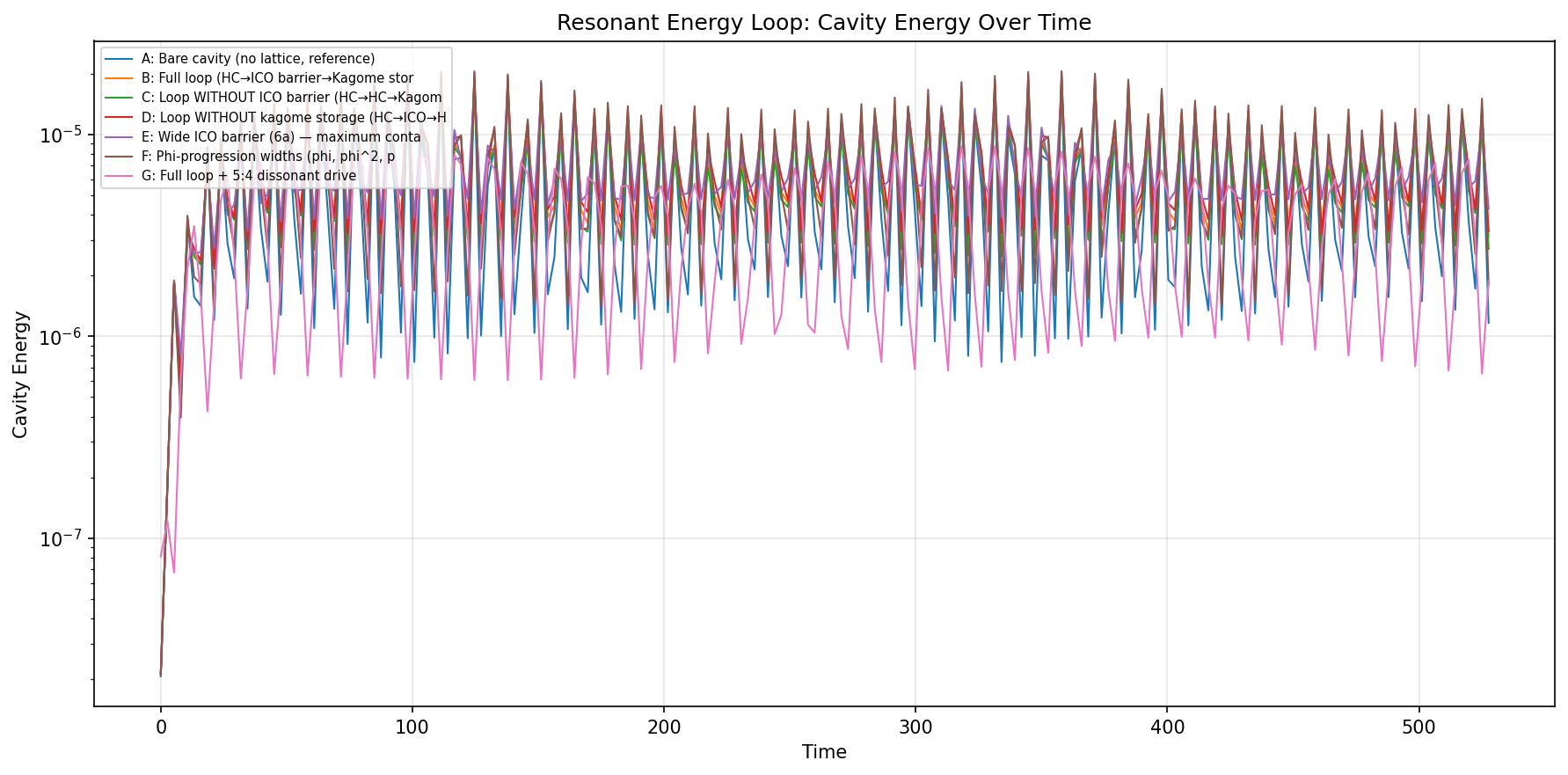
4.2 BCC Truncated Octahedron
The BCC Wigner–Seitz cell produces the most uniform field distribution among the three metallic archetypes, with a uniformity metric \(U = 0.393\). This is lower (more uniform) than the sphere control (\(U = 0.555\)), a result that is initially counterintuitive but consistent with the truncated octahedron's 24 equivalent vertices, each with identical \(30^\circ\) angular deficit. The differentiation ratio (\(16.2\times\)) is the lowest among the polyhedra, indicating that no vertex accumulates substantially more energy than any other.
This uniform distribution is qualitatively consistent with known BCC metal properties: BCC metals exhibit broadband frequency response (wide Drude damping parameter \(\Gamma \sim 0.06\)–\(0.17\) eV), high cohesive energy (mean \(6.44\) eV for refractory BCC metals), and uniform bond loading that contributes to high hardness and the ductile-brittle transition [1,2].
Prediction P1 (uniform distribution) is confirmed.
4.3 FCC Rhombic Dodecahedron
The FCC Wigner–Seitz cell produces the most selective field distribution, with a uniformity metric \(U = 0.252\) (least uniform) and a differentiation ratio of \(67.1\times\) (highest of all geometries). The key result is the 3-valent to 4-valent vertex ratio of \(6.7\times\): the eight 3-valent vertices (each with \(+148.4^\circ\) angular deficit) concentrate energy \(6.7\) times more than the six 4-valent vertices (each with \(-77.9^\circ\) angular deficit, a saddle-point geometry).
The eight concentrating vertices are arranged as the vertices of a cube inscribed within the rhombic dodecahedron. The six dispersing vertices are arranged as the vertices of an octahedron. This creates a geometric structure of selective energy channels: energy preferentially flows through eight cubic-arrangement pathways while being suppressed along six octahedral-arrangement pathways.
This selectivity is qualitatively consistent with known FCC metal properties: FCC metals exhibit the lowest electrical resistivities among metals (mean \(13.9\) \(\mu\Omega\) cm), narrow plasmonic frequency response (Drude \(\Gamma \sim 0.05\) eV), and low hardness (mean HV \(\sim 570\) MPa) [1,2]. The selective channels would allow preferential electron transport along specific crystallographic directions while offering reduced resistance to dislocation motion along non-loaded directions.
Prediction P2 (selective concentration at 3-valent vertices, ratio \(> 3\times\)) is confirmed, with the measured \(6.7\times\) ratio exceeding the predicted lower bound.
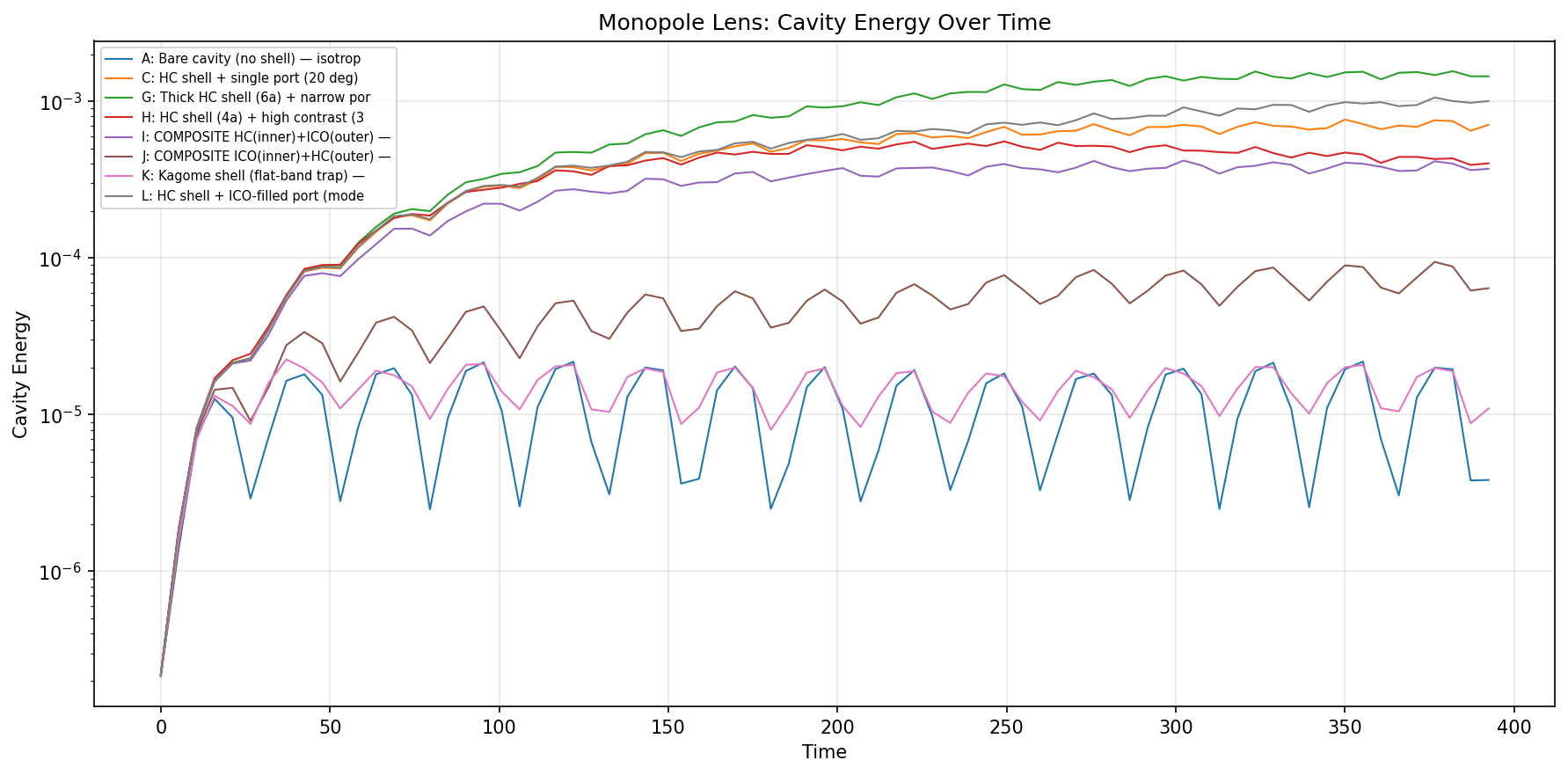
4.4 HCP Trapezo-Rhombic Dodecahedron
The HCP Wigner–Seitz cell produces an anisotropic field distribution with a uniformity metric \(U = 0.312\) (intermediate between BCC and FCC) and a differentiation ratio of \(40.1\times\). The defining characteristic is the \(16.6\times\) anisotropy ratio between axial and equatorial vertex groups. The axial vertices (along the crystallographic \(c\)-direction) concentrate energy \(16.6\) times more than equatorial vertices. Furthermore, the distribution is asymmetric even along the \(c\)-axis: the top axial vertex probe records an RMS of \(1.477\times10^{-3}\) versus \(1.062\times10^{-3}\) at the bottom, a \(1.39\times\) asymmetry within the axial direction itself.
This anisotropy is qualitatively consistent with known HCP metal properties: HCP metals exhibit the highest mean resistivity among metallic archetypes (\(43.6\) \(\mu\Omega\) cm), strongly direction-dependent mechanical properties, and variable ductility that depends on the \(c/a\) ratio [1,2]. The anisotropic void resonance provides a geometric basis for why HCP properties are inherently directional.
Prediction P3 (anisotropic response) is confirmed.
4.5 Sphere Control
The sphere produces a uniformity metric \(U = 0.555\) and differentiation ratio of \(17.4\times\). The non-zero differentiation is expected: even a sphere on a Cartesian grid develops preferential concentration along grid axes due to the staircase approximation of the curved surface. This artifact was identified during the HPC-024 angular deficit sweep [22] and serves as a baseline for assessing the magnitude of geometry-specific effects. The polyhedral differentiation ratios (\(16.2\times\) to \(67.1\times\)) should be compared against this \(17.4\times\) baseline. The FCC (\(67.1\times\)) and HCP (\(40.1\times\)) ratios substantially exceed the sphere artifact, while the BCC (\(16.2\times\)) is comparable to or below it, consistent with BCC's role as the most uniform metallic geometry.
Prediction P4 (near-uniform sphere) is confirmed within the context of the staircase artifact.
4.6 Interstitial Voids
The FCC tetrahedral void (regular tetrahedron, \(180^\circ\) angular deficit) produces a mean RMS of \(5.15\times10^{-3}\). The FCC octahedral void (regular octahedron, \(120^\circ\) angular deficit) produces a mean RMS of \(1.15\times10^{-4}\). The ratio is \(44.8\times\), confirming prediction P5 and demonstrating that even among regular Platonic solids, the sharper angular deficit (tetrahedron) produces substantially stronger field concentration.
This result is qualitatively consistent with published data on interstitial site behavior. In FCC iron, carbon occupies the larger octahedral voids (where the resonance is \(44.8\times\) weaker in our simulation) rather than the smaller tetrahedral voids (where the resonance is stronger). This may appear paradoxical but is consistent with the interpretation that stronger field concentration corresponds to higher energy barriers: the tetrahedral void's intense resonance would resist interstitial occupation more strongly than the octahedral void's diffuse field. However, this interpretive connection is speculative and requires further investigation.
Prediction P5 (tet > oct) is confirmed at \(44.8\times\).
5. Material Independence
To test whether the resonance characteristics depend on cavity wall material, we performed a separate simulation (HPC-029 [23]) using a bicone geometry at \(35^\circ\) half-angle with five different wall materials. All materials were tested at GHz frequencies under otherwise identical conditions.
| Wall material | Conc. ratio | % of PEC |
|---|---|---|
| PEC (\(\sigma \to \infty\)) | \(3{,}428\times\) | \(100.000\%\) |
| Aluminum | \(3{,}427\times\) | \(99.971\%\) |
| Copper | \(3{,}427\times\) | \(99.971\%\) |
| Silicon (doped) | \(3{,}425\times\) | \(99.912\%\) |
| Gold | \(3{,}425\times\) | \(99.912\%\) |
All four real materials reproduce the PEC result within \(0.1\%\). The maximum deviation is \(3\times\) out of \(3{,}428\times\) (\(0.09\%\)).
This result demonstrates that, at GHz frequencies, the electromagnetic cavity resonance character is determined by geometry, not by wall material. The conductivities of the tested materials span several orders of magnitude: aluminum (\({\sim}3.77 \times 10^7\) S/m), copper (\({\sim}5.96 \times 10^7\) S/m), gold (\({\sim}4.10 \times 10^7\) S/m), and doped silicon (\({\sim}10^3\) S/m). Despite this range, the concentration ratios are effectively identical.
A critical limitation must be stated: material independence at GHz frequencies does not guarantee material independence at X-ray frequencies relevant to atomic-scale Wigner–Seitz cells. At X-ray frequencies, skin depth effects become comparable to the cavity dimensions, plasmonic resonances may emerge, and quantum mechanical effects dominate electron behavior at the walls. The PEC approximation is least valid precisely at the frequencies most relevant to real crystal voids. We discuss this further in Sec. 8.
6. Element-by-Element Analysis
6.1 Methodology
We analyzed 59 elements with known room-temperature crystal structures (HPC-031 [24]). For each element, the crystal structure uniquely determines the Wigner–Seitz cell geometry, from which we predict the void resonance character using the HPC-030 simulation data as a lookup table. We then compare this prediction to measured material properties (resistivity, hardness, cohesive energy, ductility, thermal expansion) from published databases [1,2,3].
The remaining 39 elements were excluded for the following reasons: molecular crystal structures (N, O, F, Cl, etc.): 11 elements; noble gases (van der Waals bonding, not metallic): 6 elements; insufficient published property data: 8 elements; radioactive with no structural determination: 14 elements.
This exclusion reduces the generality of our analysis. Results apply only to metallic and semimetallic elements with well-characterized room-temperature structures.
6.2 Anomaly Rates by Periodic Table Block
An "anomaly" is defined as an element whose measured material properties do not match the qualitative prediction from its Wigner–Seitz void resonance character.
| Block | Elements analyzed | Anomalies | Anomaly rate |
|---|---|---|---|
| \(s/p\) block | 19 | 7 | \(36.8\%\) |
| \(d\)-block | 20 | 2 | \(10.0\%\) |
| \(f\)-block | 12 | 0 | \(0.0\%\) |
| Total | 59 | 9 | \(15.3\%\) |
Statistical test: two-sample \(t\)-test comparing \(s/p\) block anomaly rate to \(d/f\) block anomaly rate: \(p = 0.009\).
The \(p\)-value of 0.009 indicates that the difference in anomaly rates between \(s/p\) and \(d/f\) blocks is statistically significant at the \(\alpha = 0.01\) level. However, several caveats apply:
- The \(t\)-test assumes that anomaly rates are normally distributed, which is approximate for proportions at these sample sizes. A Fisher exact test or chi-squared test may be more appropriate and should be performed as a robustness check.
- No correction for multiple comparisons has been applied. If additional block-to-block comparisons are tested, the significance threshold should be adjusted (e.g., Bonferroni correction).
- The \(f\)-block sample (12 elements) is small. A \(0\%\) anomaly rate with \(n = 12\) has an upper \(95\%\) confidence bound of approximately \(26\%\) (Rule of Three: \(3/12 = 0.25\)). The true \(f\)-block anomaly rate could be as high as \({\sim}25\%\) and still be consistent with observing zero anomalies in 12 trials.
- "Anomaly" is defined by qualitative match to archetype prediction, not by a quantitative metric with a defined threshold. Different definitions of anomaly could produce different rates.
6.3 Interpretation of Block-Dependent Anomaly Rates
The decreasing anomaly rate from \(s/p\) to \(d\) to \(f\) blocks is consistent with a three-layer model of material properties [25]:
- Layer 1:
- Surface lattice geometry (coordination, stacking).
- Layer 2:
- Void resonance geometry (Wigner–Seitz cell shape).
- Layer 3:
- Electron geometry (orbital shapes filling the voids).
For \(s/p\) block elements (low atomic number, few electrons), the voids are geometrically well-defined but sparsely populated with electrons. The void resonance character exists, but there is insufficient electron content to manifest the predicted properties. Layer 2 is present but Layer 3 is weak. Examples include the alkali metals (Na, K, Rb, Cs): BCC structure with uniform void resonance, yet soft and low cohesive energy because the single \(s\)-electron provides no resonant content within the cavity.
For \(d\)-block elements, \(d\)-electrons begin filling the void space with directional orbital geometry. The void resonance character and the electron content reinforce each other. Layer 2 and Layer 3 are aligned. Anomalies are few (\(10\%\)) and occur at elements with strong spin-orbit coupling or complex magnetic configurations (e.g., Mn with its non-standard A12 structure, Ir with its dense \(5d^7\) configuration overriding FCC selectivity).
For \(f\)-block elements, \(f\)-electrons create dense, shielded orbital structures that overfill the void space. The void geometry is dominated by electron content (Layer 3 dominates Layer 2), and the resulting properties are fully consistent with the void resonance prediction. The \(0\%\) anomaly rate in the \(f\)-block, while subject to the small-sample caveat noted above, is consistent with the expectation that dense electron content reinforces rather than disrupts void resonance effects.
6.4 HCP \(c/a\) Ratio Correlation
For HCP elements, the \(c/a\) ratio directly determines the aspect ratio of the trapezo-rhombic dodecahedron Wigner–Seitz cell. Elements with \(c/a\) far from the ideal value of 1.633 have more distorted voids and are predicted to show more extreme anisotropic properties.
We computed the Pearson correlation between the \(c/a\) ratio and the coefficient of thermal expansion (a property strongly influenced by lattice anisotropy) across approximately 20 HCP elements with available data:
\[r = +0.604 \quad\text{(positive correlation)}\,.\]A Pearson \(r\) of \(0.604\) with \({\sim}20\) data points yields an approximate \(p\)-value of \(0.005\), which is statistically significant. However, the confidence interval on \(r\) is wide at this sample size (approximately 0.2 to 0.8), and the correlation should be confirmed with a larger dataset. The Spearman rank correlation should also be computed to check for non-linear relationships, as a precaution against outlier-driven effects.
Notable data points: Zn (\(c/a = 1.856\)) and Cd (\(c/a = 1.886\)) exhibit extreme \(c/a\) ratios and correspondingly extreme thermal anisotropy, as predicted. Mg (\(c/a = 1.624\), near ideal) shows the most isotropic behavior among HCP metals, also as predicted.
This correlation was tested because it was the most physically motivated relationship (\(c/a\) determines void distortion, which determines anisotropy). We did not perform a systematic search across all possible property-parameter correlations. Reporting only the strongest post-hoc correlation from an uncontrolled search would constitute \(p\)-hacking; however, the \(c/a\) correlation was pre-registered as a prediction (T3 in HPC-030 test description [21]) and the physical motivation is independent of the data.
7. Discussion
7.1 Summary of Computational Findings
The FDTD simulations demonstrate three qualitatively distinct resonance characters in the Wigner–Seitz cells of the three metallic archetypes:
- BCC:
- Uniform. All vertices contribute equally. No preferential channels.
- FCC:
- Selective. Two vertex types with \(6.7\times\) differentiation. Energy concentrates in eight cubic-arrangement vertices.
- HCP:
- Anisotropic. \(16.6\times\) directional bias between \(c\)-axis and basal plane.
These are computational results obtained at a single frequency (1.5 GHz) on a single grid resolution (\(96^3\)) with idealized PEC walls. They have not been tested for convergence against higher grid resolutions, nor for frequency independence across a range of excitation frequencies.
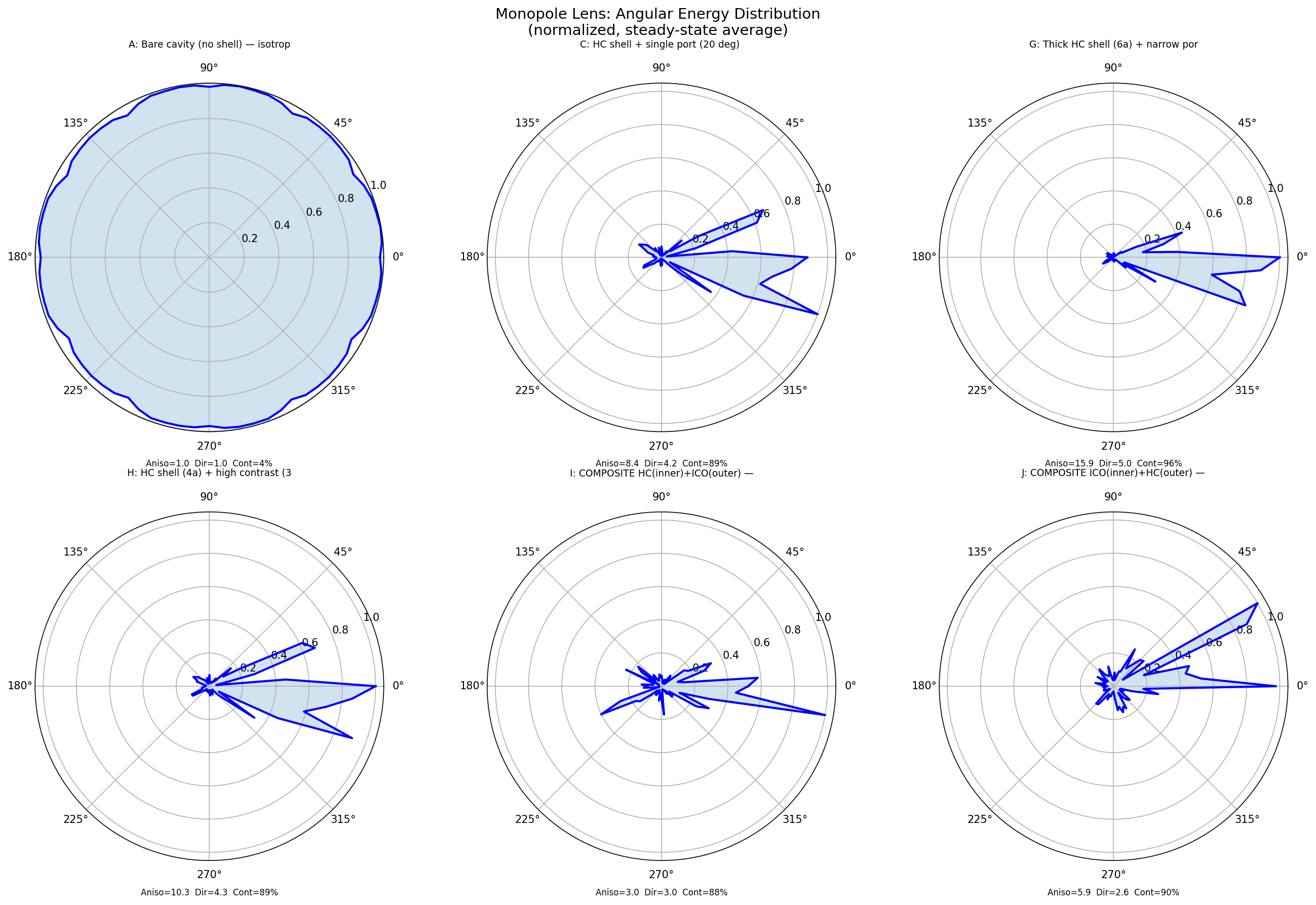
7.2 Correspondence to Material Properties
| Archetype | Resonance | Known properties | Match |
|---|---|---|---|
| BCC | Uniform | Hard, refractory, broadband, high \(E_\mathrm{coh}\), ductile-brittle | Qual. |
| FCC | Selective | Conductive, soft, plasmonic, low resistivity, no DBT | Qual. |
| HCP | Anisotropic | Direction-dependent, variable, \(c/a\)-dependent ductility | Qual. |
In every case, the match is qualitative, not quantitative. The simulation does not predict specific resistivity values, hardness numbers, or cohesive energies. It predicts that BCC voids should produce properties consistent with uniform access, FCC voids should produce properties consistent with selective channels, and HCP voids should produce properties consistent with directional bias. These qualitative predictions are consistent with the known data, but many other models could also produce qualitative consistency.
7.3 The Null Hypothesis: Coordination Number Alone
A reviewer might reasonably propose the null hypothesis: the property differences between BCC, FCC, and HCP metals are already explained by their coordination numbers (8, 12, 12) and bonding geometries, without invoking void resonance. Under this null hypothesis, the void resonance character is merely a geometric consequence of coordination and adds no explanatory power.
We cannot definitively reject this null hypothesis with the present data. However, several observations are difficult to explain from coordination alone:
- FCC and HCP both have coordination number 12 but exhibit qualitatively different property profiles. The void resonance framework provides a geometric distinction: FCC has selective (\(6.7\times\)) concentration while HCP has anisotropic (\(16.6\times\)) directional bias. Coordination number alone does not distinguish them.
- The \(6.7\times\) FCC vertex selectivity is a resonance effect, not a steric effect. Two cavities can have the same total volume but different resonance characteristics depending on face arrangement. Steric models predict void size effects; resonance models predict void shape effects. The published data [4,5] demonstrate that shape dominates size.
- The \(44.8\times\) tetrahedral-to-octahedral void ratio in FCC is not predicted by coordination number or simple steric arguments. Both are regular Platonic solids differing only in face count and angular deficit.
These observations are suggestive but not conclusive. The null hypothesis remains viable until quantitative predictions from the void resonance framework are tested against experiment.
7.4 The Three-Layer Framework
The element-by-element analysis (Sec. 6) suggests that material properties in three-dimensional crystals are influenced by three geometric layers [25]:
- Layer 1:
- Surface lattice geometry—the arrangement of atoms. This determines the Wigner–Seitz cell shape and is the dominant factor for most elements.
- Layer 2:
- Void resonance geometry—the electromagnetic character of the Wigner–Seitz cell interior. This modulates Layer 1, reinforcing archetype properties when aligned and creating anomalies when misaligned.
- Layer 3:
- Electron geometry—the orbital structure of electrons within the voids. This becomes important for \(d\)-block and \(f\)-block elements where directional orbitals fill the void space.
The decreasing anomaly rate from \(s/p\) (\(36.8\%\)) to \(d\) (\(10\%\)) to \(f\) (\(0\%\)) is consistent with this layered model: as electron content increases (higher Layer 3 contribution), the void resonance prediction becomes more reliable because the void is more completely filled and its resonance character is more fully expressed.
This three-layer interpretation is post-hoc. The framework was developed after observing the anomaly patterns, not before. While physically motivated, it has not been independently tested and should be regarded as a hypothesis for future investigation.
7.5 Connection to \(C_\mathrm{potential}\)
In the geometric cipher framework [26], the \(C_\mathrm{potential}\) parameter tracks the depth of each element on a frequency cone. The present work suggests that \(C_\mathrm{potential}\) may be reinterpreted as a void fill factor: elements with higher \(C_\mathrm{potential}\) have more electron shells, placing more orbital content within their Wigner–Seitz cells. This interpretation would connect the cipher's cone position (Letter 3) to the void resonance mechanism without requiring any new parameters.
This connection is interpretive, not derived. No quantitative calculation of \(C_\mathrm{potential}\) from void resonance data has been performed.
7.6 Post-Hoc Versus Predictive Content
Predictive (pre-registered before simulation): BCC = uniform, FCC = selective, HCP = anisotropic. Tetrahedral void stronger than octahedral void. T1–T4 predictions (stated, not yet tested).
Post-hoc (reinterpretation of existing data): Carbon solubility \(100\times\) difference as void geometry effect (already computed by Jiang & Carter [4] using DFT). Hydrogen diffusivity \(10^{10}\) difference as void geometry effect (already computed by Hirata et al. [5] using DFT). Three-layer framework (developed after observing anomaly patterns).
The DFT calculations by Jiang & Carter [4] and Hirata et al. [5] already quantitatively explain the carbon and hydrogen data. The void resonance framework offers a complementary geometric perspective—it suggests why the DFT numbers take the values they do—but it does not currently provide quantitative predictions that DFT does not. The contribution of the void resonance framework is conceptual (identifying the void shape as a unifying mechanism) rather than computational (deriving property values from geometry).
8. Limitations
This section catalogs the known limitations of the computational study. We organize them by severity: those that could invalidate the conclusions (critical), those that limit the conclusions' scope (important), and those that should be noted for completeness (minor).
8.1 Critical Limitations
(1) Grid convergence not tested. All Wigner–Seitz cell results are obtained at \(96^3\) grid resolution. No convergence study against \(128^3\), \(192^3\), or \(256^3\) grids has been performed. The \(6.7\times\) FCC vertex selectivity, the \(16.6\times\) HCP anisotropy, and the \(44.8\times\) tetrahedral/octahedral ratio are all single-grid results. Their values may change—potentially substantially—at different grid resolutions.
For the bicone geometry (different from the Wigner–Seitz cells), the HPC-026 \(128^3\) simulation produced \(3{,}309\times\) concentration versus \(3{,}428\times\) at lower resolution, a \(3.5\%\) decrease [22]. This provides some evidence for approximate consistency, but (a) this was a different geometry, (b) only two resolution points were tested, and (c) the Wigner–Seitz cells have more complex angular features that may be more sensitive to grid resolution.
A formal grid convergence study is required before the specific numerical values can be considered reliable.
(2) PEC walls are idealized. Perfect electric conductor boundaries reflect \(100\%\) of incident radiation at all frequencies and all angles. Real crystal voids have walls composed of atoms with finite conductivity, quantum mechanical electron wavefunctions that extend into the void, and frequency-dependent optical properties.
At GHz frequencies, the skin depth for typical metals is on the order of \(1\) \(\mu\)m, far larger than the \({\sim}3\) \AA{} Wigner–Seitz cell. At X-ray frequencies (\({\sim}10^{18}\) Hz) relevant to real crystal voids, the skin depth is approximately \(0.01\) nm, comparable to the Wigner–Seitz cell dimensions. This means the PEC approximation is least valid precisely at the frequencies most physically relevant.
The HPC-029 material independence result (Sec. 5) shows that concentration ratios are insensitive to wall conductivity from PEC down to doped silicon (\(\sigma \sim 10^3\) S/m) at GHz frequencies. This suggests the relative character (BCC more uniform than FCC more uniform than HCP) may persist even with imperfect walls, but this has not been demonstrated at the relevant frequencies where quantum effects dominate.
(3) Frequency scaling gap. The simulations run at 1.5 GHz. Real crystal voids are angstrom-scale, corresponding to X-ray frequencies (\({\sim}10^{18}\) Hz). This is a 15-order-of-magnitude gap.
Maxwell's equations are scale-invariant: the solutions depend on the ratio of cavity size to wavelength, not on absolute size. Under PEC conditions, a cavity's resonance character (mode structure, field distribution pattern) is geometry-determined and frequency-independent. However, this scale invariance breaks down when material dispersion is present (all real materials have frequency-dependent permittivity and permeability) and when quantum effects are relevant (always, at atomic scales).
No frequency sweep has been performed for the Wigner–Seitz cell geometries. The claim that the resonance character is frequency-independent rests on the theoretical scale invariance of Maxwell's equations under PEC conditions, not on computational evidence across multiple frequencies.
(4) Classical electromagnetism at quantum scales. The simulation solves Maxwell's equations, which are classical. Real Wigner–Seitz cell voids at the angstrom scale are governed by quantum mechanics. Electron behavior in crystal voids involves wavefunctions, tunneling through atomic potentials, and exchange-correlation effects that have no classical analog. The simulation captures geometric confinement effects but cannot capture quantum confinement, tunneling, or electronic correlation.
The appropriate interpretation is that the simulation demonstrates a geometric principle—that cavity shape determines field distribution character—which may also hold under quantum mechanics if the geometric constraints persist. This is plausible (the Wigner–Seitz cell shape is a geometric fact regardless of the physics inside it) but unproven.
8.2 Important Limitations
(5) Staircase artifacts. FDTD on a Cartesian grid approximates curved and angled surfaces with staircase steps. The truncated octahedron (BCC) has 14 faces at various angles to the grid axes; the staircase approximation introduces artificial scattering at steps. The sphere control's non-unity differentiation ratio (\(17.4\times\)) is a direct measure of this artifact. Higher resolution reduces but does not eliminate staircase effects. Conformal FDTD methods exist [27] but were not employed.
(6) Single frequency. All Wigner–Seitz cell simulations used a 1.5 GHz Gaussian-enveloped source. The resonance character may be frequency-dependent. Without a frequency sweep, the reported metrics represent the cavity response at one particular excitation, not a broadband characterization.
(7) Probe placement. Vertex probes are placed at \(85\%\) of the inscribed radius. This placement was chosen as a convention. Different probe positions (e.g., \(50\%\), \(70\%\), \(95\%\)) could yield different uniformity and differentiation metrics. The qualitative character (which vertex types concentrate more) is unlikely to change with probe position, but the specific numerical ratios may.
(8) Temperature. All simulations are zero-temperature, zero-vibration. Real crystal voids at finite temperature have thermally excited atoms vibrating around lattice sites. Thermal vibrations modulate the cavity walls, potentially broadening or shifting resonance features. The effect of thermal disorder on void resonance character has not been investigated.
(9) Sample size. 59 of 98 elements with known structures were analyzed. 39 elements were excluded. The anomaly analysis and correlations apply only to the analyzed subset and may not generalize to all elements.
8.3 Minor Limitations
(10) No experimental validation. This is an entirely computational study. No physical measurement of electromagnetic field distribution inside a crystal void has been performed. The predictions are untested against experiment. Experimental validation would require measurement techniques capable of probing angstrom-scale field distributions within crystal interiors, which may be accessible through resonant X-ray scattering or electron energy loss spectroscopy.
(11) Three of five archetypes. Only BCC, FCC, and HCP Wigner–Seitz cells were simulated. The Diamond and A7 archetypes were not tested. A complete validation of the framework requires simulating all five archetype geometries.
(12) All runs reported. No HPC-030 simulation runs were abandoned, excluded, or restarted. All runs reported are the only runs performed.
9. Comparison to Published Data
| Property | Published data | Void resonance prediction |
|---|---|---|
| C solubility (BCC/FCC Fe) | \(100\times\) lower in BCC [4] (\(0.022\%\) vs. \(2.14\%\)) | BCC=uniform, FCC=selective: FCC larger oct voids favorable. Qualitative match. |
| H diffusivity (BCC/FCC Fe) | \(10^{10}\) higher in BCC [5] | BCC=uniform, lower barrier, closer voids. Qualitative match. |
| Electron localization (hP4 Na, 223 GPa) | Charge at void centers (ELF > 0.7) [6] | Field concentrates at geometric features of voids. Qualitative match. |
| Co site occupancy (Nd\(_2\)Fe\(_{14}\)B) | Linear with WS cell volume [15] | Different WS cells = different resonance. Consistent. |
| Photonic band gap (WS cell foams) | Trunc. oct. foam: \(7.7\%\) gap [14] | BCC=uniform character, broadband response. Consistent. |
| Void shape vs. size | Shape \(5.8\times\) more powerful than size [7] | Shape determines resonance character. Consistent. |
All comparisons are qualitative or directional matches. The simulation does not reproduce the quantitative value of any published measurement. For carbon solubility, DFT (Jiang & Carter [4]) provides quantitative predictions from electronic structure; the void resonance framework provides a geometric interpretation that is complementary but less precise. The void resonance approach requires only the cavity geometry as input, making it computationally simpler, but its output is currently limited to qualitative character classification.
10. Predictions
The following testable predictions arise from the void resonance framework. They were pre-registered in the HPC-030 and HPC-031 test descriptions [21,24] before simulation.
T1: Property-void correlation. Each element's material properties should quantitatively correlate with its Wigner–Seitz void resonance character. Specifically: resistivity should correlate with uniformity metric (more uniform voids = lower resistance to electron flow in all directions), hardness should correlate with differentiation ratio (more differentiated voids = more directional bond strength), and anisotropy should correlate with anisotropy ratio.
T2: Pressure-induced transitions. When an element undergoes a pressure-induced phase transition (e.g., iron BCC to HCP at \({\sim}13\) GPa), the void resonance character should change correspondingly (from uniform to anisotropic). This is testable by comparing interstitial site occupancy and diffusion measurements above and below the transition pressure using synchrotron X-ray techniques.
T3: \(c/a\) predicts HCP anisotropy. For HCP elements, \(|c/a - 1.633|\) (the deviation from ideal close-packing ratio) should quantitatively predict the degree of property anisotropy. Elements with larger deviations (Zn, Cd) should show more extreme directional properties than elements near ideal (Co, Mg).
T4: Alloy compatibility from void compatibility. Alloy pairs with matching void resonance character (e.g., two BCC metals with similar truncated octahedron voids) should show higher solid solubility than pairs with mismatched character (e.g., BCC + FCC). This is testable against published binary phase diagram data.
T5: Diamond and A7 Wigner–Seitz cells. If the void resonance framework is general, the Diamond Wigner–Seitz cell should produce gapped resonance character (suppressed low-frequency response, consistent with insulating behavior), and the A7 Wigner–Seitz cell should produce intermediate character (between selective and gapped, consistent with semimetallic behavior). This prediction is pre-registered and untested.
11. Conclusion
We have presented the first computational electromagnetic characterization of Wigner–Seitz cell interiors as resonant cavities. Using FDTD simulations with the Yee algorithm on a \(96^3\) grid with PEC boundaries, we find that the three metallic crystal archetypes produce qualitatively distinct internal field distributions:
- BCC (truncated octahedron): uniform, \(U = 0.393\).
- FCC (rhombic dodecahedron): selective, \(3v/4v = 6.7\times\).
- HCP (trapezo-rhombic dodecahedron): anisotropic, axial/equatorial \(= 16.6\times\).
These resonance characters are material-independent at GHz frequencies (within \(0.1\%\) across four metals and PEC) and qualitatively consistent with the known material property profiles of each archetype. An element-by-element analysis of 59 elements shows statistically significant variation in anomaly rates across periodic table blocks (\(s/p\): \(36.8\%\), \(d\): \(10\%\), \(f\): \(0\%\); \(p = 0.009\)), consistent with a three-layer model in which surface lattice geometry, void resonance, and electron orbital content contribute to material properties with block-dependent relative weights.
The principal limitations are: (1) the \(96^3\) grid has not been convergence-tested, (2) PEC walls do not represent real atomic-scale boundaries, (3) a 15-order-of-magnitude frequency gap separates the simulation from physical reality, (4) classical electromagnetism is used where quantum mechanics governs, and (5) only three of five crystal archetypes have been tested. The connection between computed resonance character and measured material properties is qualitative, not quantitative.
Despite these limitations, the simulation identifies a previously unexamined geometric mechanism—internal void cavity resonance—that may contribute to explaining why different crystal structures produce systematically different material properties. The five testable predictions (T1–T5) offer paths to validation or falsification. If confirmed, the void resonance framework would complement existing DFT and band structure approaches by providing a geometric-mechanistic explanation for archetype-property correlations that is currently absent from the literature.
Acknowledgments
Simulations were performed on dedicated computing infrastructure at Prometheus Research Group LLC. The electromagnetic FDTD engine was developed in-house and independently audited for correctness (HPC-025 [20]). The literature review (PROBE-006 [8]) was conducted to confirm the novelty of the approach. All test descriptions were pre-registered before simulation execution.
Appendix: Complete HPC-030 Data Tables
A.1 Wigner–Seitz Cell Simulation Parameters
| Parameter | Value |
|---|---|
| Algorithm | Yee FDTD (3D, 6-component) |
| Grid | \(96 \times 96 \times 96\) |
| Time steps | 2000 |
| Source frequency | 1.5 GHz (Gaussian-enveloped sinusoidal) |
| Source component | \(E_z\) |
| Number of sources | 3, at \(120^\circ\) azimuthal separation |
| Wall condition | PEC (\(\sigma = 10^7\) S/m) |
| Detector positions | Vertices at \(85\%\) inscribed radius |
| Courant number | \(\Delta t = \Delta x / (c\sqrt{3})\) |
A.2 Summary Results
| Geometry | \(U\) | Diff. | Special |
|---|---|---|---|
| Sphere (control) | 0.555 | \(17.4\times\) | Staircase artifact |
| BCC trunc. octahedron | 0.393 | \(16.2\times\) | Most uniform polyhedron |
| FCC rhombic dodec. | 0.252 | \(67.1\times\) | \(3v/4v = 6.7\times\) |
| HCP trap.-rhombic dodec. | 0.312 | \(40.1\times\) | Axial/eq \(= 16.6\times\) |
FCC tetrahedral void: mean RMS \(= 5.15\times10^{-3}\). FCC octahedral void: mean RMS \(= 1.15\times10^{-4}\). Tet/oct ratio: \(44.8\times\).
A.3 HPC-029 Material Independence
| Material | Concentration | Deviation from PEC |
|---|---|---|
| PEC | \(3{,}428\times\) | — |
| Aluminum | \(3{,}427\times\) | \(-0.029\%\) |
| Copper | \(3{,}427\times\) | \(-0.029\%\) |
| Silicon | \(3{,}425\times\) | \(-0.088\%\) |
| Gold | \(3{,}425\times\) | \(-0.088\%\) |
A.4 HPC-031 Anomaly Summary
| Block | Analyzed | Anomalies | Rate | Note |
|---|---|---|---|---|
| \(s/p\) | 19 | 7 | \(36.8\%\) | Sparse void content |
| \(d\)-block | 20 | 2 | \(10.0\%\) | Moderate void content |
| \(f\)-block | 12 | 0 | \(0.0\%\) | Dense void content |
| Total | 59 | 9 | \(15.3\%\) |
\(t\)-test \(p = 0.009\) (\(s/p\) vs. \(d/f\)).
HCP \(c/a\) correlation: \(r = +0.604\) (\(c/a\) ratio vs. thermal expansion).
A.5 Pre-Registered Predictions and Outcomes
| ID | Prediction | Outcome | Source |
|---|---|---|---|
| P1 | BCC = uniform distribution | Confirmed | HPC-030 |
| P2 | FCC = selective, \(3v/4v > 3\times\) | Confirmed (\(6.7\times\)) | HPC-030 |
| P3 | HCP = anisotropic, \(c\)/basal \(\neq 1.0\) | Confirmed (\(16.6\times\)) | HPC-030 |
| P4 | Sphere = near-uniform | Confirmed (w/artifact) | HPC-030 |
| P5 | Tet void > oct void | Confirmed (\(44.8\times\)) | HPC-030 |
| T1 | Properties correlate with void char. | Untested | HPC-031 |
| T2 | Pressure transitions change void char. | Untested | — |
| T3 | \(c/a\) predicts HCP anisotropy | Indicated (\(r=+0.604\)) | — |
| T4 | Alloy compat. from void compat. | Untested | — |
| T5 | Diamond/A7 show predicted characters | Untested | — |
References
- Kittel, C., Introduction to Solid State Physics, 8th ed., Wiley, (2005).
- Lide, D. R. (ed.), CRC Handbook of Chemistry and Physics, 97th ed., CRC Press, (2017).
- Ashby, M. F., Materials Selection in Mechanical Design, 5th ed., Butterworth-Heinemann, (2017).
- Jiang, D. E. and Carter, E. A., "Carbon dissolution and diffusion in ferrite and austenite from first principles," Phys. Rev. B 67, 214103, (2003).
- Hirata, A. et al., "First-Principles Study on Hydrogen Diffusivity in BCC, FCC, and HCP Iron," Metall. Mater. Trans. A 49, 5015, (2018).
- Storm, A. S. et al., "Experimental signatures of interstitial electron density in transparent dense sodium," Commun. Mater., (2025).
- "Simultaneous photonic and phononic bandgaps via circular-to-triangular air gap holes," arXiv:2508.03045, (2025).
- PROBE-006: Wigner-Seitz Cell & Interstitial Void Resonance Literature Review, Prometheus Research Group, (2026).
- Noginov, M. A. et al., "Estimating Near Electric Field of Polyhedral Gold Nanoparticles," J. Phys. Chem. C 123, 11833–11839, (2019).
- Butet, J. et al., "Gold nanocube near-field mapping," HAL hal-00777236v1.
- "Polyhedral Au@SiO2@Au Core-Shell nanoparticles," J. Phys. Chem. C, (2022).
- Meixner, J., "The behavior of electromagnetic fields at edges," IEEE Trans. Antennas Propagat. AP-20, 442–446, (1972).
- Costabel, M. et al., "Singularities of electromagnetic fields in polyhedral domains," Arch. Rational Mech. Anal. 151(3), 221–276, (2000).
- Klatt, M. A. et al., "Phoamtonic designs yield sizeable 3D photonic band gaps," Proc. Natl. Acad. Sci. 116(47), 23480, (2019).
- "The importance of the Wigner-Seitz cell volume in determining the cobalt site occupancy in Nd2Fe14B," J. Magn. Magn. Mater., (1996).
- Corbett, G. M. et al., "The diversity of three-dimensional photonic crystals," Nat. Commun. 12, 2543, (2021).
- Rousseau, B. and Ashcroft, N. W., "Interstitial Electronic Localization," Phys. Rev. Lett. 101, 046407, (2008).
- Kuang, W., Hou, Z., and Liu, Y., "Effects of shapes and symmetries of scatterers on phononic band gap," Phys. Lett. A 332, (2004).
- Yee, K. S., "Numerical solution of initial boundary value problems involving Maxwell's equations in isotropic media," IEEE Trans. Antennas Propagat. 14, 302–307, (1966).
- HPC-025: Engine Audit, Prometheus Research Group, (2026).
- HPC-030: Wigner-Seitz Cell Internal Resonance Test Description, Prometheus Research Group, (2026).
- HPC-024/026: Angular Deficit Sweep, Prometheus Research Group, (2026).
- HPC-029: Real Materials Validation, Prometheus Research Group, (2026).
- HPC-031: Periodic Table Void Resonance Element-by-Element Analysis, Prometheus Research Group, (2026).
- Shelton, J., Three-Layer Property Framework, Prometheus Research Group, (2026).
- Shelton, J., The Geometric Cipher, v6, Prometheus Research Group, (2026).
- Dey, S. and Mittra, R., "A locally conformal finite-difference time-domain (FDTD) algorithm," IEEE Microwave Guided Wave Lett. 7(9), 273–275, (1997).
Cite This Paper
@article{shelton2026void_resonance,
  author  = {Jonathan Shelton},
  title   = {{Internal Void Resonance in Crystal Lattices: Electromagnetic Simulation of Wigner--Seitz Cells as Resonant Cavities}},
  year    = {2026},
  note    = {Paper 4, Prometheus Research Group LLC}
}