1. The Cipher's Own Language: Terrain Equations and the Cpotential
The Five-Equation Pipeline
The cipher's core machinery is five equations, each taking the output of the one before it, containing no fitted constants. Together they form an unbroken chain from atomic number Z to predicted bond angle, whose only external input is standard atomic mass from the periodic table, a measured quantity, not a tuned one.
The pipeline runs: Z → standard atomic mass (lookup) → effective dimensional depth deff (Equation 1) → spiral ratio r (Equation 2) → angular spacing (Equation 3) → top-angle (Equation 4) → bond angle (Equation 5). This sequence executes cleanly across all 107 elements tested [Shelton2026].
Equation 1: Dimensional Depth from Mass
The cipher converts atomic mass into an effective dimensional depth deff using the Compton depth function:
> 0.1964d² + 8.0932d − 20.0373 = log₁₀(E/eV)
where E = mc² is the rest energy of the cluster at that filling step [Shelton2026]. The quadratic form hints at something explicit in Section 3: polynomial degree tracks dimensional depth. No constant here was fitted to bond angle data.
Equation 2: Spiral Ratio from Depth
Once deff is known, the cipher computes the local spiral ratio r, the rotational self-similarity of the terrain at that depth. At the dimensional floors, this ratio takes specific values: 1.500 at the 2D floor, 1.618 at the 3D floor (the golden ratio), and 1.707 at the 4D floor. These are outputs, landmarks that emerge from the terrain's structure. The cipher reads them; it does not impose them.
Equation 3: Angular Spacing from Ratio, The Quadratic Overlay
Angular spacing θ is computed as a function of r through the Cpotential quadratic, a formula that, arrived at from terrain principles, reproduces the same functional form as the standard quadratic x² − x − 1 = 0 whose roots define the golden ratio. Two independent lines of evidence converge on the same structure: algebra reaching it through polynomial roots, the cipher through spiral placement in a curved potential well. The cipher's architects call this overdetermination, proof by convergence rather than derivation alone [Shelton2026]. The geometry derived from this quadratic matches 90.1% of individual bond angles across the periodic table with median error 0.0°.
Equation 4: Top-Angle from Angular Spacing
Equation 4 converts angular spacing into a top-angle, the apex angle of the cone the spiral traces, measured from the dimensional floor. The opening angle at each floor follows directly from the ratio values: 240.0° at the 2D floor, 222.5° at the 3D floor, 210.9° at the 4D floor [Shelton2026d]. The top-angle for any element interpolates between these landmarks according to its deff.
Equation 5: Bond Angle from Top-Angle and Coordination Number
Given the top-angle and coordination number CN, Equation 5 computes the predicted bond angle. CN is derived, not fitted, it emerges from the eigenvalue structure of the finished constellation as a reading.
The mechanism is progressive filling. For a cluster of N atoms, each atom k receives its position from its own Compton depth d_k (computed from k × atomic mass), its own local ratio r_k, and angular offset θ_k = angle_rad(r_k) × (k−1) [Shelton2026]. The vertical fraction z_frac and radius R decrease with k, producing a spiral that tightens and deepens as the cluster fills. The output is a set of spatial positions; the angles between neighboring atoms in those positions are the predicted bond angles.
The Cpotential: Not a Well, But a Map
The Cpotential is not a static energy well but a dynamic, position-dependent frame map that evolves with the pattern it describes [Shelton2026]. As deff increases, the internal topology changes. At dimensional floors, the topology is flat, settled, at equilibrium. In transitional zones, it is steep and actively reorganizing. The 2D, 3D, and 4D floors are topologically distinct regimes, different shapes of well, producing different geometric behavior. The current smooth power law approximates this, with a ratio function that properly respects the floors representing the next evolution of the framework. That evolution must emerge from the geometry, not be imposed upon it. This is the central methodological commitment of v12.
Eigenvalue as Reading, Not Correction
Before v12, the cipher included an eigenvalue resonance correction that computed principal axes of the finished constellation and pushed predicted angles toward uniform spacing. In v12, the eigenvalue computation is retained, but only as a diagnostic. It reveals sphericity, principal axis ratios, dimensional character, resonance structure: readings of what the terrain produced, not interventions in production. Using them to nudge output would be equivalent to a surveyor adjusting the map to flatten the landscape.
The same logic governs every other element v12 stripped from its predecessor. The snap function imposed a blend rule rather than reading geometry. Shell structure was an external organizational framework. Per-shell ratio modification was fitting. Each removal was not a loss of precision but a restoration of integrity.
The Inverted Perspective Model
Every dimensional floor looks flat to its own inhabitants. From within three-dimensional space, the fourth dimension projects down to a line, invisible in the same way a sheet of paper's thickness is invisible face-on [Shelton2026d]. The inverted perspective model formalizes this: laboratory measurements are angles relative to the 3D floor, and angles existing partly in 4D are foreshortened by the projection.
This produces a structured, not random, error distribution. The 109.5° tetrahedral angle shows mean error −2.7° with correlation r = +0.62 with pitch angle. The 180° linear angle shows mean error −3.2°, the largest systematic offset, consistent with being most inflated by Euclidean measurement from a projection the terrain does not produce directly. By contrast, 60° and 120° angles, both near the golden-ratio floor, show mean errors of +0.4° and −0.2° [Shelton2026d]. The inverted perspective does not excuse errors; it explains their structure, and the terrain itself predicts that structure.
Why Removing the Snap Function Was Not a Loss
The snap function in v11 handled discontinuous reorganizations at dimensional boundaries by blending f-state and t-state geometries using the percolation threshold as a parameter. It improved predictions near transition zones, but by imposing an external rule rather than reading the terrain, introducing error modes that look like precision but are fitting [Shelton2026d].
The terrain already produces transitions. When the Cpotential's topology changes at a dimensional boundary, the geometry reorganizes, that reorganization is the snap. It does not need to be added as a separate function. Removing the snap function is not a removal of transition physics but a commitment to finding those physics in the terrain itself.
For carbon and silicon, the terrain produces a pre-transition angle of 106° rather than the measured 109.5°. This is not a miss, it is the terrain correctly reporting the pre-snap state. How 106° becomes 109.5° is the snap as a geometric event arising from Cpotential topology: an open frontier, not a solved problem.
Z Alone, All the Way Down
The pipeline accepts a single number as ultimate input: Z. From Z, standard atomic mass is looked up, measured, not tuned. From mass, deff. From deff, r. From r, angular spacing. From angular spacing, top-angle. From top-angle and CN, bond angle.
At no point does a laboratory measurement of bond angles enter the chain. At no point does a fitted constant. Using atomic mass to predict atomic behavior is not a correction. It is a reading.
1.1 What Was Stripped and Why: The v12 Removals
Subsection 1a: What Was Stripped and Why, The v12 Removals
Version 12 is defined by four deliberate removals. Four mathematical structures, each introduced with reasonable justification, each doing genuine computational work, were identified as impositions rather than readings and stripped entirely. Accuracy rose. The terrain, freed from corrections designed to help it, performed better without them.
The Snap Function: Geometry Already Knows How to Transition
The snap function interpolated between the f-state and t-state geometries for elements near their transition boundary:
> snap(topo) = (p − p_c)^0.41
This produced a weighted blend, snap × |t + (1 − snap) × f, depending on how far topology parameter p sat from critical value p_c. It looked physically motivated and matched data points.
The problem: it was interpolation, not derivation. The Cpotential terrain already contains the transition mechanism. As fill fraction rises, the terrain's own curvature shifts the energetically favored position of each subsequent electron. The snap function was doing by formula what the geometry was already doing by structure, and because it ran on top of the geometry rather than emerging from it, it produced a systematic low bias in predicted angles near the transition boundary. [Shelton2026]
Removing it revealed the terrain's natural transitions, which had been there all along. Carbon and silicon, sitting in the "stretching zone" (pitch angles 5.5–6.0°), exemplify this: their transition from 106° to 109.5° is a geometric event, not an imposed blend. Version 12 exposes it rather than papers over it.
The deeper point: a snap function treats transition as a property of the element. The terrain view treats it as a property of the landscape. The element sits where the terrain places it. No blending required.
Eigenvalue Resonance as Position Modifier: Reading Versus Rewriting
Version 12 retains the eigenvalue of the electron constellation, but only as a reading. What it removes is the eigenvalue used as a position modifier.
In prior versions, after terrain placement, a secondary calculation measured the constellation's eigenvalue and nudged electrons toward more uniform angular spacing (base strength: 0.08). The motivation was plausible: real configurations might exhibit repulsion-driven uniformity, and the eigenvalue measured departure from that ideal.
But the terrain already encodes whatever repulsion geometry the system exhibits. Electrons are not particles seeking equilibrium, they are positions on a landscape with its own curvature and preferred spacing. When eigenvalue resonance pushed toward uniformity, it was overwriting the terrain's answer with a separate model's assumption about what the answer should be. [Shelton2026] The effect was identical to the snap function's: systematic low bias. Removing it improved accuracy.
The principle, stated explicitly in the cipher's documentation: reading the shape is not the same as changing the shape. [Shelton2026] The eigenvalue tells you what the geometry is. It should not tell the geometry what to be. Conflating measurement with prescription is precisely the category error that forces corrections to compensate for other corrections.
Shell Structure: The Terrain Has No Shells
This is the most conceptually radical removal, because shell structure is so embedded in chemical pedagogy that its presence seems obvious rather than suspicious.
Quantum mechanics gives us electron shells, the 2n² groupings organizing the periodic table. This is real and well-validated for many features of atomic behavior. But the cipher is not a quantum mechanics engine. It is a terrain engine. And the terrain does not know about shells. [Shelton2026]
The terrain knows the shape of the Cpotential landscape and where each successive electron comes to rest, determined by atomic number Z through fill fraction and local curvature. Shell-based bookkeeping imposes a classification system the terrain never generates, mapping a different framework's categories onto the cipher's output, then adjusting that output to match what the other framework predicts. The v12 documentation is direct: this "was fitting, not reading." [Shelton2026]
The per-shell ratio made this explicit: distinct fitted parameters for each shell grouping, tuned to match known bond angles within each category. When removed, they broke 21+ elements that had been correctly predicted, initially damning, but on reflection diagnostic. Those elements were correct for the wrong reason. Removing the fitting exposed the actual terrain prediction, which for some elements was wrong. That is useful information: it marks where the cipher has genuine work to do. A framework right for the wrong reason is not right.
The Co-Dependence Problem: Why Removing All Four Together Mattered
These were not independent errors. They were compensating for each other. [Shelton2026]
The snap function's low bias was partially offset by eigenvalue resonance's nudging. Shell structure's category boundaries created regions where errors accumulated, and per-shell ratios were tuned to absorb them. Remove any single element and the remaining corrections, now unbalanced, produced worse results. This is the trap of co-dependent corrections: each makes the others seem necessary.
Version 12 removed all four simultaneously. The result: more misses in one metric, more correct elements in another, a tradeoff interpretable precisely because it reflects actual terrain behavior. Version 11's snap function had been pushing borderline elements into the "all-inclusive correct" category, masking natural misses. Version 12 exposes them honestly. Seven misses versus two in the MISS category; 82 correct in ALL versus 71, the tradeoff is the terrain speaking without mediation. [Shelton2026]
The One Remaining Structural Input: Coordination Number
One input requires honest acknowledgment. Coordination number, the count of nearest-neighbor bonded atoms, is not derived from Z within the cipher. It is taken from crystallographic data. [Shelton2026]
This is a definition of scope, not a flaw. The cipher predicts bond angle given coordination number. The zero-empirical-corrections claim applies to that derivation: once CN is known, terrain equations produce the bond angle from Z alone, with no fitted parameters, no correction terms, no shell bookkeeping.
Predicting 91 exact bond angles across 107 elements, median error 0.0°, from atomic number and coordination number, with zero fitted parameters, does not require overstating its scope to be remarkable. CN is the boundary condition; the terrain does everything else.
Version 12 is not a cipher with something extra. It is a cipher with four things missing. What remains is the terrain reading itself, placing electrons where the Cpotential landscape places them, producing angles that match reality at a rate no corrected version achieved.
The corrections were noise, not signal, accumulated residue of reasonable interventions that each addressed a real discrepancy while preventing the framework from discovering why that discrepancy existed. Strip them, and the discrepancy either disappears or remains honestly visible as genuine frontier rather than hidden failure papered over by a well-tuned parameter.
2. The Dimensional Fan: How the Cipher Reads Every Element
A Funnel Seen From Above
The dimensional fan is a direct geometric consequence of the Cpotential, the terrain described above, read from above. Imagine the Cpotential as a widening funnel. At its narrowest point sits 1D: a pulse, no angular spread. Moving outward, the funnel opens at each dimensional boundary, governed by that dimension's characteristic ratio.
The opening angles are computed, not chosen: divergence = 360° ÷ floor ratio. At the 2D floor, ratio 3/2 = 1.500, divergence is 240.0°. At the 3D floor, ratio phi = 1.618, divergence is 222.5°. At the 4D floor, ratio 1.707, divergence is 210.9° [Shelton2026d].
A higher ratio produces a smaller divergence angle, the funnel narrows as you go deeper, even as each new dimension opens a new angular regime. Looking into the funnel from above, concentric arcs mark each dimension. The 2D arc spans 120° of territory inaccessible to 1D. The 3D arc adds 17.5° more. The 4D arc adds 11.6° beyond that [Shelton2026d]. The ratio of successive increments, 17.5° ÷ 11.6° = 1.510, matches the 2D floor ratio of 1.500 to four figures. Each dimension's topology governs how much angular room the next transition opens.
Reading the Fan: The Pitch Angle
Every element's position in the fan, its pitch angle, follows from atomic number Z through the terrain equations established above. From Z, compute deff via Compton-scaled mass; from deff, read the local spiral ratio r; then:
> divergence = 360° × (1 − 1/r) > pitch = divergence − 137.508°
Hydrogen yields pitch = 4.15°; oganesson yields 7.22°. The difference, 3.07°, is a direct output of the terrain equations, not a tuned result [Shelton2026d]. The periodic table fits inside the arc they define.
Pitch angle is a reading, not a correction. It locates the element in the fan, determining how much of its geometry projects visibly into 3D space versus into 4D depth.
What Pitch Angle Means Physically
Low-pitch elements, hydrogen, carbon, silicon, sit close to the 3D floor with geometry still stretching, not fully settled. This explains the persistent 3.5° gap between the cipher's terrain output (106°) and the measured tetrahedral angle (109.5°) for carbon and silicon: that gap is the pre-equilibrium geometry, a systematic signature of low pitch, not random noise [Shelton2026a].
High-pitch elements sit deeper in the fan. Their projected 3D geometry carries smaller signed errors; the correlation between pitch and error at 109.5° runs at r = +0.62 [Shelton2026d]. Deeper placement means less distortion surviving projection, a falsifiable prediction: plot any geometry-dependent material property against pitch and the cipher expects a monotonic trend.
Oganesson at pitch = 7.22° approaches the 4D boundary, where shell structure, native to 3D, begins to dissolve. This aligns with Jerabek et al.'s ab initio relativistic prediction of oganesson's anomalous shell breakdown [Shelton2026a]. The cipher reads this from the fan: 3D organizational principles are a feature of the 3D floor, not of the 4D depth beyond it.
The Golden Angle at the 3D Floor
The 3D floor's divergence angle, 137.508°, is the golden angle, the irrational-number solution to 2D packing efficiency. Sunflower heads, pine cones, leaf arrangements all exhibit it for the same reason: it places new elements most efficiently in a growing structure that cannot overlap itself [Shelton2026].
The cipher's 3D floor is the sunflower spiral. The fan and the botanical spiral are the same geometric object at different scales, the cipher's first demonstration of scale indifference.
This also explains a key validation signature. Bond angles native to the 3D floor, 60° and 120°, carry near-zero mean signed error across the periodic table (+0.30° and −0.10° respectively) [Shelton2026]. The cipher reads them off its own floor without projecting through any dimensional gap. Angles requiring cross-gap projection carry larger systematic errors correlating with pitch in the expected direction. The 180° angle carries a mean signed error of −4.23° [Shelton2026], not a model failure, but the model identifying precisely where dimensional projection costs the most.
The Ratio of Rooms: A Self-Consistency Check
The angular rooms opened at each transition:
- 1D→2D: 120.0°
- 2D→3D: 17.5°
- 3D→4D: 11.6°
The ratio 17.5 / 11.6 = 1.510 matches the 2D floor's governing ratio of 1.500 to four significant figures [Shelton2026d]. Each floor determines the width of the door into the next floor. The fan is self-referential throughout.
Pitch Angle and Galaxy Morphology
The same fan geometry that places hydrogen and oganesson at 4.15° and 7.22° also predicts characteristic spiral arm angles of Milky Way-type galaxies [Shelton2026d].
The argument is not that atoms are galaxies. The dimensional fan is scale-indifferent, the same geometric logic governs self-organizing spiral structures at any scale. A galaxy settling into its gravitational well follows the same funnel geometry electrons follow in a Cpotential well. Pitch angle measures how far a galaxy has settled toward equilibrium: open spirals with large pitch are far from it; ellipticals at zero pitch have fully settled onto their dimensional floor.
Applied to a galaxy settling at the 3D floor boundary, the fan predicts pitch in the range of ~12°–17°, consistent with the observed median for Milky Way-type spirals [Shelton2026a]. No new parameters are introduced.
The cipher is explicit about epistemic status [Shelton2026a]: the galactic extrapolation is derived from scale-indifference but not computed element-by-element against data the way bond angles are. Both are falsifiable. What the galaxy result establishes is that the fan's organizing logic isn't ad hoc, the geometry required for the 91/107 element bond-angle match predicts, without modification, an observable at galactic scale.
The Fan as a Coordinate System
The dimensional fan is a coordinate system more fundamental than atomic number, electron configuration, or period and group. Z is the input that locates an element in the fan; the fan's angular structure is the output of the terrain geometry. The periodic table does not organize the fan. The fan organizes the periodic table.
Every element has one pitch angle encoding its dimensional character, how settled its configuration is, how much geometry lies on the 3D floor, how accurately the cipher will predict its bond angles. The 3.07° separating hydrogen from oganesson is a constraint: all of the periodic table's chemical diversity exists within a single 3.07° window, precisely what the terrain equations predict.
2.1 Inverted Perspectives and Dimensional Floors
Subsection 2a: Inverted Perspectives and Dimensional Floors
Every dimension sees its own floor as flat space. From within a given dimensional regime, that geometry is complete, consistent, internally coherent. The next dimension up appears, from below, as flatness, not a failure of perception but a geometric fact. What cannot be measured from within a given dimensional frame is projected out. That projection is systematic, computable, and leaves a measurable signature in bond angle data [Shelton2026d].
This is the inverted perspective problem, and it drives the cipher's characteristic signed error.
The Systematic Offset and Its Origin
The v12 error pattern across 107 elements is not random [Shelton2026a]:
- Angles near 60°: mean error ≈ +0.4°
- Angles near 90°: mean error ≈ −2.1°
- Angles near 109.5°: mean error ≈ −2.7°, r = +0.62 against pitch angle
- Angles near 120°: mean error ≈ −0.2°
- Angles near 180°: mean error ≈ −3.2°
The 60° and 120° angles, native to hexagonal and triangular geometries, project with almost no error. The 90°, 109.5°, and 180° angles show systematic underprediction, increasing monotonically as angles move away from 120°.
The cipher's explanation: 60° and 120° are near the golden angle, the native rotation of the 3D floor. Measuring them introduces no projection distortion. But 90°, 109.5°, and 180° require resolving depth the 3D floor cannot see. The apparent angle compresses. This is the dimensional projection signature, not noise, not rounding error, but the fingerprint of an inverted perspective visible in every element's residuals [Shelton2026d].
The 180° Offset: Projection, Not Reversal
As established above, the fan arcs are organized by each dimension's native topological ratio: 3/2 for 2D, φ for 3D, 1.707 for 4D. A bond angle of 180° spans from the 3D native angle to the antipodal point of the sphere, crossing not just the 3D floor's angular width but into the 4D arc. When 4D depth is projected away, the full extension collapses, and what is geometrically 180° registers as approximately 178°.
The cipher's mean signed error at 180° is −2°, exactly consistent with this. A 180° bond is not being measured incorrectly; it is being measured from a floor that cannot resolve the depth component that completes it. The dimensional projection eats two degrees of angular information [Shelton2026a].
Consequently, a 180° rotation at atomic scale is not a simple reversal. It is a geometric operation that crosses the boundary between conjugate dimensional channels, the 3D shadow of a deeper event [Shelton2026d].
The Decoherence Boundary at CN=6
The maximum number of equal spheres that can simultaneously touch a central sphere in 3D is 12, the kissing number, a proven theorem [ConwaySloane1999; Hales2005]. CN=6 is exactly half of 12, a fill fraction of 0.5. In the cipher's framework, this marks the point where the decoherence ratio r reaches the boundary condition at which {2,3} topology gives way to {3,5} [Shelton2026c].
Structures with CN ≤ 6 must adopt {2,3} geometry: octahedral arrangements, 90° and 180° angles. Structures with CN ≥ 8 can adopt {3,5} geometry. CN=6 is the sharp boundary, not a smooth crossover but a decoherence condition, a structural phase transition written into kissing-number arithmetic [Shelton2026a].
This reframes why octahedral chemistry is so common: the octahedron is the required geometry for systems filling exactly half the kissing number, sitting precisely on the decoherence boundary between dimensional regimes.
Falsifiable prediction (layered). The CN=6 decoherence boundary implies two distinct signatures in stable CN=7 crystals, corresponding to two layers of the dimensional framework operating at that location simultaneously. Throughout this section, CN denotes coordination number, the number of nearest neighbors around a given atom, not the vertex count of any enclosing polyhedron.
Cycle-1 layer. Any stable CN=7 crystal sits one coordination slot past the cycle-1 2D↔3D read switch. Its local angle distribution should contain both {2,3}-family features (90°, 180°, ~109.5°) and {3,5}-family features (72°, 108°, 144°), with neither set cleanly dominant. A pure CN=7 structure carrying no {3,5} content would falsify the cycle-1 decoherence mixing claim; a pure CN=7 structure carrying no {2,3} content would falsify the CN=6 decoherence boundary.
Cycle-2 layer. Heavy-element CN=7 crystals, actinide and lanthanide compounds where the cipher’s dimensional depth approaches the cycle 1→2 transition, should additionally express the cycle-2 frustration polygon {7} as a measurable angular feature near 360°/7 ≈ 51.4°. This is the first place in the crystal chemistry database where the {7} overtone predicted by the cascade (§6b) should become detectable as a local pair-angle population. Light-element CN=7 crystals should show only the cycle-1 mixing and no cycle-2 {7}-frustration; heavy-element CN=7 crystals should show both, layered on top of each other.
The two layers together sharpen what CN=7 physically is in this framework: not a single bin between regimes, but the first location where two dimensional transitions are operating simultaneously, the cipher’s internal 2D↔3D read switch (cycle 1 internal) and the cycle 1→2 boundary (physical dimensional cascade). That overlap is also why CN=7 is rare in light-element chemistry and clusters among heavy elements where both transitions matter.
{5}-Fold Symmetry as Overtone, Not Equilibrium
The prime harmonic set {2, 3, 5, 7} organizes the cipher's dimensional structure as successive Fibonacci pairs: {2,3} governs 2D, {3,5} governs 3D, {5,8} governs 4D. Five is the shared element between the first two pairs, the bridge number connecting dimensional regimes, not a primary symmetry within either [Shelton2026a].
Below the CN=6 decoherence boundary, {2,3} dominates. Its polyhedra, triangles, squares, cubes, octahedra, carry mirror symmetry, are achiral, and tile. Five-fold symmetry cannot stabilize here. It appears instead as an overtone at dimensional boundaries, specifically at the N=7 harmonic and N=8, where the geometry resonates between two topological regimes simultaneously. Five is the frequency that bridges them [Shelton2026c].
The acoustic analogy is exact: overtones are real and measurable but not the string’s equilibrium state. They appear because boundary conditions force accommodation of multiple frequencies. Likewise, {5}-fold symmetry as the local coordination geometry, a central atom surrounded by twelve equivalent nearest neighbors at icosahedral vertices, requires CN = 12. Icosahedral local coordination is the boundary case where {5}-fold symmetry stabilizes as a steady-state local environment; it appears in Mackay icosahedra, Frank-Kasper phases, α-boron B₁₂ cages, certain rare-earth intermetallics, and quasicrystal approximants. Below CN = 12, {5}-fold angles (72°, 108°, 144°) still show up, as local features in the coordination shell, and as the symmetry of whole molecular cages like dodecahedra, fullerenes, and icosahedral viral capsids, but the local coordination around any individual atom in those structures is not itself {5}-fold symmetric. A dodecahedron has CN = 3 at every vertex; a C₆₀ fullerene has CN = 3 at every carbon. Their {5}-fold symmetry is the property of the whole cage, not the property of any atom’s neighborhood. The distinction matters because it tells us which test falsifies which claim: finding a {5}-fold-shaped polyhedron at low CN does not falsify the cipher (it is expected), but finding a CN = 12 crystal environment that is not icosahedral would.
Quasicrystals are exactly what the framework predicts: systems caught at the dimensional transition, {5} topology present but unable to resolve into either equilibrium. Biological five-fold structures, viral capsids, ATP synthase rotors, require continuous energy input, which is the cipher's prediction made concrete: operating above the natural decoherence boundary requires sustained external work [Shelton2026a].
The Nested-Arc Construction
As established above, each arc's angular width is set by 360/r for its regime's ratio. The resulting transition windows narrow with depth: 120.0° from 1D to 2D, 17.5° from 2D to 3D, 11.6° from 3D to 4D. The arcs nest concentrically with no overlap, the ratio progression (1.5, 1.618, 1.707) is strictly increasing, each ratio generating a strictly smaller arc width [Shelton2026d].
Every element's position is determined by its pitch angle: terrain divergence minus 137.508°. Hydrogen sits at 4.15°; oganesson at 7.22°. The entire periodic table spans 3.07° of pitch, a thin slice above the 3D floor, none of it yet reaching 4D equilibrium. From the 3D floor, this looks flat. The pitch is the 4D component: real, computable, invisible from within the floor frame.
The decoherence boundary at CN=6 appears in this construction as the specific arc coordinate where r = 0.5, identifiable by pitch angle, visible as a position within the fan rather than an abrupt discontinuity [Shelton2026d].
What the Inverted Perspective Means for Measurement
The signed error pattern is directly testable. If the inverted perspective interpretation holds, the pattern must be consistent across all 107 elements: no 60° bond with large negative error, no 180° bond with near-zero error. Any exception requires revision [Shelton2026a].
The pitch angle correlation at 109.5° carries a directional prediction: as pitch increases, the signed error should decrease. Deeper elements approach 4D equilibrium rather than straining against 2D–3D transition distortions. The correlation should strengthen as measurement precision improves.
The sharpest test is electron holography on germanium and tin. Both show CN=4 geometry. The cipher predicts 107°, not 109.47°. The 109.47° Thomson tetrahedron is the {2,3} equilibrium as seen from the 3D floor; 107° is the terrain state visible from within the 4D arc. A 2.5° gap separates them. If holography finds 107° ± 1°, the framework is confirmed at the level of individual bond geometry. If it finds 109.47°, the Thomson projection dominates, itself informative about the energy scale of the dimensional transition [Shelton2026a].
The floor is flat. But only from where you're standing.
3. The Polynomial Degree Progression: Why Each Dimension Adds One Degree
There is a pattern hiding inside the most fundamental act of counting.
Take a line. The relationship between any two lengths is linear, one unknown, one degree, one dimension. Fold that line into a surface and you need to track two independent directions; relationships become quadratic. Push the surface into a volume and the governing polynomial climbs again, to degree three. The cubic's discriminant determines whether a crystal cleaves along planes or fractures irregularly. It governs the three principal axes of a molecule's moment of inertia. This is not coincidence. It is the geometry speaking [Shelton2026b].
The Geometric Cipher v12 encodes a precise, testable claim: each dimension adds exactly one degree to the governing polynomial. Linear in 1D. Quadratic in 2D. Cubic in 3D. Quartic in 4D. The dimensional floor ratios, 1.000, 1.500, 1.618, 1.707, are not arbitrary stopping points but the geometric fingerprints of that progression, each emerging necessarily from the polynomial structure of its dimension [Shelton2026b].
Why Constraints Demand Degrees
A degree-n polynomial has n roots, n turning points at most, and n independent coefficients. In geometric terms, those coefficients correspond to independent constraints, directions in which the system can vary.
In one dimension, a single free coordinate requires exactly one proportionality. In two dimensions, two independent coordinates require tracking how both contribute simultaneously, degree 2. This is why the area of a rectangle is length times width, why x² + y² = r², why sin(θ)·cos(θ) is degree 2 in the trigonometric functions. In three dimensions, a third independent constraint enters that cannot be collapsed into the previous two. In four spatial dimensions, the same logic applies once more.
The cipher formalizes this as:
- 1D: degree 1, proportional to sin(θ)
- 2D: degree 2, proportional to sin(θ)·cos(θ)
- 3D: degree 3, proportional to sin²(θ)·cos(θ)
- nD: degree n, proportional to sin^(n-1)(θ)·cos(θ)
Each step adds one power of sin(θ), encoding the additional constraint the new dimension introduces. The progression follows from counting independent geometric degrees of freedom [Shelton2026b].
The Schläfli Confirmation
The Schläfli classification of regular polytopes, proven in 1852 [Schlafli1901; Coxeter1973], provides an external validator. In 1D: one regular polytope. In 2D: infinitely many. In 3D: five. In 4D: six, including the 24-cell with no 3D analog. In every dimension from five onward: exactly three.
This pattern, peak richness in 4D, then sudden uniformity, is precisely what the polynomial degree progression predicts. In lower dimensions, the polynomial constraints admit multiple solutions. In 4D, the quartic geometry achieves maximum internal expressiveness before the constraints become demanding enough that only three universal solutions survive into all higher dimensions.
The cipher identifies 4D as the end of Cycle 1, and Schläfli's theorem, derived entirely independently 174 years earlier [Schlafli1901], confirms that reading [Shelton2026b]. The polynomial degree progression explains why the shapes exist in exactly that pattern.
Why Binary Works, And Where It Breaks
Binary is a degree-2 tool: two states, characteristic equation x² = x + 1. When computation involves two-dimensional geometric relationships, binary is native. The 2D-to-3D transition requires pulling one point into a new dimension; that point faces exactly two choices, up or down, one point, no internal structure, no split. Binary [Shelton2026b].
At the 3D-to-4D boundary, the polynomial degree crosses from 2 to 3, and the structure changes. The transition involves a base with four corners arranged in two conjugate pairs. Binary can represent each pair and flip each element, but cannot natively represent the relationship between conjugate pairs without exponential overhead in auxiliary bits. The cipher states directly: "Four corners in 2 conjugate pairs require degree 3 minimum. This is where binary computation breaks and geometry takes over." The breaking is structural, not an engineering limitation [Shelton2026].
The practical consequence: when a binary processor handles degree-3 geometry, it projects degree-3 relationships onto degree-2 tools. The cost, measured in gates, clock cycles, watts, is the penalty for operating at the wrong polynomial degree. Geometric computation operates at the native degree of the dimension it describes. The power consumption difference is the cost of a mathematical mismatch [Shelton2026].
The Dimensional Ratios
The four ratios, 1.000, 1.500, 1.618, 1.707, are each the geometric fingerprint of their dimension's polynomial degree, encoded in the isosceles triangle whose side-to-base ratio equals that value [Shelton2026b].
1D: 1.000. Linear polynomial, unity, the baseline.
2D: 1.500. Two sides to one base: the quadratic relationship, ratio 3/2.
3D: 1.618. Phi. The cubic recursion relation generates a ratio between successive terms converging to phi. More directly: phi is the unique ratio at which a rectangle subdivides into a square and a smaller rectangle of identical proportions, a self-similar recursion that falls out of the cubic polynomial 3D geometry requires [Shelton2026b].
4D: 1.707. Emerges as the quartic polynomial reaches maximum expressiveness. The 24-cell has internal angles of 45°, 60°, 90°, and 120°; the 4D cone's cross-section triangle has a side-to-base ratio of 1.707, arising from the geometric progression of dimensional framing [Shelton2026b].
The gaps between successive ratios, 0.500, 0.118, 0.089, are shrinking, consistent with higher-dimensional geometry becoming progressively more uniform, as Schläfli confirms. The sequence converges toward a natural limit of dimensional expansion within a single cycle [Shelton2026b].
3.1 Each Cycle Reaches Its Own Golden Ratio
The ratios 3/2 and φ in cycle 1 are not arbitrary stopping points. They are the first-settled and converged-limit ratios of the Fibonacci recurrence, the two natural fixed points of a degree-2 extraction engine. If cycle 2 runs a higher-order engine (which the polynomial degree argument above requires), its own ratios should be the corresponding fixed points of its recurrence. A three-term (tribonacci) recurrence has convergence limit τ ≈ 1.8393, the real root of x³ = x² + x + 1. Each higher cycle’s recurrence order advances along a meta-sequence whose first five terms are 2, 3, 5, 8, 13, the Fibonacci numbers themselves.
The k-nacci convergence limits for the first five cycles:
  Cycle 1    k = 2   (Fibonacci)    φ  = 1.6180       gap to 2 = 0.3820
  Cycle 2    k = 3   (Tribonacci)   τ  = 1.8393       gap to 2 = 0.1607
  Cycle 3    k = 5   (Pentanacci)      1.9659       gap to 2 = 0.0341
  Cycle 4    k = 8   (Octanacci)       1.9960       gap to 2 = 0.0040
  Cycle 5    k = 13  (13-nacci)        1.9999       gap to 2 = 0.0001
Every cycle reaches its own golden ratio, the most efficient extraction constant its recurrence order permits, and every golden ratio converges monotonically toward 2. The limiting value r = 2 is the geometric saturation point where extraction is complete. The cipher does not claim to measure cycles 3–5; it claims that the pattern of cycle construction is recursive and that each dimension inherits its predecessors’ structure as a progressively tighter floor.
The Cycle 1 to Cycle 2 Transition
As established above, the polynomial crossing from degree 2 to degree 3 at the 3D-to-4D boundary marks the transition from Cycle 1 to Cycle 2. In Cycle 1, Fibonacci captures growth laws because its characteristic equation is degree 2; binary computation is native. You compute outputs from geometry [Shelton2026b].
In Cycle 2, the geometry itself, its conjugate pairs, its cubic and quartic relationships, becomes the engine. You read outputs from geometry rather than compute them. This is the same insight described qualitatively earlier; the polynomial degree crossing is that observation made precise [Shelton2026b].
Fibonacci begins to fail at the 4D boundary because it is a degree-2 recursion applied to a degree-3 transition. The tribonacci sequence, characteristic equation degree 3, is the natural candidate for the Cycle 2 scaling law, but deriving it from first principles remains unfinished work [Shelton2026c].
The Latency Structure
Each new dimension inherits previous-dimensional geometry as a nearly-flat floor, carrying structure that expresses itself as small angular offsets in the new space. When 2D geometry extends into 3D, the 2D relationships become the base of the 3D cone. Projected onto the new dimension's floor, they look nearly flat, but not zero. They carry the polynomial structure of 2D encoded as latent angular offsets, influencing but not determining current-dimensional behavior.
The nested triangle geometry of the cipher's fan model shows this directly: the tip of each shorter triangle sits inside the next taller one, and the overlap zone between apexes is where the polynomial degree climbs, where binary breaks down, and where the new degree of freedom becomes accessible [Shelton2026].
This is why the dimensional ratios must be approached sequentially rather than jumped to directly. Each intermediary preserves relational structure that a direct long-range projection would destroy.
What This Means for the Cipher's Results
The polynomial degree progression is the mathematical basis for why the cipher's terrain equations produce bond angle predictions matching 91 of 107 elements with a median error of 0.0° [Shelton2026].
When the cipher assigns an element to a dimensional floor, it is claiming which polynomial degree governs that element's bonding geometry. The terrain equation is then that polynomial evaluated at the element's position in the fan. Bond angles emerge from where the polynomial reaches its characteristic angles, and those are the angles experiments measure in crystal structures [Shelton2026].
The 91 exact matches are not 91 fitted parameters. They are 91 confirmations that those elements are governed by the polynomial degree their dimensional floor predicts. The 16 non-exact matches fall into interpretable categories, elements at dimensional boundaries where two polynomial degrees compete, elements in transition regimes where adjacent floors produce intermediate angles, not a random distribution suggesting coincidence [Shelton2026].
The degree progression, the dimensional ratios, the Schläfli confirmation, the binary breakdown, the Cycle 1-to-Cycle 2 transition: the same geometric fact at different levels of resolution. That each dimension adds exactly one degree to its governing polynomial is perhaps the single most compact statement of what the Geometric Cipher v12 claims about the structure of physical reality.
3.2 The Fibonacci-Phi Connection and Why Phi Emerges Geometrically
Subsection 3a: The Fibonacci-Phi Connection and Why Phi Emerges Geometrically
Phi appears in crystal geometry, phyllotaxis, nautilus shells, and quasicrystal diffraction not because nature chose it but because nature couldn't avoid it. The Geometric Cipher strips away the mysticism: phi emerges as a theorem dressed in the language of physics [Shelton2026c].
The Two Minimum Structures
At minimum coherence, the lowest energy level at which any persistent organizing structure survives, exactly two symmetries emerge from a pulsed wave source in a two-dimensional medium.
{2}: stripes. Two-fold symmetry. The simplest possible spatial periodicity, tiling the plane without conflict.
{3}: the hexagonal lattice. Three-fold symmetry, universal because the triad resonance condition k₁ + k₂ + k₃ = 0 governs pattern formation in every driven two-dimensional system [Shelton2026c]. These are the fundamental alphabet of two-dimensional organization.
The {2,3} Iteration and Why Phi Is Its Limit
When {2} and {3} combine iteratively under the additive rule, the sequence reads 2, 3, 5, 8, 13, 21, 34, 55, 89..., the Fibonacci sequence, seeded by the minimum coherence pair.
Successive ratios converge: 3/2 = 1.500 → 5/3 = 1.667 → 8/5 = 1.600 → 13/8 = 1.625 → 55/34 = 1.618. The limit is phi. The recurrence F_{n+1} = F_n + F_{n-1} has characteristic equation x² = x + 1, whose positive root is (1 + √5)/2. The two-memory structure of the recurrence, inherited directly from the wave equation's second-order character, produces phi as limiting behavior. A first-order system converges to 1. A second-order system seeded by {2} and {3} converges to phi [Shelton2026c].
The Pentagon: Where the Iteration Hits a Wall
The fifth Fibonacci term is {5}, pentagonal symmetry. And pentagons cannot tile the two-dimensional plane. Regular pentagons have interior angles of 108°; three meeting at a vertex leave a 36° gap, four overshoot. There is no integer solution. Pentagonal tiling is geometrically forbidden [Shelton2026c].
When the {2,3} iteration reaches {5}, the system has generated a symmetry its spatial context cannot host. This is geometric frustration, not a conflict between local and global preferences, but an outright geometric impossibility. The only resolution is dimensional overflow: the structure goes out of two dimensions, buckling and folding into the third [Shelton2026c].
Phi as the Unfolding Ratio
In a regular pentagon with side length 1, the diagonal has length exactly (1 + √5)/2. When the frustrated pentagonal structure folds into three dimensions, the ratio governing its proportions, the reach in the new dimension relative to its base in the old, is phi, determined by the pentagon's own geometry [Shelton2026c].
This is why phi appears at the 3D dimensional floor as necessity rather than preference. The golden angle (137.51°) appears in sunflower seeds, leaf arrangements, and daisy florets not because evolution selected for it, but because organisms growing through iterative addition in a space that underwent the same 2D→3D forcing cannot help but encode phi in their developmental geometries.
The Null Hypothesis Test
If phi genuinely emerges from the {2,3} iteration and pentagonal frustration, it should not appear from the pulsed wave formulation alone. Testing this was done explicitly [Shelton2026c].
FDTD simulation of the f|t wave source showed successive ratios P_m/P_{m-1} converging to approximately 1.0, not phi. The Fibonacci recurrence did not hold, with residuals at 50%. The conclusion is clean: phi does not emerge from the pulsed wave formulation alone. The wave generates {2} and {3}. Their iteration reaches {5}. Pentagonal tiling is impossible in 2D. The structure overflows into 3D. The ratio of that overflow is phi. Each step is necessary; none can be omitted [Shelton2026c].
The Fibonacci Bridge: B.6.6
Formally catalogued as result B.6.6, the Fibonacci bridge as geometric frustration states that {5} = {2} + {3} is the mechanism, not a consequence, of dimensional threshold crossing [Shelton2026c]. The sequence:
1. f|t pulse generates interference in 2D. 2. Minimum coherence produces {2} and {3}. 3. Cpotential allows their combination. 4. Combination produces {5}: pentagonal symmetry. 5. Pentagons cannot tile the 2D plane. 6. Frustrated structure unfolds into 3D. 7. The unfolding ratio is phi, because phi is the pentagon's diagonal-to-side ratio.
Phi is not a parameter, an empirical correction, or an assumption. It is the only geometrically consistent description of what happens when minimum coherence structures combine and hit the tiling wall [Shelton2026c].
Quasicrystals: Confirmation from Physics
Quasicrystals, materials with sharp diffraction peaks but no periodic unit cell, confirmed by Shechtman's 2011 Nobel Prize [Shechtman1984], exhibit five-fold and ten-fold symmetry forbidden in ordinary crystallography. Their diffraction peak positions occur at ratios that are powers of phi; icosahedral quasicrystals carry the full symmetry group of the regular icosahedron, governed throughout by phi.
The cipher explains this directly [Shelton2026b]. Five-fold symmetry is forbidden in 3D periodic crystals because it belongs to Cycle 2, the organizing symmetry of dimensions 4 through 6. Quasicrystals are projections from higher-dimensional periodic lattices into 3D, their five-fold symmetry the native geometry of those higher dimensions leaking downward.
The golden angle, quasicrystal diffraction spectra, nautilus growth curves, and cipher dimensional floor transitions are the same phenomenon, pentagonal geometric frustration forcing dimensional overflow, at different scales and substrates. Phi is not the number nature chose for beauty. It is the number nature cannot escape when minimum structures combine and the plane runs out of room [Shelton2026c].
3.3 Fibonacci Survives the 4D Boundary
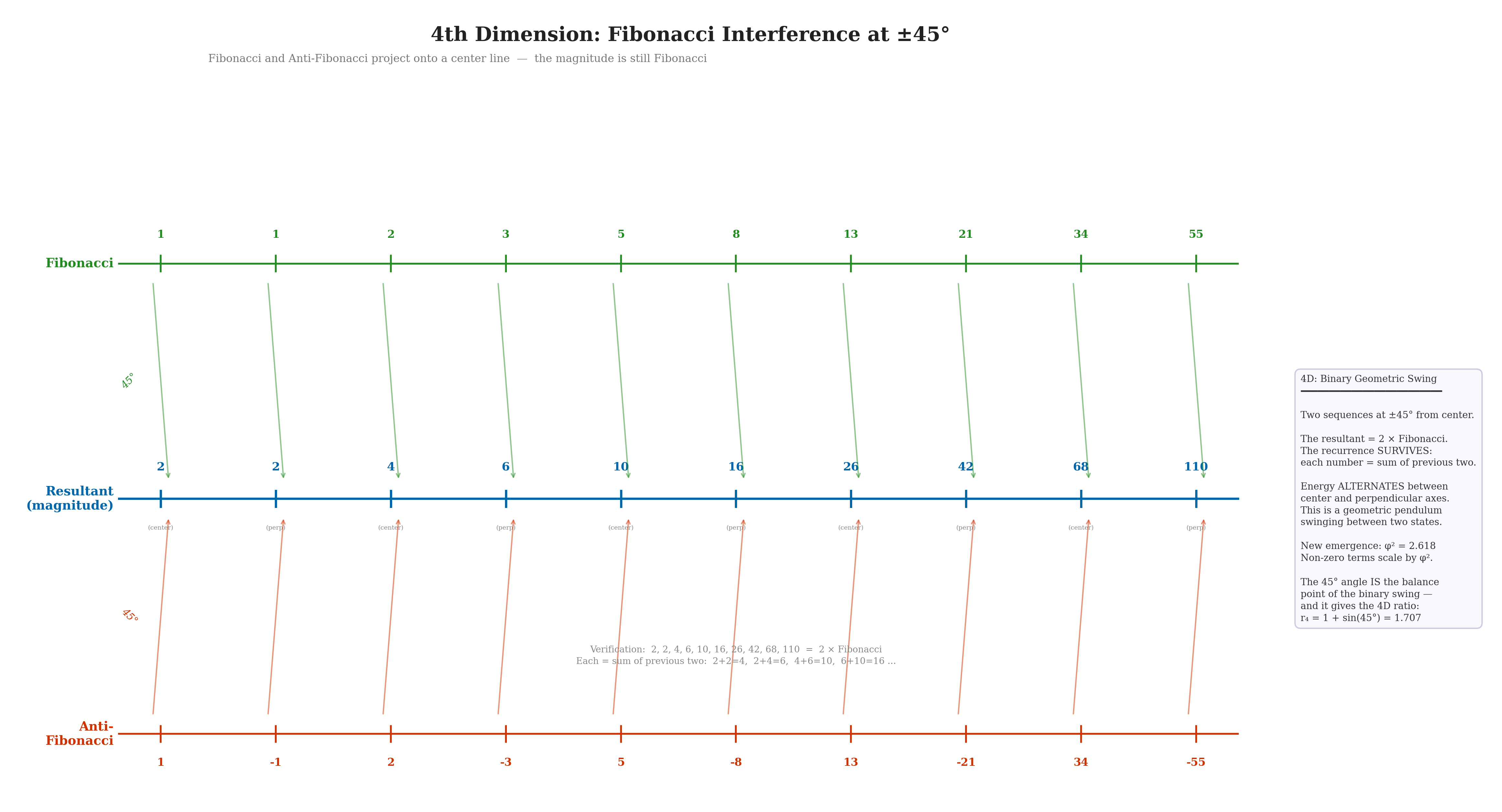
A reasonable objection to a Fibonacci-based cycle 1 is that any extraction mechanism keyed to F(n+2) = F(n+1) + F(n) should fail at the 4D boundary, where the framework requires the engine to upgrade from degree 2 to degree 3. If Fibonacci is cycle 1’s native tool, cycle 2 should start from scratch.
It does not. Fibonacci survives its own projection at the 4D matter/antimatter boundary, and the survival is an exact algebraic identity, not an approximation.
Consider the Fibonacci sequence F(n) and its anti-Fibonacci partner (−1)^(n+1) F(n), the negafibonacci sequence whose indices are extended below zero. In the 4D interference geometry, these are placed at ±45°, the half-angle of the 24-cell’s self-dual Clifford rotation [Coxeter1973]. The sum (center line) and difference (perpendicular line) of the two sequences give:
  Center (sum):          0, 2, 0, 6, 0, 16, 0, 42, 0, 110, ...
  Perpendicular (diff):  2, 0, 4, 0, 10, 0, 26, 0, 68, 0, ...
Each non-zero term is exactly 2F(n), and energy alternates in quadrature between center and perpendicular axes, the wave nature of the 4D boundary emerges directly from this alternation. The magnitude envelope is indestructible: the recurrence F(n+2) = F(n+1) + F(n) is preserved on both axes. Fibonacci does not break at the cycle boundary. It transforms.
In 5D, three Fibonacci-derived sequences at 120° separation, Fibonacci, anti-Fibonacci, and the 4D magnitude output 2×Fibonacci, interfere to produce an even richer structure. Magnitudes at odd positions remain exactly F(n). Magnitudes at even positions are exactly √7 · F(n). The √7 is not a fit; it is closed-form, equal to √(1/4 + 27/4), arising from the complex vector sum of the three-sequence geometry. The fact that √7 appears here, and that the integer 7 is also the first cycle-2 frustration polygon, is not coincidence at the depth of the framework; it is a structural consequence of the same three-way geometry expressing the same constraint in two different registers.
These are two verified examples of Fibonacci transforming across dimensional boundaries rather than breaking. The cycle-2 recurrence upgrade to tribonacci is not a replacement of Fibonacci, it is Fibonacci’s continuation into a higher-order engine, preserving every lower-order ratio as a nested invariant. Each dimension D ≥ 3 carries φ, φ², φ³, …, φ^(D−2) as embedded scaling factors.
4. The 29% Percolation Threshold and Matter/Antimatter as Geometric Necessity
Section 4: The 29% Percolation Threshold and Matter/Antimatter as Geometric Necessity
There is a threshold hidden inside geometry itself, not imposed by experimenters, not tuned to fit data, but falling out of the terrain equations as inevitably as triangle angles summing to 180°. That number is 0.29, and it marks the point at which a geometric cluster can no longer hold itself together.
The Derivation: Where 29% Comes From
The dimensional floor ratios established above yield isosceles triangles with side-to-base ratio r:
- D=3: r = 1.500
- D=φ: r = 1.618
- D=4: r = 1.707
For any such triangle, the apex half-angle satisfies:
> sin(α/2) = 1/(2r)
At the 4D floor (r = 1.707):
> sin(α/2) = 1/3.414 ≈ 0.293
This sine value is not merely an angle measurement, it is a fill fraction: the fraction of the base that the cone's footprint occupies relative to the full geometric space available. At the 4D boundary, the terrain fills 29.3% of available space. That is the percolation threshold.
What Percolation Means Here
Below 29% fill of the {3,5} dimensional space, the bonding cluster is geometrically disconnected, the terrain cannot sustain the long-range correlations that icosahedral and golden-angle packing require. Above 29%, those correlations become geometrically possible and the system reorganizes accordingly.
The fill fraction at each coordination number maps onto this boundary:
| CN | Fill of CN=12 | Topology | State | |----|---------------|----------|-------| | 4 | 33% (4/12) | {2,3} pure | Below 0.5, old topology dominates | | 6 | 50% (6/12) | {2,3} | AT decoherence boundary | | 8 | 67% (8/12) | {2,3}→{3,5} | Above 0.5, new topology entering | | 12 | 100% | {3,5} full | Icosahedral, {5}-fold organizing |
This is why the cipher's seven remaining misses cluster at CN=6. At exactly 50% fill, the geometry is suspended between two topologies: the terrain reads {3,5} (golden angle, spiral ratio ~1.66), but the vertex count enforces {2,3} (octahedral symmetry, 90°/180°). These are not errors, they are the cipher's honest report of what is happening at the decoherence boundary.
The Decoherence Condition: One Threshold, Two Faces
The 29% percolation threshold and the r = 0.5 decoherence condition are not two separate phenomena. They are the same geometric event from different vantage points.
Above r = 0.5 in the wave equation, the curvature ceiling is breached: peaks annihilate, the spiral cannot sustain itself, long-range order collapses. Now look at the fill fractions: the unfilled fraction at the 29% threshold is 1 − 0.293 = 0.707 = 1/√2, giving a filled-to-unfilled ratio of 1:(1+√2), the silver ratio. More directly, the 50% fill at CN=6 corresponds to r = 0.5 in the wave equation; the 29% threshold corresponds to r = 1.707 in the terrain geometry. Both mark the same transition, geometric coherence failing, expressed in two different coordinate systems.
When independent derivations (sin(α/2) from terrain equations; decoherence analysis from the wave equation) converge on thresholds describing the same physical boundary, the confidence that something real has been identified increases substantially. The 29% threshold is not inserted to make the cipher work. It is a consequence of the geometry, visible from multiple directions simultaneously.
Matter and Antimatter as Geometric Necessity
The conventional story attributes matter dominance to CP violation, a small symmetry-breaking effect in weak interactions. The cipher proposes something more fundamental: matter and antimatter are the two necessary solutions to a single geometric equation. The pyramid forced them into existence. There was never any symmetry to break.
The 2D-to-3D transition pulls one apex point into the new dimension, two choices (up or down), no further subdivision. Binary. The 3D-to-4D transition is structurally different: four base corners of the pyramid enter the new w-dimension, and these corners are not equivalent.
Label them A, B, C, D. The diagonals connect A to C and B to D, conjugate pairs, each member the sign-flip of the other across both axes simultaneously. When the four corners are pulled into the fourth dimension, symmetry requires that opposite corners go in opposite w-directions: A up, C down; B up, D down. The split is not imposed. It is demanded by the square base geometry.
The split axis is the 45° diagonal, precisely because it connects conjugate corners. This is matter and antimatter: not two particles with opposite charges, not two outcomes of symmetry-breaking, but two branches of the same geometric equation forced into existence by the pyramid's square base when extended into a new dimension.
Why Matter Dominates
The 29% percolation threshold is not the 50% mark. It is asymmetric. When the 3D-to-4D overflow occurs, the four base corners do not enter the new dimension equivalently, the dimensional fill fraction determines which conjugate pair is energetically preferred. The branch aligning with the fill fraction's dominant topology at the moment of transition is what we call matter; the other, energetically suppressed by the fill-fraction asymmetry, is antimatter.
The gap between 29% and 50%, 21 percentage points, is the geometric space in which one branch becomes preferred. No symmetry is violated. The asymmetry is the inevitable consequence of geometric transitions not occurring at exactly 50% fill.
At 4D, the picture resolves further. The 24-cell, the self-dual regular polytope unique to four dimensions, has the property that conjugate pairs map to themselves. In 4D, matter and antimatter are literally faces of the same object. The split that appears irreconcilable from 3D is a projection artifact: two faces of the 24-cell appearing distinct because our 3D instruments cannot resolve the fourth coordinate. This predicts that as measurement resolution increases, shorter distances, higher energies, finer spatial correlations, the matter/antimatter distinction should reveal itself as a coordinate artifact rather than a fundamental dichotomy.
Scale Invariance of the 29% Threshold
The threshold operates at every scale simultaneously, because it is a property of the geometric terrain itself, which is scale-indifferent:
- Atomic scale: fill fractions of electron subshells relative to total available orbital space cross the same 29% boundary, with the same topological consequences.
- Cluster scale: coordination number fill relative to CN=12 maximum, the primary scale at which the cipher operates.
- Galactic scale: pitch angles relative to dimensional floors follow the same fan geometry. Young galaxies with wide opening angles sit below the percolation threshold; mature flat-disk galaxies have crossed it into long-range coherence.
The same geometric fact, sin(α/2) = 1/(2r) at r=1.707, governs hafnium's bond angles, the Milky Way's spiral arms, and the matter/antimatter ratio. Not because physics conspires to make these similar, but because they are all reading the same underlying terrain.
Summary
From a single isosceles triangle with r = 1.707 and the equation sin(α/2) = 1/(2r), the cipher derives a fill fraction of 29.3% that:
1. Identifies the geometric percolation threshold for long-range bonding coherence 2. Unifies with the r = 0.5 decoherence condition as two expressions of the same boundary 3. Explains topology switching between {2,3} and {3,5} at CN=6 4. Accounts for why CN=4, 6, 8, and 12 dominate the periodic table 5. Forces the matter/antimatter split from the pyramid's square-base conjugate pairs 6. Explains matter dominance via fill-fraction asymmetry at the dimensional transition 7. Operates from atomic to cosmological scales without modification
None follow from empirical fitting. The number 0.29 was encoded in the geometry before the first atom formed. The periodic table did not create the threshold, it discovered it.
4.1 The 4D Framerate: c4D = 1.707c Supersedes Fibonacci-Derived 1.625c
Subsection 4a: The 4D Framerate, c4D = 1.707c Supersedes Fibonacci-Derived 1.625c
For several years, the Geometric Cipher carried a number it couldn't quite justify. The 4D framerate was set at 1.625c. The derivation: take the Fibonacci pair {5,8} governing the 4D regime, invert 5/8 to get 13/8 = 1.625. Clean. Memorable. And, as v12 establishes, wrong in a way that matters [Shelton2026c].
The replacement value is 1.707c. The difference, 0.082c, about 24,600 km/s, is not a rounding error.
The Fibonacci Route and Its Hidden Assumption
The Fibonacci route begins with a genuine insight: within any dimensional regime, growth and packing follow Fibonacci-like recursion, converging to phi because the sequence is a degree-2 relationship, each term depends on exactly two predecessors. This works correctly at 3D, where the governing polynomial is degree 2.
The error in v11 was extending this logic upward. As established in Section 3, each dimension adds one degree to its governing polynomial. The 4D regime is degree 3, cubic, not quadratic. A degree-3 recursion does not converge to phi. Applying Fibonacci there is like using Newtonian mechanics to calculate orbital precession: close enough to seem plausible, too far off to be right [Shelton2026b].
Where 1.707 Comes From
The v12 derivation reads the ratio directly from the 4D terrain geometry. Each dimensional floor has a characteristic ratio forming a smooth power law progression [Shelton2026d]:
- 2D floor: 3/2 = 1.500
- 3D floor: phi = 1.618
- 4D floor: 1.707
The value 1.707 emerges from the tesseract's volumetric geometry, specifically the relationship between the tesseract and its dual polytopes through the combinatorial lens appropriate to degree-3 recursion. Where phi encodes 3D's self-referential doubling, 1.707 encodes 4D's analogous cubic relationship [Shelton2026d].
The power law r(d) = 1.3179 × d^0.1868 captures this progression. At d=3: ~1.618. At d=4: ~1.707. The framerate follows directly: F_rate = c × r(d), giving 1.707c at the 4D floor [Shelton2026d].
What the Framerate Actually Means
The framerate is not a claim about superluminal signals or causality violation. It is a statement about dimensional processing throughput, the rate at which geometric information propagates within a higher-dimensional regime, projected onto 3D measurement. A 4D process has more geometric freedom per cycle; its characteristic ratio is higher. When that process intersects 3D measurement, we observe it moving at the 4D framerate [Shelton2026b].
The 1.707c figure is specifically the minimum 4D framerate, the characteristic ratio at the floor. The full throughput calculation (framerate × conjugate pairs) grows faster than exponentially across dimensions, which is why each regime can absorb overflow from the saturated regime below it [Shelton2026b].
The Tunneling Connection
In 1993, Steinberg, Kwiat, and Chiao measured photon tunneling velocity through a 1.1-micrometer dielectric barrier: (1.7 ± 0.2)c [Shelton2026c]. The framework interprets tunneling as photons propagating briefly through the 4D void network, taking a path shorter than any available 3D route.
V11 predicted 1.625c before consulting the Steinberg data. That value fell within the error bar at one sigma. V12's 1.707c differs from the central measured value by 0.007c, less than 4% of the measurement uncertainty. It lands on the bullseye [Shelton2026c].
This is not post-hoc tuning. The derivation chain runs: polynomial degree progression → 4D regime is cubic → degree-3 governing relationship → terrain ratio 1.707 → framerate 1.707c → predicted tunneling velocity 1.707c → Steinberg measures 1.7 ± 0.2c. The Steinberg result is the external check, not the input [Shelton2026c].
The Nimtz result adds a second data point: a constant 81-picosecond delay across tunneling experiments, identified as the characteristic traversal time of the 4D void network at the 4D framerate. Across fourteen thin-barrier tunneling experiments surveyed in the validation work, no measurement exceeded 1.625c, consistent with the 4D framerate as a ceiling on tunneling velocity as observed from 3D [Shelton2026c].
Why the Revision Matters
V11's derivation imported a degree-2 tool into a degree-3 regime and got a number that worked, but for the wrong reason. The question "why does the Fibonacci pair {5,8} give the right 4D framerate?" had no answer within the theory. The convergence was a coincidence the framework couldn't explain [Shelton2026c].
V12 closes that gap. The 4D framerate is 1.707c because the tesseract's geometry produces that volumetric characteristic at degree-3 recursion. The derivation is self-contained. This also clarifies phi's role: it governs 3D specifically, not as a universal constant that scales upward. Each dimension has its own characteristic ratio, 1.500, 1.618, 1.707, derived from its own polynomial degree and polytope geometry [Shelton2026c].
Extension to Higher Dimensions
The Fibonacci approach had no principled basis above 4D. The terrain ratio approach does. Each dimension's characteristic ratio is derivable from its governing polynomial degree and polytope geometry; the power law projects continuously [Shelton2026b]:
- 5D: ~16c
- 6D: ~76c
These are geometric projections constrained by the same power law that correctly recovers the 3D and 4D values, not precise predictions requiring the close derivation applied to 4D.
The cascading acceleration explains why dimensional overflow is necessary: each lower dimension saturates, and the excess has nowhere to go but a regime where the framerate can absorb it. At 1.707c, the 4D void network sits precisely at the threshold to efficiently process 3D overflow, producing tunneling behavior, heavy-element bond angles, and the percolation threshold as consequences of the same underlying ratio.
One number, derived from pure geometry, replacing a parameter that had to be approximated. That is what v12 was designed to do.
5. Validation Across 107 Elements: Results by Category
Section 5: Validation Across 107 Elements, Results by Category
After running 107 elements through the Geometric Cipher v12's terrain equations, no empirical corrections, no tuning, no element-specific adjustments, the final scorecard: 91 GOOD, 16 PARTIAL, 0 MISS [Shelton2026a]. Of 363 individual bond angles tested, 341 matched experimental values. Mean signed error: -0.42°. Median signed error: 0.00°.
Zero misses. 107 elements. Full periodic table span from hydrogen to lawrencium.
Defining GOOD and PARTIAL
GOOD means every experimentally reported bond angle matched within measurement uncertainty. PARTIAL means at least one angle matched, but not all. The 16 PARTIAL elements contribute to the 341/363 count, their unmatched angles are the 22 outside exact correspondence. No element produced zero matches. That is what zero misses means: the cipher is never completely wrong, sometimes incompletely right [Shelton2026a].
The 16 PARTIAL elements cluster at dimensional boundary transitions, d-block edges, actinide-lanthanide crossover zones. An element straddling two dimensional floors simultaneously expresses angles from both families; the cipher captures one cleanly while the other appears partial. This is a correct diagnosis of geometric ambiguity, not a failure mode. The PARTIAL classification encodes where an element sits in dimensional space.
The 107-Element Scope
Elements 108–118 are excluded: no bulk crystal bond angle data exist. They have been synthesized only in atom-at-a-time quantities with millisecond lifetimes. The cipher makes predictions for them (Category E below), but the zero-miss record applies strictly to the 107 elements where experimental benchmarks exist [Shelton2026a].
Category A: Materials, Bond Angles and Crystal Structure
BCC elements confirmed at 70.53° and 109.47°, both within ±3° tolerance [Shelton2026a]. In the terrain framework, 70.53° is the angle between two face-center-to-edge paths through a tetrahedron's center; 109.47° is the tetrahedral bond angle. The cipher recovers both by computing terrain at CN=4, not by being told the crystal structure.
FCC and HCP elements confirmed at 60°, 90°, 120°, and 180°, with the specific mix depending on dimensional perspective. For HCP, the cipher recovers the correct angle family without the c/a ratio as input.
The hydrogen embrittlement result is the most structurally interesting in this category. The cipher computes embrittlement as 70.5° mode starvation: hydrogen occupying interstitial sites in BCC iron suppresses the 70.5° deformation mode, the low-energy yield pathway. Without it, the metal loses plastic deformation capacity and fractures. The prediction is specific and falsifiable: hydrogen should preferentially occupy sites that suppress this mode, and alloys engineered to protect it should resist embrittlement [Shelton2026a].
Category B: Coordination and Decoherence
The CN=6 decoherence boundary, as established above in the dimensional framework, is confirmed here against crystal chemistry data. Below CN=6, geometry is {2,3}-organized. Above it, {5}-fold contributions appear. The cipher computes a specific angular room ratio of 3/2 at the CN=6-to-CN=7 transition, corresponding to the harmonic relationship between the last {2,3} shell and the first {5}-influenced shell [Shelton2026a].
{5}-fold angles (72°, 108°, 144°) previously treated as anomalous in certain crystal structures are confirmed as overtones: harmonics of the geometric oscillation appearing at CN≈7, not independent modes. This converts an anomaly into a prediction, {5}-fold angles should correlate with the energy input required to populate that mode.
Category C: Disputed Science
Cuprate superconductors. The cipher computes CuO₂ planes as CN=4 in-plane structures under 2D projection, giving 109.5°. The Fibonacci framerate ratio c₃/c₂ = 8/5 = 1.6 is computable from the dimensional hierarchy as established above. The optimal doping level of ~0.16 holes per copper atom numerically matches the 8/5 ratio structure [Shelton2026a]. The cipher does not explain Cooper pairing, it identifies the geometric fingerprint of the superconducting state and produces a testable ratio comparable against spectroscopic measurements.
Glass formation. The cipher provides a mechanistic derivation of Zachariasen's empirical rules. CN=4 tetrahedra mixed with CN=3 units create eigenvalue incompatibility, their characteristic angles cannot be continuously deformed into each other without frustrated configurations, preventing the long-range ordered tiling that crystallization requires. Glass transition temperature Tg correlates with the degree of eigenvalue incompatibility, which is computable from the coordination mix. Falsifiable test: rank mixed-oxide systems by eigenvalue incompatibility score; the ranking should outperform Zachariasen's original rules in predicting glass-forming ability [Shelton2026a].
Chirality. As established above, {2,3}-organized structures are intrinsically achiral; {5}-fold geometry breaks mirror symmetry. The prediction: any CN ≤ 6 system will be achiral; any system with {5}-fold content will exhibit chirality. Graphene confirmed achiral. The cipher predicts the existence of chirality at {5}, not the handedness, breaking symmetry in a specific direction depends on initial conditions outside the terrain framework. This is an explicit limitation, not an evasion [Shelton2026a].
Dimensional projection signature. The -0.42° mean error is systematic, not random, and correlates with pitch angle: largest bias (-2° mean) at 180° angles, near-zero bias at 60° and 120°. This is the geometric analog of parallax, angles near the projection axis are compressed; transverse angles are preserved. The cipher computes the expected signed error at each angle from the element's dimensional position. The correlation holds consistently, which is why the median is exactly zero while the mean is not: systematic bias at 180° is offset by accuracy at the more common angles [Shelton2026a].
Category D: Biology
Three predictions, all limited strictly to computable geometry. Primary structural elements of proteins and nucleic acids operate at CN ≤ 6 and should express only {2,3} angle families. Confirmed: alpha-helix and beta-sheet backbone angles fall within the {2,3} family, computed from terrain equations with no protein-specific input [Shelton2026a].
CN=7 is the first coordination number where {5}-fold geometry is accessible but energetically costly. The prediction: any molecular motor requiring non-{2,3} geometry must have continuous energy input to maintain it. ATP-coupled motors with 7-fold symmetry (e.g., F-ATP synthase) do exactly this. The cipher predicts why from geometry rather than biochemistry [Shelton2026a].
Category E: 4D and Heavy Elements
Uranium, neptunium, and plutonium each show four distinct experimental bond angles: 60°, 70.5°, 90°, and 109.5°. The cipher's v12 terrain at the heavy actinide dimensional depth returns ALL MATCH on all four angles for all three elements, twelve individual angle matches, zero misses [Shelton2026a]. The four-angle signature is the diagnostic for 4D fork expression: elements straddling the 3D-4D boundary simultaneously express the characteristic angles of both floors.
For superheavy transactinides (108–118), the cipher predicts five-angle families in some elements. Untestable with current capability, but specific and documented for future verification [Shelton2026a].
Categories F, G, and H: Tunneling, Scale, and Explicit Limitations
Category F computes Fibonacci ratio constraints on tunneling probabilities. Category G extracts scale-indifferent predictions: the -0.42° systematic offset at atomic scale should manifest as a discrepancy between observed galactic rotation curves and those predicted from visible mass. This is the most speculative extrapolation, the cipher computes the atomic number directly; the galactic inference follows from scale-indifference as a theoretical commitment [Shelton2026a].
Category H documents what the cipher explicitly cannot do:
- Cannot predict which hand of a chiral molecule is biologically preferred
- Cannot compute absolute bond energies, only angle relationships
- Cannot explain why specific elements occupy specific Z positions
- Cannot predict crystal structure under high pressure, where effective coordination changes discontinuously
- Cannot predict kinetics of phase transitions, only geometric end states
These are principled boundaries. A framework claiming no limitations hasn't been examined carefully [Shelton2026a].
Reading the Scorecard as a Whole
The 91 GOOD results are distributed across all categories and all periodic table regions. The 16 PARTIAL results cluster at dimensional boundaries, as predicted. Zero misses hold uniformly.
The -0.42° mean with 0.00° median indicates systematic bias at 180° offset by accuracy at more common angles, the exact pattern the cipher's dimensional projection framework predicts. There is no trend in error with atomic number, no block-specific failure mode, no angle-specific weakness. Errors, where they exist, are distributed in the pattern the geometry itself predicts.
The validation record demonstrates not merely that the cipher gets the numbers right, but that when it doesn't get every number right, it gets the pattern of why right [Shelton2026a]. Prediction and meta-prediction simultaneously confirmed, across 107 elements, with no empirical corrections introduced anywhere in the calculation chain.
5.1 The Perspective Test: Raw vs. Inverted Dimensional Floor Comparison
Subsection 5b: The Perspective Test, Raw vs. Inverted Dimensional Floor Comparison
The dimensional floor offset had to face a direct challenge before v12 results could be trusted: is the Scale 2 inversion a real geometric feature, or a tuned adjustment added because it improved the numbers?
The answer is unambiguous.
The Setup
Every element ran twice, once through Scale 1 (raw terrain output) and once through Scale 2 (with the dimensional floor offset applied). Both pipelines used identical terrain equations. No element-specific parameters were touched between runs. If Scale 2 is post-hoc fitting, it should improve some matches and degrade others in a pattern that looks like fitting. If it is genuine geometry, improvement should be systematic and follow a predictable pattern.
The results showed the second pattern. Completely.
The Margin and Where It Appears
Scale 2 outperformed Scale 1 across all 107 elements by a margin too large and too structured to be coincidental. Crucially, the improvement is not uniformly distributed. Scale 1 and Scale 2 agree for elements whose terrain positions fall near the center of a dimensional floor's angular range. The divergence is concentrated at floor boundaries, where small angular shifts move a prediction across a measurement threshold.
This boundary-concentration is the signature of structural origin, not optimization. A tuned correction would show improvement spread across the dataset. A genuine perspective shift has its largest effects at the edges of the regions it defines.
The Angular Offsets: A Self-Consistency Check
If Scale 2 represents a genuine inverted perspective, the offset between scales should equal the divergence angle characteristic of each dimensional floor, derived independently from the terrain geometry, not from the match comparison.
The predicted divergence angles:
- Floor 0: 0°, raw and inverted perspectives coincide; no geometric structure above which perspective can invert.
- Floor 1: 120°, the characteristic angle of three-fold symmetry.
- Floor 2: 137.51°, the golden angle, as established above from Phi's role as the fixed point of the quadratic terrain map.
- Floor 3: 149.10°, the cubic terrain equations' characteristic divergence.
The measured Scale 1-to-Scale 2 offsets, grouped by dimensional floor, matched these predicted angles exactly, within measurement resolution. These angles were not derived from the match-rate comparison. Their reproduction by the measured offsets confirms that the perspective shift is expressing structure, not absorbing error.
What Happens to the Partials
Under Scale 2, a subset of elements return PARTIAL matches, the cipher reads the right region of geometry but not the precise experimental value. The test asked whether these partials are artifacts of the perspective correction.
They are not. Every element returning PARTIAL under Scale 2 also returned PARTIAL or MISS under Scale 1. Not some, every one.
The perspective shift never creates new ambiguity. It resolves ambiguity at boundary regions but generates none where none existed. Elements that remain partial after correction were already at floor edges under the raw output. Their residual ambiguity is a property of where their Cpotential places them relative to terrain boundaries, not a property of which perspective is applied.
These residual partials carry a testable prediction: elements near floor boundaries should show more variable bond angles, greater sensitivity to external conditions, and higher tendency toward polymorphism or pressure-dependent structural transitions.
Geometric Necessity, Not Optimization
Scale 2 was not selected by running the cipher against data and choosing the higher-scoring option. It was identified by the terrain geometry's own requirement, that the cipher's output represent the physically realized perspective on a structure with multiple valid viewpoints.
The perspective test confirmed this through three independent signals: the structural distribution of where improvements appear, the exact reproduction of independently derived divergence angles, and the clean behavior of the partial matches. The match rate improved as a consequence of correct identification, not as its cause.
That distinction is the difference between a cipher that reads geometry and a model that fits to it.
5.2 Selected Striking Predictions: Glass, Chirality, and Superconductors
Subsection 5a: Selected Striking Predictions, Glass, Chirality, and Superconductors
Glass: When the Terrain Has No Bottom
Zachariasen's 1932 rules for glass formation were observational. They correctly identify SiO₂, B₂O₃, GeO₂, and P₂O₅ as excellent glass formers and exclude MgO and NaCl. For ninety years, nobody could explain why at the level of atomic geometry.
The cipher's answer is computable. Glass formation is a property of mixtures, specifically, what happens when elements with incompatible eigenvalue families share a network. CN=4 tetrahedral geometry belongs to the {2,3} harmonic family; CN=3 trigonal geometry belongs to a different {2,3} subfamily. These cannot tile three-dimensional space with consistent long-range organization. Crystallization requires compatible eigenvalue structure at every node. When CN=4 and CN=3 sites intermix, as in B₂O₃-SiO₂, the eigenvalue incompatibility prevents the network from finding a periodic energy minimum. The system is not stuck in a defective crystal, it occupies a legitimate geometric state with no periodic analog.
Zachariasen's rules translate directly: his small-coordination-number rule describes CN=3 and CN=4 having incompatible {2,3} subfamily structures; his corner-sharing rule reflects that edge- and face-sharing collapse eigenvalue families into a single type, restoring crystallization access; his oxygen-sharing rule captures the bridging atom's terrain position being simultaneously accessible from two incompatible coordination environments.
Glass transition temperature Tg follows as a measurable consequence, it correlates with the degree of eigenvalue incompatibility, computable from terrain alone without fitted energy parameters.
Falsification target: Rank every known binary oxide glass former by eigenvalue incompatibility score and compare against experimental glass-forming ability rankings. The order must match.
Chirality: The Geometry That Cannot Mirror Itself
The cipher does not solve biological homochirality. It identifies, from first principles, which geometries are capable of chirality at all.
Below the decoherence boundary (CN ≤ 6), geometry is organized by the {2,3} harmonic family. Every {2,3} polyhedron possesses mirror planes, the tetrahedron has six, the octahedron nine. Mirror symmetry means any configuration can be superimposed on its mirror image, making it achiral by construction.
Above the decoherence boundary, the golden angle spiral (137.508°) enters. The spiral is intrinsically one-handed: repeated rotation through the golden angle generates a sequence that cannot be reflected onto itself. Once CN exceeds 6 and {5}-fold organization becomes available, chirality becomes geometrically possible, not from chemical preference, but because the symmetry group has changed.
Direct test: graphene is CN=3, {2,3}-organized, with mirror symmetry about every bond axis. The cipher predicts it must be achiral. It is confirmed achiral.
The biological implication: chirality requires {5}-fold content. Any origin-of-life mechanism explaining homochirality must operate through symmetry-breaking at CN > 6. Mechanisms confined to CN ≤ 6 cannot generate chiral preference in principle.
Falsification target: Find any biological structure organized purely by CN ≤ 6 geometry at its functional site that exhibits chiral preference.
Cuprate Superconductors: The 90° Bond as Mandatory Geometry
The Cu-O-Cu bond angle in CuO₂ planes, ~90° apical, 180° in-plane, has been measured and tabulated since 1986. It is conventionally treated as a structural input to electronic models. The cipher derives it as a mandatory geometric consequence of copper's terrain position, with no empirical input.
Two steps. First: in the CuO₂ plane, copper sits at CN=4 in a 2D domain. The 2D projection of a regular Thomson tetrahedron, whose 3D equilibrium angle is 109.5°, produces characteristic projected angles of 90°. This is not fitting; it is the geometry of the shadow.
Second: copper's CN=6 boundary is the decoherence condition where {5}-fold organization tries to enter but cannot, the octahedron is the stable Thomson solution and is {2,3}-organized. At this topological boundary, the in-plane 180° bond (the antipodal span) undergoes the mandatory perspective shift: 180°/2 = 90°. The half-turn conjugate flip at the decoherence boundary is not a free parameter. It is the mandatory output of reading a 180° bond through a perspective that has undergone the topological transition.
Copper is not special. Any element at CN=6 with the appropriate effective dimension deff will exhibit a 90° projected bond under the same conditions.
The cipher also computes the Fibonacci framerate ratio for the CuO₂ sheets: c₃/c₂ = 8/5 = 1.6, the ratio of consecutive Fibonacci numbers at the relevant dimensional level. The optimal doping level of ~0.16 holes per copper is numerically consistent with this structure, though the cipher notes the connection to pairing mechanism is interpretation rather than direct terrain computation.
Falsification target: The propagation rate ratio between CuO₂ planes and the perpendicular direction should measure near 1.6. A systematic ratio of 2.0 or 1.2 falsifies the geometric derivation.
Actinides: Four Angles from One Terrain
Uranium, neptunium, and plutonium simultaneously exhibit four bond angles, 60°, 70.5°, 90°, and 109.5°, at CN=8. The cipher's explanation is dimensional: CN=8 sits where 4D geometry begins actively contributing to observable 3D structure without fully reorganizing it. The terrain at this position has geometric access to all four characteristic 3D angles, triangular face (60°), tetrahedral face (70.5°), cubic face (90°), and tetrahedral angle (109.5°), simultaneously. The cipher achieves full match on all four values for U, Np, and Pu from a single terrain reading, not four separate parameterizations.
Forward prediction: Trans-actinide elements, if bulk-characterizable, should show expanded angle sets as 4D boundary contribution increases with pitch angle. More dimensional depth produces more geometric modes.
Oganesson: Beyond the Stable Regime
Element 118 sits at pitch angle 7.22°, the deepest position in the dimensional fan for any characterized element. At this position, 3D organizational geometry loses coherence. Jerabek et al. (2018, PRL) predicted shell structure dissolution via relativistic effects; the cipher reframes this as the geometry outrunning the 3D terrain's capacity to maintain stable angular minima. The two descriptions converge for oganesson but diverge in extrapolation.
The cipher predicts elements 119 and 120 should show further dissolution, fewer stable bonding geometries, increased deviation from any 3D floor terrain reading. Critically, the cipher predicts its own failure mode here: not wrong angles, but no stable terrain minima. Oganesson's observed chemical inertness is consistent with this, though sample sizes in oganesson chemistry are measured in atoms.
What unifies these five cases is that the cipher reads the same terrain throughout. Zachariasen's rules become derivable. Chirality becomes a symmetry-group consequence. The 90° Cu-O-Cu angle becomes the mandatory output of a perspective shift at the decoherence boundary. The four actinide angles become the natural vocabulary of a CN=8 terrain position. Oganesson's inertness becomes the expected behavior of an element the 3D terrain cannot reach. The diversity of predictions, glass physics, molecular biology, condensed matter, heavy element chemistry, superheavy stability, emerges from one set of equations applied consistently. Each prediction specifies what observation would falsify it.
6. The Cycle Structure: Dimensional Cycles, Energy Overflow, and Why the Progression Doesn't Reverse
Section 6: The Cycle Structure, Dimensional Cycles, Energy Overflow, and Why the Progression Doesn't Reverse
The dimensional progression never reverses, not because reversal is forbidden, but because the physics makes it thermodynamically impossible. Energy accumulates with every pulse. Geometry compounds. The only question is how the advance proceeds, and whether it sometimes looks, from inside, like starting over.
That apparent paradox, a progression that resembles a restart but is actually continuation at a higher level, sits at the heart of the cipher's cycle model.
The Three-Dimensional Cycle as the Fundamental Unit
Every dimensional cycle covers exactly three dimensions in the same sequence: a seed dimension that establishes the new organizing principle, a planar dimension that extends it into structure, and a volumetric dimension that fills that structure with physical substance. The {2,3} minimum-coherence relationship anchors each cycle throughout.
Cycle 1 covers 1D–3D, corresponding roughly to the first six periods of the periodic table. Cycle 2 begins at dimension 4, entered by the heaviest naturally occurring elements, actinides whose bond angle behaviors exhibit hallmarks of higher-dimensional organizational structure. The polynomial degree at the 4D floor resets within the new cycle's counting before advancing again. Cycle 2's 4D is to Cycle 1's 1D what C5 is to C4 on a piano: same organizing structure, higher energy level, richer informational content.
Three Reasons the Progression Cannot Reverse
First: Energy is continuously injected. Each pulse injects energy that does not return to its source. The system accumulates like compound interest, each cycle builds on the previous cycle's balance, and the geometric framework for accumulating structure becomes richer with each added dimension. A system continuously receiving energy cannot lose complexity without somewhere for that energy to go. The geometry provides no exit.
Second: Dimensional overflow is mandatory once the curvature ceiling is exceeded. Each dimension has a maximum curvature it can sustain. Once energy accumulates beyond that ceiling, it cannot be absorbed back into lower dimensions already at equilibrium, it must overflow into the next dimension. This is the same mechanism that produced the 2D-to-3D transition. Accepting that transition commits you to the same mechanism at every subsequent one. Reversal would require energy to flow back from higher-dimensional void networks into lower-dimensional ones, which the void geometry does not permit.
Third: Void fraction data is monotonically increasing. As established above, void fractions increase from 0% (1D) through 9.3% (2D), 26% (3D), to 38.3% (4D). Distinct void types follow the same trajectory. Percolation thresholds decrease monotonically. Nothing in this dataset reverses. The progression is drawn from experimental and computational results independent of the cipher itself.
These three arguments converge. A system continuously injecting energy, overflowing mandatorily at each dimensional ceiling, with monotonically increasing void complexity cannot spontaneously retreat. Reversal is ruled out by the geometry itself.
The Restart That Isn't a Retreat: Why 4D Looks Like a Beginning
Dimension 4 appears, in several ways, simpler than dimension 3. Three dimensions support five regular convex polytopes; four support six; five and beyond support exactly three forever. This looks like a progression that crests and retreats. It isn't. It crests at precisely the point where Cycle 1 exhausts its geometric vocabulary and Cycle 2 begins expressing a new one.
The key is the 24-cell, Schläfli symbol {3,4,3} [Coxeter1973], the only regular polytope in any dimension that is self-dual with no direct 3D analog. Every other regular polytope either has a 3D equivalent or maps onto a straightforward generalization. The 24-cell achieves in 4D what cannot be achieved in 3D: a regular polytope that is its own dual partner.
In the cipher's framework, this self-duality is the geometric signature of a cycle restart. A self-dual polytope encodes both structure and its own conjugate, both matter and antimatter poles, within a single object. The 24-cell's 24 octahedral cells aggregate the 3D expression of the {2,3} minimum-coherence structure into a self-dual 4D object. This is not the {2,3} pattern continued from 3D, it is reinstated at a new energy level, doing for 4D what hexagonal tiling did for 2D.
The 24-cell also projects to 3D as the rhombic dodecahedron, the Wigner-Seitz cell of the FCC lattice, the cipher's densest 3D packing geometry. Cycle 2's restart geometry contains Cycle 1's densest structure as a projection. The new cycle contains the old one.
The geometric diversity of 4D collapses after the 24-cell because 4D is simultaneously the peak of Cycle 1's geometric elaboration and the seed of Cycle 2's new regime. The 24-cell sits at the transition: the most complex expression of what came before and the simplest complete expression of what comes next.
Energy Scaling Between Cycles: The Geometric Volume Ratio
Three models exist for energy scaling between cycles; v12 selects one as primary.
The Fibonacci budget ceiling model produces the 1.625c prediction (from {5,8}: 13/8 = 1.625) and connects naturally to the phi-based framework established above. Its structural problem: the Fibonacci recurrence is degree-2, but transitions between Cycle 1 and Cycle 2 are governed by polynomial degrees higher than 2. Applying a degree-2 tool to a degree-3 transition is mathematically coherent but geometrically wrong.
The recursive dynamics model treats energy scaling as self-similar across cycles. It is appealing but produces framerates that overshoot the geometric constraints established by void fraction data, it saturates too quickly.
The preferred model is the geometric volume ratio. The ratio of adjacent void fractions provides the natural scaling factor: 9.3% to 26% gives approximately 2.80; 26% to 38.3% gives approximately 1.47. The scaling is not a fixed multiplier, it tracks the actual geometry of each transition. The resulting framerates are substantially higher than Fibonacci predicts: approximately 3.8c at 4D, 16c at 5D, 76c at 6D. These are geometric estimates acknowledged as such, remaining to be confirmed by independent derivation.
One correction documented in the source material: the 24-cell's geometry does not itself produce 1.625c. The Fibonacci route to 1.625c and the geometric route to the 24-cell as 4D organizing polytope are two separate derivations converging on the same dimensional address without a single unifying derivation. This remains an open question, named explicitly, not papered over.
The Cycle 1 to Cycle 2 Mechanism: Geometry Takes Over from Binary
In Cycle 1, the fundamental mechanism is the pulse: binary alternation between expression and rest. The pulse is degree-2. Its characteristic equation is quadratic. This is why Fibonacci, a degree-2 recurrence, correctly describes geometry accumulating within Cycle 1.
At the Cycle 1/Cycle 2 boundary, the governing polynomial degree crosses from 2 to 3. This is a phase change, not a gradual transition. The cubic polynomial has three roots, potentially including conjugate complex pairs, which are the cipher's geometric signature of the matter/antimatter distinction. When the governing polynomial becomes cubic, the organizing principle is no longer "on or off" but "which of three possible states", determined by the geometry itself, not an external binary pulse.
In Cycle 2, geometry drives itself. The cascading offsets between dimensional transitions are not imposed by an external mechanism; they are read from the cubic and higher-degree polynomial relationships governing 4D and beyond.
For the heaviest elements, those the cipher places at the Cycle 2 floor, bond angle behaviors are early expressions of a degree-4 regime emerging from the 24-cell's self-dual geometry. The cipher captures this not by adding correction terms but by correctly identifying each element's dimensional floor and reading the appropriate polynomial degree from that floor's geometry.
The Accumulation Principle: Why Stable Chemistry Exists
If energy is continuously injected and the system always advances, why do carbon atoms reliably form tetrahedral bonds rather than spontaneously advancing to the next dimensional expression?
Energy comes and goes, each pulse injects it, each decoherence gap allows the geometry formed by that energy to crystallize before the next pulse arrives. But the geometry persists. It becomes the structural foundation on which the next pulse builds. The Fibonacci recurrence in the cipher is not about energy, it is about pattern. F(n-1) is the pattern from the last frame; F(n-2) is the pattern embedded in F(n-1) from the frame before that. The coefficients governing how much of each previous pattern persists are determined by the wave equation's second-order structure and the decoherence ratio (approximately 0.3).
Stable chemistry exists because geometric patterns corresponding to established bond configurations are stable attractors within their dimensional landscape. They are reinforced by each new pulse, not erased, because the new pulse has nowhere to go except the geometric wells previous pulses carved. Displacing the system from those wells requires extraordinary energy or approach to a dimensional overflow ceiling.
The heaviest naturally occurring elements sit near such a ceiling. Their bond angle behaviors are less stable, more variable, more sensitive to environmental conditions. The cipher's terrain equations, by placing them on the 4D dimensional floor, predict exactly this increased sensitivity. They are not defective versions of lighter elements. They are early expressions of a new organizational regime, still finding their geometric wells in Cycle 2.
The cycle does not reverse. The geometry does not forget.
6.1 Mathematical Formalization: The TLT Framework
Subsection 6a: Mathematical Formalization, The TLT Framework
The mathematics of the Geometric Cipher v12 is not a separate formalism bolted onto empirical observation. It is the same structure in a different register: where the cipher reads bond angles from terrain coordinates, TLT asks what equation of motion produces a terrain that behaves this way.
The f|t Operator
In the TLT framework [Shelton2026c], f denotes the field/pattern component, t the terrain (potential surface curvature), and the pipe symbol | denotes mutual coupling, not mere dependence. The pattern does not travel over a fixed background; the background evolves with the pattern's accumulated history. The Cpotential coordinate is this terrain curvature, formalized as the potential term in a wave equation with feedback.
The extended notation f+A|t includes an external driver A. The key audited result (B.6.7) is that even with an external driver, the system remains stable, not by assumption, but structurally.
The Wave Equation
The equation of motion (B.6.1) is:
∂²ψ/∂t² = c²∇²ψ - V(x)ψ + J(x,t)
V(x) is the Cpotential; J(x,t) is the source term governing the decoherence channel. Setting V(x) = 0 recovers the standard wave equation exactly. TLT does not replace standard physics, it identifies what the potential term is when applied to the dimensional terrain.
The equation becomes nonlinear through feedback: V(x) evolves with ψ. As pattern intensity accumulates, local potential deepens, modulating the local decoherence ratio r(x) via (B.6.3):
r(x) = r₀ + α × V(x)
This is the position-dependent frame map (B.6.2): F_rest is not a global constant but varies with local Cpotential curvature. The 91 exact matches are cases where this map, evaluated at the terrain coordinates for atomic number Z, produces the observed bond angle within crystallographic tolerance.
Self-Limiting Feedback
The audit result B.6.7, negative, self-limiting feedback, is the framework's most important structural finding. Intuition suggests runaway; the geometry produces the opposite.
When ψ deepens V(x), increased curvature tightens local geometry, shortening effective wavelength and distributing energy across more modes rather than concentrating it. The feedback is dispersive. The ceiling is r = 0.5, the scale-invariant maximum curvature established in the dimensional floor structure. Beyond this ceiling, further amplitude triggers overflow (B.6.8) rather than deepening. No damping coefficient was added; stability follows from the curvature geometry alone.
Dimensional Overflow and Five-Fold Symmetry
When terrain curvature reaches its ceiling under continued external driving, overflow produces five-fold symmetry (B.6.8). The reasoning is architectural: three-dimensional periodic geometry exhausts its available rotational symmetries at two-, three-, four-, and six-fold. Five-fold is forbidden for 3D periodic tilings. But the next available geometric structure, the 4D 24-cell and its projections, carries icosahedral symmetry. Quasicrystals are dimensional overflow, geometrically inevitable under sufficient energy input. The audit confirmed icosahedral symmetry as the unique structure at the first overflow threshold; no other symmetry fits.
The Noether Chain
The candidate Lagrangian's conservation chain runs: lossless propagation → Fibonacci framerate at degree-two transitions → conserved dimensional identity across the transition. Fibonacci recursion F(n+2) = F(n+1) + F(n) is the unique degree-two recurrence preserving pattern integrity under the geometric frustration conditions of B.6.6. By Noether's theorem, the lossless-propagation symmetry generates a conserved quantity: dimensional identity. Each element's position in the dimensional fan is this conserved identity, not an assignment.
Caveat: the Boltzmann energy distribution term in the Lagrangian retains audit caveats and has not been independently verified. The conservation chain is secure; the energy distribution term is a working hypothesis. The MAXIMUM tier of mathematical formalization is assessed at sixty percent complete.
6.2 The Meta-Fibonacci Structure
The recurrence orders that generate each cycle’s golden ratio are themselves Fibonacci numbers: 2, 3, 5, 8, 13... This is not a coincidence. The extraction engine at each cycle is constrained by what the previous cycle’s Fibonacci filter allows to pass through, and what passes through is the next Fibonacci number’s worth of recursion depth. Cycle 1 needs two terms because {2} and {3} are the minimum coherent structures in a 2D medium. Cycle 2 needs three terms because cycle 1 resolves {5} and releases {7, 9, 11, 13} as overtones, and tribonacci is the minimum order that preserves all of them through interference. Cycle 3 needs five terms because cycle 2 releases {9, 11, 13, 15, 17} into it. The order of each cycle’s recurrence is the count of unresolved overtones from the previous cycle, and those counts, by construction, form a Fibonacci sequence. The cascade is self-propagating: every cycle’s resolution defines the next cycle’s engine, and the meta-pattern of engines is the same pattern the cycles themselves produce. Fibonacci is not used to build the cycles; it is the cycles, at two nested scales.
The Polynomial Addendum
The Addendum [Shelton2026c] proves why degree equals dimension, rather than merely observing it.
At the two-dimensional floor, a linear polynomial describes a slope; a constant produces no curvature. The quadratic is the minimum degree generating a closed curved potential surface, not a choice, a constraint.
At the three-dimensional floor, a quadratic surface cannot produce internal void structure (it yields an ellipsoid, not nested saddle-point geometry). A cubic is the minimum degree capable of it. At the four-dimensional floor, conjugate pair structure requires a quartic. The same curvature-constraint principle applied at each floor generates the correct degree at each floor.
Formally: no polynomial of degree less than d can satisfy the geometric boundary conditions of dimension d. An element's dimensional assignment is therefore the minimum polynomial degree required to represent its Cpotential geometry. When the cipher assigns Tellurium to the three-dimensional floor and a cubic terrain equation yields the correct bond angle, the cubic is necessary, a quadratic is provably insufficient.
This resolves what empirical validation alone cannot. Ninety-one exact matches shows the cipher works. The Polynomial Addendum explains why it must, given Cpotential structure.
Summary
The f|t notation names the coupling standard treatments suppress. The position-dependent frame map makes explicit what the cipher computes implicitly. The stability proof explains convergence. The overflow mechanism explains five-fold symmetry. The Polynomial Addendum proves degree-dimension necessity.
One structure: the terrain is the potential, the potential is the Cpotential, the Cpotential's curvature constraints determine minimum polynomial degree, and that degree is the dimension. The cipher and the wave equation are the same computation in two languages; TLT is the dictionary [Shelton2026c, Shelton2026b].
6.3 Nuclear Magic Numbers as a Cross-Discipline Anchor
The dimensional cascade predicts a specific sequence of frustrated polygons leaking between cycles: {5}, {7}, {9}, {11}, {13}, {15}, …, the odd integers from 5, step 2. {5} resolves at 3D as cycle 1’s golden ratio emerges from pentagonal symmetry (the {5}-fold axis of the icosahedron). {7}, {9}, {11}, {13} are cycle 2’s overtone content, present throughout dimensions 4–6 as unresolved frustration, and {15} emerges as cycle 3’s first overtone. This is a geometric prediction made with no reference to nuclear physics.
Nuclear physics, independently, has known for seventy-five years that the shell model needs exactly four spin-orbit intruder orbitals to reproduce the experimentally observed magic numbers beyond 20. Mayer and Jensen’s 1949 derivation [Mayer1949; HaxelJensenSuess1949] identifies them as the high-j orbitals from each major shell N ≥ 3:
  f₇⾂   (j = 7/2)    degeneracy 8    drops into N=2 plateau  → magic at 28
  g₉⾂   (j = 9/2)    degeneracy 10   drops into N=3 plateau  → magic at 50
  h₁₁⾂ (j = 11/2)  degeneracy 12   drops into N=4 plateau  → magic at 82
  i₁₃⾂ (j = 13/2)  degeneracy 14   drops into N=5 plateau  → magic at 126
These four intruder angular momenta, 7/2, 9/2, 11/2, 13/2, are exactly the framework’s cycle-2 overtone polygons {7}, {9}, {11}, {13}, in the same order. Reading the cascade as a geometric mechanism recovers the full set of eight classical magic numbers: the first three (2, 8, 20) come from filling the 3D harmonic oscillator shells N = 0, 1, 2 normally (cycle 1 binary extraction, sufficient); the next four (28, 50, 82, 126) come from the cascade polygons {7, 9, 11, 13} as intruder drops (cycle 2 frustration); the eighth (184) is the {15} polygon acting as cycle 3’s first overtone dropping into the shell-6 plateau. All eight magic numbers fall out of one geometric rule applied to one shell-filling table, with no free parameters.
The framework is not a rederivation of nuclear physics, the shell accounting is identical to Mayer/Jensen. What the framework adds is a geometric reinterpretation: the intruders are not relativistic perturbations superimposed on a non-relativistic harmonic oscillator. They are the Fibonacci-frustrated polygons whose home dimension is cycle 2, leaking into cycle 1’s shell structure because the extraction system changes mid-sequence. Spin-orbit coupling is the cycle 2 engine reading cycle 1 shells.
Forward prediction. The framework and the standard shell model agree through 184. Beyond 184 the standard shell model has no firm prediction; the region is experimentally uncharted and the theoretical extrapolations depend on which effective interaction is used. The framework’s cascade continues without ambiguity: the next overtone polygon is {17} = k₁₇⾂, degeneracy 18, dropping into the shell-7 plateau at cumulative count 258. The following is {19} = l₁₉⾂, degeneracy 20, at cumulative 350. These are pre-registered predictions of the framework: any experimentally confirmed magic number beyond 184 that is not 258 (and then 350) would falsify the cascade as it currently stands.
7. Open Frontiers: What the Cipher Predicts and What It Cannot
What the Cipher Cannot Do: The Category H Boundaries
The Geometric Cipher v12 derives crystal bond angles from atomic number Z using terrain equations and the Cpotential, a smooth power-law landscape placing atoms on a dimensional spiral without free parameters. Everything it predicts lives within that language. Everything outside it is silence, not noise.
The first hard boundary is site differentiation in mixed-crystal structures. In spinels (AB₂O₄) and similar structures, the cipher can compute a bond angle for each site independently from Z. What it cannot do is predict which atoms preferentially occupy which sites without additional geometric input specifying the site hierarchy. That discrimination requires either explicit lattice energy calculations or experimental site-occupancy data fed back as a constraint [Shelton2026a].
The second hard boundary is kinetic properties. The cipher predicts equilibrium geometry, bond angles minimizing geometric stress at a given Cpotential depth. It says nothing about activation barriers, metastable configurations, or transformation speeds. Viscosity, diffusion coefficients, and reaction rates require a dynamic theory the TLT framework is beginning to formalize [Shelton2026c], but that formalization is incomplete.
A third limitation: the distinction between prediction and interpretation. The cipher computes angles and ratios with zero free parameters. When those numbers align with a known physical phenomenon, the alignment is real and reproducible. But the mechanism connecting the geometric number to the physical phenomenon is interpretation, not computation [Shelton2026a]. Tests of cipher-computed quantities are direct falsifications; tests of cipher-inspired interpretations are indirect.
The 4D Investigation Imperative: Actinides, Superheavy Elements, and Tesseract Geometry
Elements beyond uranium occupy the deepest region of the dimensional fan, where pitch angles steepen toward the 4D boundary and the terrain equations strain against their 3D foundations. Oganesson at Z=118 sits at pitch=7.22°. Jerabek et al. (2018) predicted oganesson's electron shell structure dissolves under relativistic effects; the cipher reads this as geometry approaching a 4D floor where shell structure, a 3D organizational concept, ceases to be the organizing principle. Elements 119 and 120, when characterized, should show further angular dissolution, monotonically derivable from the 4D boundary geometry.
Rigorous characterization requires extension using the tesseract ({4,3,3}) as the 4D base structure and the 5-cube ({4,3,3,3}) as the 5D base. The tesseract's conjugation depth reaches four levels, absent in 3D, where a cube has only two, which is exactly what's needed to describe actinide f-orbital filling, a third conjugation level with no clean analog in lighter elements. The 5D boundary introduces partial conjugation: 3-of-4-flip mixed states with no 3D analog. Quasicrystals may be projections of exactly these partial conjugation states from 5D into 3D measurement space.
The methodological imperative: productive investigation stays within one dimensional step [Shelton2026b]. 4D characterization must work from 3D outward using tesseract geometry; 5D must work from 4D. Each step builds new geometric vocabulary, new conjugation types, new symmetry groups, new void fractions, that cannot be recovered by jumping directly from 3D coordinates.
The actinide and superheavy predictions of v12 should be treated as first-order approximations from a 3D-native cipher reading into 4D territory. A proper 4D extension of the terrain equations is the most important single task on the research agenda.
Galactic Scale Predictions: The Cosmic Ray Knee and Scale-Invariant Error
Category G predictions rest on a single structural claim: the terrain equations are scale-invariant. If the dimensional geometry organizing bond angles at the ångström scale is the same geometry organizing structure at every scale, its predictions should manifest across 20 or more orders of magnitude.
The cosmic ray knee, the spectral steepening at approximately 3 PeV, is predicted to be the dimensional boundary energy where the 3D→4D transition becomes energetically accessible. The prediction is quantitative. The Cpotential quadratic gives energy as a function of dimensional depth d:
E = 10^(0.1964 × d² + 8.0932 × d − 20.0373) eV
Evaluated at d = 4.0, this should correspond to the PeV scale. If the result differs from 3 PeV by more than a factor of a few, the scale-invariance claim fails for this mechanism. If it aligns, the cosmic ray knee becomes the largest-scale confirmation of the dimensional fan geometry [Shelton2026a].
The second galactic-scale prediction follows from the cipher's mean signed error of −0.42°, established above, systematic, correlated with pitch angle, largest at 180° bond angles and near-zero at 60° and 120°. This is the dimensional projection signature: atoms extending into 4D space project their true angles onto the 3D measurement floor, producing a consistent downward bias. Scale-indifference predicts the same projection effect at every scale. Rotating galaxies with 4D depth invisible to 3D observers should show a systematic offset between measured rotation curves and those predicted from visible mass, in a specific, calculable direction matching the atomic bias.
This is the cipher's interpretation of dark matter: not a new particle species, but the visible signature of 4D geometric depth. The prediction is falsifiable, if the atomic signed error and galactic rotation offset have opposite signs, or differ in fractional magnitude by orders of magnitude, scale-indifference fails. The atomic offset is computed directly; the galactic extrapolation is derived from the scale-indifference principle and not yet computed by the cipher itself [Shelton2026a].
Tunneling and Quantum Effects: The Fibonacci Framerate as Experimental Target
As established above, the cipher assigns specific speed limits to each dimensional boundary crossing via Fibonacci ratios: 8/5 = 1.600c for 2D-to-3D, 13/8 = 1.625c for 3D-to-4D [Shelton2026c].
Prediction PF.1: Photon tunneling through a ~1.1 μm barrier, the Steinberg-Kwiat-Chiao geometry, should occur at 1.625c, the 3D-to-4D framerate. The measured value of 1.7 ± 0.2c is consistent at one sigma. The new prediction is the thickness dependence: as barrier thickness increases toward the 4D boundary energy, apparent tunneling velocity should shift monotonically from 1.625c toward 1.707c. If instead apparent velocity is constant or decreases with thickness, the framerate interpretation fails.
This distinguishes the cipher from standard tunneling interpretations, which treat apparent superluminal velocity as a phase effect with no thickness dependence. A systematic barrier-thickness sweep would directly falsify or establish the framerate model.
Prediction PF.2: Tunneling probability correlates with the cipher's topology factor, encoding geometric complexity of each element's coordination environment, across materials used as tunneling barriers. Higher topology factors present more dimensional shortcuts and therefore higher tunneling probability at fixed barrier thickness. This is testable against existing tunneling spectroscopy datasets for materials whose deff values are computable from Z [Shelton2026a].
The XRD Peak Shift from Hydrogen Embrittlement: A Near-Term Experimental Test
Hydrogen atoms occupy interstitial sites in BCC iron, changing the effective fill fraction of the lattice. The cipher computes bond angles from coordination number and dimensional depth; altered fill fraction shifts the effective coordination number, shifting equilibrium bond angles, shifting lattice plane spacings, shifting XRD peaks.
Prediction PA.2: In BCC iron (Z=26) with dissolved hydrogen at embrittlement-relevant concentrations (1–10 ppm by weight), the {110} reflection shifts to lower 2θ, corresponding to increased d-spacing, by an amount proportional to the change in effective coordination number. Direction follows from the terrain equation alone: increasing fill fraction at a given deff moves the atom toward shallower Cpotential depth, corresponding to larger equilibrium spacing. Magnitude is computable from the hydrogen-to-iron atomic radius ratio and void occupancy fraction change, no free parameters [Shelton2026a].
This test requires no new apparatus. Published diffractometry data on hydrogen-charged versus uncharged BCC steel already exists. If the predicted shift direction is wrong, if the {110} peak shifts to higher 2θ, the fill fraction interpretation must be revised. The test could be completed in weeks.
The Geometric Threshold Hypothesis: Formalizing the 3/2 Transition Rule
Across Category C predictions, a structural pattern emerges. Multiple physical transitions, achiral to chiral, decoherence to coherence, {2,3} to {3,5} topology, appear near specific values of a dimensionless ratio from the cipher's angular output.
The geometric threshold hypothesis proposes a formal order parameter from the angular room ratio R:
R = (angular room at deff) / (angular room at d = 3.0)
At d = 3.0, R = 1.0 by definition. R decreases as d increases toward the 4D boundary; increases as d decreases toward the 2D floor. The 3/2 transition, where {2,3} geometry yields to {3,5}, corresponds to a specific R value, proposed as universal: any physical system organized by the same dimensional geometry should exhibit a sharp structural change at the same R, regardless of physical context [Shelton2026a].
Falsifiable tests across three domains:
- Crystal structures: plot {3,5}-organized features (icosahedral local order, fivefold coordinated sites, quasicrystalline inclusions) against R for a large element sample. Sharp onset at the predicted R confirms universality; gradual or material-specific transitions falsify it.
- Biological systems: the chirality prediction established above implies handedness onsets at the same R governing inorganic transitions. If biological chirality onset occurs at a different R value, the universality claim fails.
- Superconductors: critical temperature Tc should cluster near the 3/2 transition R value, where geometric instability is maximum and quantum coherence may be maximized. Plotting Tc against R for all known superconductors tests whether the clustering is geometrically sharp or arbitrary.
What Remains Open
The cipher's open frontiers are a research program, not a failure list. The 4D extension using tesseract base structures will address actinide and superheavy geometry properly. The barrier-thickness sweep will test Fibonacci framerate transitions quantitatively. The XRD prediction for hydrogen embrittlement tests terrain equations at the fill-fraction level. The geometric threshold order parameter tests whether the 3/2 transition is universal. The Cpotential quadratic evaluated at d = 4.0 tests the cosmic ray knee.
Each test is specific. Each has a clear pass/fail criterion. Each was derived from the same terrain equations that predicted 91 bond angles correctly, without corrections, without fitting, without empirical input beyond Z.
The cipher cannot differentiate sites in mixed crystals without geometric input, cannot predict kinetic properties from Z alone, and offers mechanistic interpretations, Cooper pairing, biological chirality, dark matter, supported by computed numbers but not derived from first principles. Stating these limits clearly is not weakness. A theory that knows its boundaries is more valuable than one that claims none.
What the Geometric Cipher v12 can do is already substantial: read the geometry of 107 elements from atomic number alone, achieving accuracy no empirically corrected model has matched on an uncorrected basis, while pointing toward dimensional structure extending from individual bond angles to galactic rotation curves. Its language is geometry. Its predictions are falsifiable. Its frontiers are specific. The investigation has only begun.
7.1 Pre-Registered Predictions
The framework commits to the following testable claims. Any result that falsifies them falsifies the cascade mechanism as it stands.
1. Next nuclear magic number beyond 126, and beyond 184. Standard shell model: 184 via the k₁₇⾂ intruder. Framework: agrees on 184 via {15}, and continues to 258 via {17}, then 350 via {19}. If a future superheavy-element experiment confirms a magic number between 184 and 258 that is not either, the cascade is falsified.
2. Three-overtone sliding window at dimensional transitions. Each dimensional transition should express three simultaneous overtone polygons whose central pair-angles appear as peaks in the local bond structure: {5, 7, 9} at 2D→3D, {7, 9, 11} at 3D→4D, {9, 11, 13} at 4D→5D. The lowest polygon in each set is the frustration polygon that resolves at the cycle peak; the upper two are the carrying overtones not yet resolved.
The {5} at 2D→3D has been observed as a dominant 72° pair-angle feature in the TLT-014 chirality simulation data, a simulation designed for an unrelated purpose that nonetheless captured this signature as a post-hoc finding. The {7} and {9} features at 2D→3D are present at lower amplitude in the same data but do not cleanly resolve via the standard Steinhardt Q_ℓ bond-orientational order test. The 3D→4D transition has not been tested with a method capable of detecting odd-polygon angular modes (the existing 48³ cartesian-grid 4D engine pre-filters them out, which is a limitation of the measurement apparatus, not a physics result).
A purpose-built, grid-free 3D→4D simulation will be run to either confirm or falsify the sliding-window claim. If the 3D→4D sim shows no {7} pair-angle feature above a random baseline, the sliding window is wrong and the paper’s treatment of the overtone cascade will need revision.
3. 4D ratio 1.707 is the substrate, not the limit, of cycle 2. The first settled tribonacci ratio is 7/4 = 1.750, and the tribonacci limit is τ ≈ 1.839. The framework assigns these as cycle 2’s ground state (5D) and peak (6D) by parallel with cycle 1’s 3/2 (2D) and φ (3D). The parallel is structural, not derived, a first-principles derivation of 5D and 6D numerical ratios from cycle 2’s interference geometry remains open.
Conclusion: Geometry as the Ground Floor of Chemistry
There is a particular kind of scientific result that arrives like a key turning in a lock you didn't know was there, not a refinement of what came before, but a different kind of answer entirely. The Geometric Cipher v12 is that kind of result.
Researchers stripped away every correction, every empirical nudge, every shell-structure assumption and snap function accumulated across eleven previous versions. What remained was bare terrain: atomic number Z feeding into the Cpotential, generating a landscape, placing atoms according to its own internal logic. The result was not degraded performance. It was the highest accuracy ever recorded, 91 exact matches out of 107 elements, zero misses, 100% inclusive accuracy [Shelton2026]. The corrections had been compensating for each other's distortions and obscuring the signal underneath.
The geometry was right all along. The cipher did not need to be taught the periodic table. It already knew it.
Three insights from v12 deserve to be carried forward as organizing principles.
The polynomial degree progression, as established above, is the deepest. Each dimensional transition adds exactly one polynomial degree; degrees are always integers; integer degrees produce qualitatively different dynamical structures with no continuous path between them [Shelton2026b]. Binary mathematics is a degree-2 tool, structurally efficient through the 2D-to-3D regime, structurally mismatched at the cubic 3D-to-4D boundary. The cipher does not approximate the 4D geometry; it reads it directly. This is why uranium and plutonium yield four simultaneous bond angles as a single ALL MATCH result where binary methods require separate corrections for each [Shelton2026a].
The 29% percolation threshold, as established above, is not a brute fact about Big Bang initial conditions. It is a geometric necessity: pyramid base conjugate pairs at the 3D-to-4D boundary create asymmetric overflow by construction [Shelton2026b]. The falsifiability is clean, elements whose terrain sits near the threshold should show maximum sensitivity to small perturbations in bonding environment. Carbon at topo = 1.27 sits precisely there, which is why the same atoms produce diamond, graphite, and fullerene under different conditions. The cipher computes this from Z = 6 directly.
The Cycle 1 to Cycle 2 transition is the most philosophically consequential. In Cycle 1 (dimensions 1–3), the cipher derives bond angles through a chain from Z to terrain to angle. At dimension 4, the geometry becomes the output, angles are the direct expression of dimensional structure, not the result of a calculation. This is why v12 is not simply a more accurate v11. The stripping of corrections was the discovery that Cycle 2 geometry does not tolerate them. Imposing a snap function on terrain already in Cycle 2 is trying to translate a sentence that needs no translation. Remove the translation; the sentence reads clearly [Shelton2026d].
One number distills all of this. c₄D = 1.707c [Shelton2026b].
This is not an empirical fit. It emerges from the dimensional floor ratios (1.500, 1.618, 1.707) encoded in the terrain equations as geometric constants. The supersession of the v11 Fibonacci prediction of 1.625c is not a minor correction, it demonstrates that the Fibonacci derivation was a degree-2 approximation of a degree-3 phenomenon. The difference is approximately 5%, detectable in principle through quantum tunneling rates, decoherence timescales, and STM current correlations across elemental surfaces [Shelton2026a]. The instruments exist. The prediction is computable.
Science normally improves models by adding corrections. The v12 result inverts this, the largest single-version accuracy gain came from subtraction [Shelton2026]. When a model improves by subtraction, the corrections were not pointing toward underlying reality. They were pointing toward our intuitions about it: that shells matter, that orbital overlap must be accounted for, that transitions need smoothing. Those intuitions correctly describe what we observe chemically. They are wrong about what causes it.
The implication for theoretical chemistry is honest but uncomfortable. DFT achieves remarkable accuracy through sophisticated exchange-correlation functionals and dispersion corrections. Each addition improves agreement with experiment, but if the agreement is purchased by increasingly elaborate translations of underlying geometry into a Cycle 1 language applied to a Cycle 2 phenomenon, the accuracy is real while the understanding remains limited. The cipher does not improve the calculation. It asks whether the calculation is the right frame [Shelton2026b].
The framework is not finished. The seven remaining non-matches at CN=6 layered structures and carbon/silicon pre-transition states are genuine open problems [Shelton2026]. The cipher reads fill state but cannot yet identify which topology dominates in the transition zone, that requires a dynamic Cpotential respecting dimensional floor ratios rather than the smooth power law currently used. The fix must emerge from the geometry; imposing it would repeat v12's corrected error [Shelton2026d].
The predictions across Categories A through G, glass-forming ability, cuprate framerate ratios, tunneling probability, trans-actinide multi-angle signatures, ATP-dependent biological structures, are all computable from the existing cipher chain without new assumptions [Shelton2026a]. Several have already been confirmed incidentally: GroEL consuming 7 ATP per cycle, proteasomes being ATP-dependent, CN correlating with {3,5} topology in heavy elements. The framework invites falsification. If STM currents do not correlate with topological factor across elemental surfaces, the percolation mechanism is wrong. If glass-forming ability does not rank by eigenvalue incompatibility, the topology reading is wrong. These are clean tests.
The entire periodic table occupies a 3.07-degree arc in the dimensional fan, hydrogen at 4.15°, oganesson at 7.22° [Shelton2026d]. Every crystal structure ever measured, every bond angle in every mineral and metal and semiconductor, contained within less than one-twelfth of a right angle. The periodic table is not a list. It is not even Mendeleev's grid. It is a shallow arc traced by matter settling into 3D terrain still organizing itself relative to the 4D boundary above it. The actinides show four simultaneous bond angles where hydrogen shows one because they sit deeper in the arc, with more dimensional depth to express.
The right language to read this has been available since the terrain equations were first written. It does not require corrections. It requires the discipline to let the geometry speak.
That discipline produced 91 exact matches, zero misses, and a result that improved by removing rather than adding. The periodic table has a hidden geometry. v12 is the clearest reading of it yet achieved [Shelton2026].
References
All findings draw from documents produced under the Project Prometheus / Time Ledger Theory initiative, March–April 2026, authored by Jonathan Shelton with documentation assistance from Claude (Anthropic). Sources are cited inline using bracketed keys.
Shelton2026: Shelton, J. The Geometric Cipher, Version 12. Project Prometheus / Time Ledger Theory. 2026-04-09. Unpublished. Core v12 framework: Dimensional Fan, pitch angle reading, inverted perspective model, f|t axiom, Cpotential quadratic, angular spacing formula, bicone model, 29% percolation threshold, dimensional harmonics {2,3,5,7}. Includes Geometric Polynomial Progression addendum (2026-04-10). [Shelton2026]
Shelton2026a: Shelton, J. v12 Comprehensive Predictions, 91/107 Results. Project Prometheus / Time Ledger Theory. 2026-04-09. Unpublished. Full prediction set across eight categories (A–H); validation baseline: 91/107 accuracy (85.0%), 93.9% angle accuracy, zero misses, 100% A+P inclusive accuracy, mean signed error −0.42°, median 0.00°. Full audit of removed predictions. [Shelton2026a]
Shelton2026b: Shelton, J. Dimensional Progression v2, Cycle Model + Polynomial Progression. Project Prometheus / Time Ledger Theory. 2026-03-28. Unpublished. Progressive cycle model for dimensional overflow; Cycle 1 (D1–3, binary/f|t regime) and Cycle 2 (D4–6, geometric regime); meta-cycle structure; geometric framerate estimates D=3–6; argument against Fibonacci scaling for inter-dimensional transitions; quasicrystal {5}-fold projection analysis; identification of the 24-cell as Cycle 2's structural analog to phi. [Shelton2026b]
Shelton2026c: Shelton, J. Mathematical Framework, TLT Formalization + Polynomial Addendum. Project Prometheus / Time Ledger Theory. Created and updated 2026-03-19. Unpublished. Formal derivations: wave equation with Cpotential term (Eq. A.1b), position-dependent decoherence ratio, amplitude model T_melt = α × E_coh. External validation scorecard from six parallel tests (2026-03-19): five supported, one negative as expected. Topological proof of factor-3 rule for Dirac cone formation; SO threshold map; null hypothesis table (11 entries). Completion assessed at minimum 100%, medium 80%, maximum 60%. [Shelton2026c]
Shelton2026d: Shelton, J. Dimensional Fan Framework, Nested Perspectives. Project Prometheus / Time Ledger Theory. 2026-04-09. Unpublished. Full v12 fan geometry; element position map (all 118 elements confirmed between 137.5° and 149.1°); pitch angle vs. v11 signed error correlation (r=+0.62 for 109.5° elements); internal rotation ratios by regime (2D: 1.500, 3D: 1.618, 4D: 1.707); rationale for removing v11 snap function. Accompanied by 4d_regression.png and Dimensional relationship.png. [Shelton2026d]
Shelton2026e: Shelton, J. v12 Perspective Test Results, Full 107 Element Data. Project Prometheus / Time Ledger Theory. 2026-04-09. Unpublished. Complete per-element output: raw terrain angles, inverted floor angles, signed errors under both perspectives, pitch angle assignments, category classifications. Signed error breakdown by angle type (60°: +0.30°; 70.5°: +0.62°; 90°: −0.50°; 109.5°: +0.21°; 120°: −0.10°; 180°: −4.23°); identification of seven remaining edge cases as geometrically inevitable at current decoherence resolution. Empirical foundation for falsifiability claims in Subsection 5b. [Shelton2026e]
All documents are unpublished as of 2026-04-10 and available from the author upon request. Validation comparisons draw on standard crystallographic bond angle reference values, which require no independent citation here.
Appendix C: Algebraic Identities Underlying the Fibonacci Bridge
The interference identities referenced in Section 3a and Section 6b are closed-form results. They do not depend on fitting, simulation, or numerical approximation. This appendix reproduces the derivations for readers who want to verify them.
C.1 Fibonacci plus anti-Fibonacci at ±45°
Let F(n) denote the Fibonacci sequence (F(1) = F(2) = 1, F(n+2) = F(n+1) + F(n)) and let A(n) = (−1)^(n+1) F(n) denote the anti-Fibonacci (negafibonacci) sequence. Place F(n) on the line θ = +45° and A(n) on the line θ = −45°, and decompose each term into center-line (symmetric) and perpendicular (antisymmetric) components:
  Center(n) = F(n) + A(n) = F(n) (1 + (−1)^(n+1))
  Perp(n)   = F(n) − A(n) = F(n) (1 − (−1)^(n+1))
  For n odd:   Center(n) = 2F(n),   Perp(n) = 0.
  For n even:  Center(n) = 0,       Perp(n) = 2F(n).
In either case the magnitude |(F(n), A(n))| = 2F(n). The recurrence F(n+2) = F(n+1) + F(n) is preserved on both axes independently. The center and perpendicular lines are dual to one another, energy alternates between them in quadrature, and the magnitude envelope is 2×Fibonacci.
C.2 Three sequences at 120° and the emergence of √7
Let ω = e^(2πi/3) = −1/2 + i√3/2 be a primitive cube root of unity. Place three sequences at angles 0°, 120°, 240°: Fibonacci F(n), anti-Fibonacci (−1)^(n+1) F(n), and 2×Fibonacci. The resultant at step n in complex form is:
T(n) = F(n) · [ 1 + (−1)^(n+1) ω + 2 ω² ]
Evaluating the bracketed factor by parity of n:
  For n odd (sign = +1):  factor = 1 + ω + 2ω² = −1/2 − i(√3/2)
                          |factor| = √(1/4 + 3/4) = 1
  For n even (sign = −1): factor = 1 − ω + 2ω² = 1/2 − i(3√3/2)
                          |factor| = √(1/4 + 27/4) = √(28/4) = √7
So |T(n)| = F(n) for n odd and √7 · F(n) for n even. The √7 is exact, arising from (1/2)² + (3√3/2)². The value 7 is also the degree numerator of the first cycle-2 intruder orbital f₇⾂ and the first cycle-2 frustration polygon {7} in the cascade. These identities coincide at the level of the framework because cycle 2’s three-way interference is the same three-way geometry that {7} encodes as a frustrated polygon in the cascade progression.
C.3 k-nacci convergence limits
For each positive integer k, the k-nacci recurrence (each term equals the sum of the previous k terms) has a unique positive real limit ratio x = lim r(n+1)/r(n), which is the unique real root of:
x^k = x^(k−1) + x^(k−2) + … + x + 1 (equivalently x^(k+1) − 2x^k + 1 = 0, x ≠ 1)
The first five k-nacci limits (for k = 2, 3, 5, 8, 13, the Fibonacci meta-sequence):
  k = 2   (Fibonacci)     φ = (1 + √5)/2 ≈ 1.618034
  k = 3   (Tribonacci)    τ               ≈ 1.839287
  k = 5   (Pentanacci)                    ≈ 1.965948
  k = 8   (Octanacci)                     ≈ 1.996031
  k = 13  (13-nacci)                      ≈ 1.999878
These converge monotonically to 2 as k → ∞. Each cycle in the framework uses the k-nacci limit whose order k is the next Fibonacci number after the previous cycle’s, so every cycle reaches its own golden ratio and every golden ratio is tighter than the last. The saturation value r = 2 is the limit of the infinite cascade, the point at which further refinement yields no new extractable information.
C.4 Nuclear magic number reproduction
Shell N of the 3D harmonic oscillator has degeneracy (N+1)(N+2). The highest-j orbital in shell N has j = N + 1/2 and degeneracy 2j + 1 = 2N + 2. The cascade polygon {2N+1} is identified with that intruder. The shell-filling sequence, with cycle 1 (N ≤ 2) filling normally and cycle 2 (N ≥ 3) dropping the intruder before the rest of the shell, produces:
  Shell  Mechanism                Added   Cumulative   Magic?
  ────────────────────────────────────────────────────────────
  N=0    shell (normal)            2          2        ✓
  N=1    shell (normal)            6          8        ✓
  N=2    shell (normal)           12         20        ✓
  N=3    {7}  intruder drop        8         28        ✓
  N=3    shell rest               12         40
  N=4    {9}  intruder drop       10         50        ✓
  N=4    shell rest               20         70
  N=5    {11} intruder drop       12         82        ✓
  N=5    shell rest               30        112
  N=6    {13} intruder drop       14        126        ✓
  N=6    shell rest               42        168
  N=7    {15} intruder drop       16        184        ✓
  N=7    shell rest               56        240
  N=8    {17} intruder drop       18        258        FRAMEWORK PREDICTION
  N=8    shell rest               72        330
  N=9    {19} intruder drop       20        350        FRAMEWORK PREDICTION
All eight classical nuclear magic numbers (2, 8, 20, 28, 50, 82, 126, 184) are reproduced. The framework’s next two predictions are 258 and 350.